
Memes are a cultural shorthand that, like all forms of communication, evolve with those who use them. Nobody can claim to know or understand every single meme that exists. There are simply too many, and they can often be too personal to the individuals creating and sharing them. Still, there are some common elements that can help you understand them.
What makes a meme a meme?
Even if memes seem impossible to understand, chances are you’ve come across at least one over the years that’s made sense to you. Whether you partook in the Ice Bucket Challenge, have a “Keep Calm” mug on your desk at work, or have ever used the words “fail” or “winning” ironically or not, then you’ve participated in a meme. You found out about it through word of mouth, you understood it, you changed its context, and you appropriated it for your own usage. And these are the key components of what makes a meme a meme.
While an outright definition of a meme is hard to nail down, the term is most often associated with an image or video that portrays a particular concept or idea that is then usually spread through online social platforms. That idea goes on to proliferate through social media, forums, instant messaging apps, and even news sites. The images and videos that convey the message are often altered and built upon during this process, which often results in the evolution of the original idea into something else entirely. They may simply be posted with a new caption to portray an altered form of it.
Context can have a huge impact on what a meme means or how relevant it is to the recipient.
Memes can also impart significantly more information than simple text alone. In the same way emoji have been used to convey complex moods or emotions, a meme can impart a complex idea, state of mind, or shared understanding far quicker than typing out and reading a written explanation of an idea.
From dancing babies to the Momo Challenge
Some researchers have traced the idea of a meme back hundreds of years, but its modern interpretation is considered by most to have been coined by British evolutionary biologist Richard Dawkins. He described the idea of a meme in his 1976 book The Selfish Gene as a cultural entity or idea that replicates, evolves, and is passed from person to person. He couldn’t know it at the time, but that term would later be used to describe an infinite number of permutations of different phrases, images, sounds, and videos, all spread via the internet in an effort to share ideas and thoughts quickly and succinctly.
Most would consider the first internet meme to be the dancing baby. Sometimes referred to as “Baby Cha-Cha,” the short GIF of an animated baby dancing became a viral hit in 1996. It was shared widely through email chains and showed up in popular TV shows like Ally McBeal. It wasn’t until the 2010s that memes became a cultural phenomenon in their own right, though. Today, they are one of the major ways people communicate online, with millions of permutations of the most popular ones.
The memes that have come and gone over the years are too many to count and too varied to cover in detail (although we did collect all the most famous ones). But you could include everything from planking to Good Guy Greg to the Momo Challenge on the list. Memes are incredibly varied, ever-changing, and impossible to pin down in a neat and defined category.
The speed of their sharing and creation is only accelerating, too, so attempting to learn or understand all of them is an impossible task. But that doesn’t mean we can’t try to wrap our heads around the most important ones.
How to understand a meme
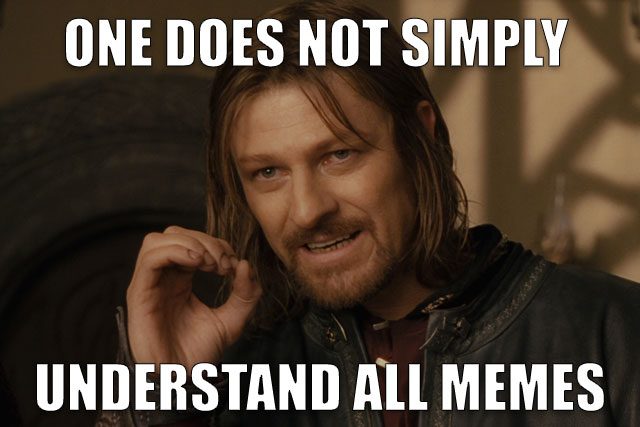
Some memes are easier to understand than others. The easiest ones are known as “image macro” memes, which usually involve some sort of expressive image and block text. They’re emphatic and designed to help convey an emotional state in a manner that’s simple to understand. They acknowledge a shared experience between the creator and the viewer.
Others can be a little harder to nail down. Something like Slender Man can seem scary or dangerous. Others might be bizarrely obscure, referencing a particular episode of a TV show or movie that aired decades ago. Often, the origins of such memes can be buried in context so deep that understanding their origins requires dedicated research.
How important that is depends on why you want to understand the meme. If you simply want to use it yourself, picking up the rough idea of what it means from the latest usage of it is often enough to create your own and be in on the joke.
If you want to discover more about what it means so that you can determine if it’s something you want your children, students, or dependents associating with, the best people to ask for more information is them. Helpful resources like Know Your Meme and Wikipedia (for the most well-known ones) can further clarify where a meme originates and how it has developed and evolved over time. However, it’s important to note that memes are constantly changing. How the people you’re looking to protect actually use those memes could be entirely personal for them. They might even have a collection of their own created memes that aren’t as popular.
The majority of memes are created to be funny, and their impact relies on how they are perceived and used by the people that view them. If someone in your life is frequently sending around memes or looking at memes that you just don’t get, we encourage you to ask them to describe their meaning to you. If needed, you can then specify the broader significance of what that might mean outside of the communication tools and platforms it has grown on.
Another option is to start making memes of your own if you have an interest in doing that. Popular websites like ImgFlip and Kapwing’s Meme Maker are excellent places to kick off your new meme-making hobby. If you need some additional assistance, we’ve created a great guide that will walk you through the process in a list of easy-to-follow steps.


