  1. Home
  2. Space
  3. News

This iodine satellite propulsion system could help reduce space debris

Add as a preferred source on Google
Promotional image for Tech For Change. Person standing on solar panel looking at sunset.
This story is part of Tech for Change: an ongoing series in which we shine a spotlight on positive uses of technology, and showcase how they're helping to make the world a better place.

A depiction of the iodine thruster developed by ThrustMe being used to change the orbit of a small satellite.
A depiction of the iodine thruster developed by ThrustMe being used to change the orbit of a small satellite. ThrustMe

One of the contributing factors to the ever-increasing problem of space debris is the rising number of small satellites being launched. When these satellites fail or are no longer needed, they are often left to float in their orbits, clogging up the space around our planet with potentially dangerous junk.

Recommended Videos

Some proposed solutions to this problem include schemes to capture and dispose of debris. But another approach is to create less debris in the future, by equipping satellites with technology so they can be destroyed when no longer needed. The European Space Agency (ESA) recently reported that an iodine thruster system has been used for the first time to do just that: Adjusting the orbit of a small satellite.

The idea is that when a satellite reaches the end of its life, it can self-destruct by using a thruster to change its orbit so it falls into the atmosphere and burns up. With the satellite burnt up, it wouldn’t leave debris in its old orbit.

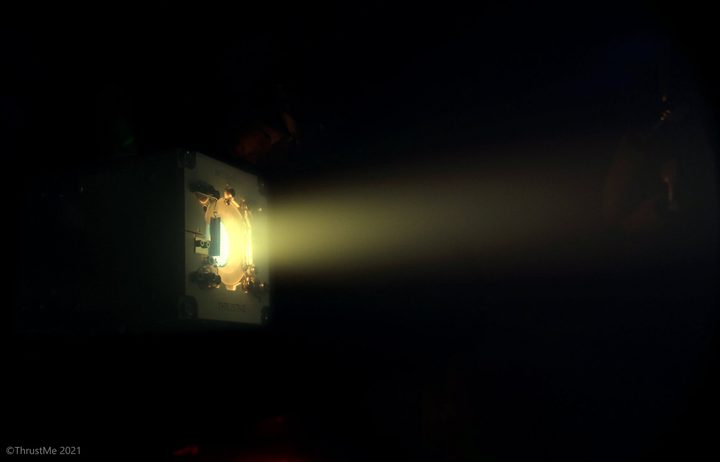
The thruster technology is developed by a French company called ThrustMe, and is unusual in its use of iodine as a propellant. Iodine is cheaper than other propellants and is also non-toxic and stable, which makes it easier and simpler to work with. “When heated, it turns to gas without going through a liquid phase, which makes it ideal for a simple propulsion system,” ESA explains. “It is also denser than traditional propellants, so it occupies smaller volumes onboard the satellite.”

The first satellite to be moved using this iodine propulsion method was a telecommunications nanosat called SpaceTy Beihangkongshi-1. It was launched in November 2020 on a CZ-6 Long March 6 rocket from Taiyuan, China. To see whether the propellant system would work, it was test-fired earlier this month. With everything looking good, it was then used to actually move the orbit of the satellite.

In the future, similar systems could be attached to small satellites relatively cheaply, allowing them to self-destruct when no longer required and thus reducing space debris.

Georgina Torbet
Georgina has been the space writer at Digital Trends space writer for six years, covering human space exploration, planetary…
Astronauts reportedly took shelter after work on Russia’s leaky ISS module triggered concerns
The ISS really picked a stressful time to start leaking again
The International Space Station.

Astronauts aboard the International Space Station reportedly took precautionary shelter measures after maintenance work on a long-troubled Russian module raised fresh safety concerns about air leaks aboard the orbiting laboratory.

According to reports, the incident involved Russia’s Zvezda service module, which has experienced recurring air leak problems for several years. During repair work and pressure tests connected to the leak investigation, astronauts were instructed to isolate themselves in safer sections of the ISS as engineers monitored the station’s integrity and pressure stability.

Read more
Blue Origin’s massive New Glenn rocket explodes in a fiery blaze during tests
The incident leaves NASA's Moon Base ambitions and Amazon's Kuiper constellation without their primary launch vehicle at the worst possible moment.
Explosion, Fire, Nuclear Explosion

Blue Origin's New Glenn rocket exploded during a static fire test at Launch Complex 36 in Cape Canaveral, Florida. The incident took place on the night of May 28, 2026. 

The explosion was captured on a live stream by NASASpaceflight.com and footage of the explosion spread rapidly across X. The Space Launch Complex 45 has confirmed in an official statement (shared by Spaceflight Now on X) that all personnel have been accounted for and there have been no injuries or fatalities.

Read more
Orbot Robotics’ space robot has four arms, but its Goro physique has a purpose
This four-armed robot could make routine space-station work easier for astronauts
Robot with four arms

Helios is a new four-armed robot from Zurich-based Orbit Robotics, and at first glance, it reminded me of Goro from Mortal Kombat. But unlike the prince from Outworld, Helios is not built for combat. It is designed to help astronauts on space stations with the repetitive, time-consuming work that keeps life in space running.

Orbit Robotics says that in microgravity, legs are not much help. Instead of walking or standing, Helios needs to move through tight station interiors, hold itself steady, and handle cargo, tools, or equipment. Its four-arm design turns extra limbs into both mobility aids and working hands.

Read more