  1. Home
  2. Social Media
  3. Web
  4. Legacy Archives

Google+ gets a traffic surge of 1269 percent

Add as a preferred source on Google
google-plus-logo-640
Image used with permission by copyright holder

If you’ve been thinking of trying out a new social network, you’re not alone. Google Plus has seen a sharp rise in traffic over the past week according to new data from Experian Hitwise.

Last week, right before the F8 conference, Google Plus was made open to the public and introduced a number of new features including stuff for Hangouts, Google Docs and some added search functions. Since then, Google’s star social networking service has seen a traffic surge of 1269 percent, with U.S. visits at 15 million—significantly trumping the paltry 1.1 million U.S. visits from the preceding week.

Recommended Videos

That data doesn’t even take into account mobile users, or those that wander over to Plus using the black bar. It’s not exactly clear what caused the spike, though its possible to draw a correlation from the drop of the invite feature or criticism over Facebook changes. Whatever the reason, Plus doesn’t seem to be going the way of Orkut anytime soon.
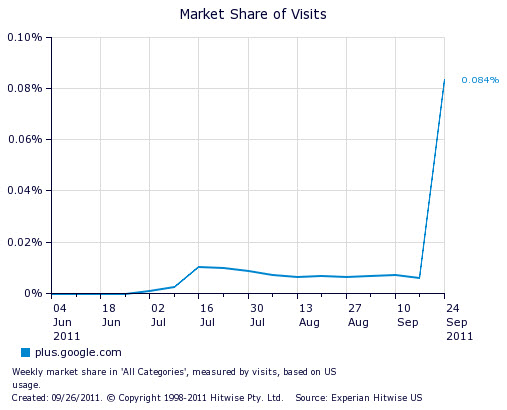
graphs don't lie
Image used with permission by copyright holder

Currently, Hitwise is ranking Plus at number 8 in the Social Networking and Forums category, just behind MySpace and way up from its former spot at 54. ReadWriteWeb also points out that Paul Allen’s estimates have the Google Plus user count now at 43 million.

Further chipping at the rivalry with Facebook, CityVille, Zynga’s most popular game on Facebook has recently come to Google’s social networking site. Cityville currently has 72 million users.

Google also rolled out an interesting change for one of Plus’ main features, Circles. Similar to Twitter lists, now Google Plus users will be able to share separate circles of friends with others. A share link will pop on the Google+ Circles page, which will allow you to share with your friends. The new feature doesn’t allow others to see the title of the circle or if the circle creator updates members.

Jeff Hughes
Former Digital Trends Contributor
I'm a SF Bay Area-based writer/ninja that loves anything geek, tech, comic, social media or gaming-related.
YouTube is coming for celebrity deepfakes with new AI likeness detection tech
Celebrity deepfakes are in YouTube’s crosshairs with new AI detection tools
Phone in hand showing YouTube logo

YouTube is cracking down on celebrity deepfakes, and this time around, it is not just talking about the problem in vague platform-safety terms. In a new blog post, YouTube announced that it is expanding its likeness detection technology to the entertainment industry.

So now, the tools will be accessible to talent agencies and management companies for the celebrities they represent. This tool works in a way that is similar to Content ID, but rather than matching copyrighted media, it looks for AI-generated content using a person's likeness and gives eligible participants the ability to find that content and request removal.

Read more
Meta wants you to pay for WhatsApp now, and it’s already testing the waters
WhatsApp

WhatsApp has been free for over a decade, but Meta is starting to change that. The company is testing a paid subscription tier called WhatsApp Plus, and if you haven't heard about it yet, you probably will soon. The rollout was first spotted by WABetaInfo, and Meta's own Help Center page has since confirmed some of the details. 

So, what do you actually get?

Read more
Tinder wants to check your humanity by gazing into an orb. Yes, you read that right
Staring into an orb to prove you are human is no longer science fiction.
tinder-world-id-human-verification

Online dating is already a trust minefield, and now Tinder wants to add an eyeball scan to the mix. The popular dating app has announced a global partnership with World, the biometric identity company founded by OpenAI's Sam Altman. To prove you are a real human on Tinder, you will soon have the option to get your eyes scanned by a physical orb device.

What is World ID and how does Tinder's human verification work?

Read more