  1. Home
  2. Emerging Tech
  3. Health & Fitness
  4. News

With a touch of sunlight, this tiny device kills 99.999 percent of bacteria

Add as a preferred source on Google

Water is our most precious resource. We may take this for granted, in developed regions but some 2.8 billion people around the world are affected by the scarcity of clean drinking water.

A tiny new device may help change that. Developed by researchers at the Department of Energy’s SLAC National Accelerator at Stanford University, the device is about half the size of a postage stamp and uses solar energy to disinfect water with bacterial contamination. The researchers reported their experiments in a paper this week in the journal Nature Nanotechnology.

Recommended Videos

People often use one of two methods to disinfect germ-ridden water in regions that lack a pure source: boiling or placing plastic water bottles in direct sunlight so the ultraviolet rays can kill microbes. The problem is, boiling uses fuel and the UV method may take up to 48 hours without even fully disinfecting the water.

In an effort to find a more effective and energy-efficient technique, Stanford researcher Yi Cui and his team developed the nanostructure device, made up of fingerprint-like arrangements of copper and a photocatalytic chemical called molybdenum disulfide. When struck by light, the walled structures release hydrogen peroxide and other bactericidal chemicals, which destroy the harmful bacteria and quickly dissolve.
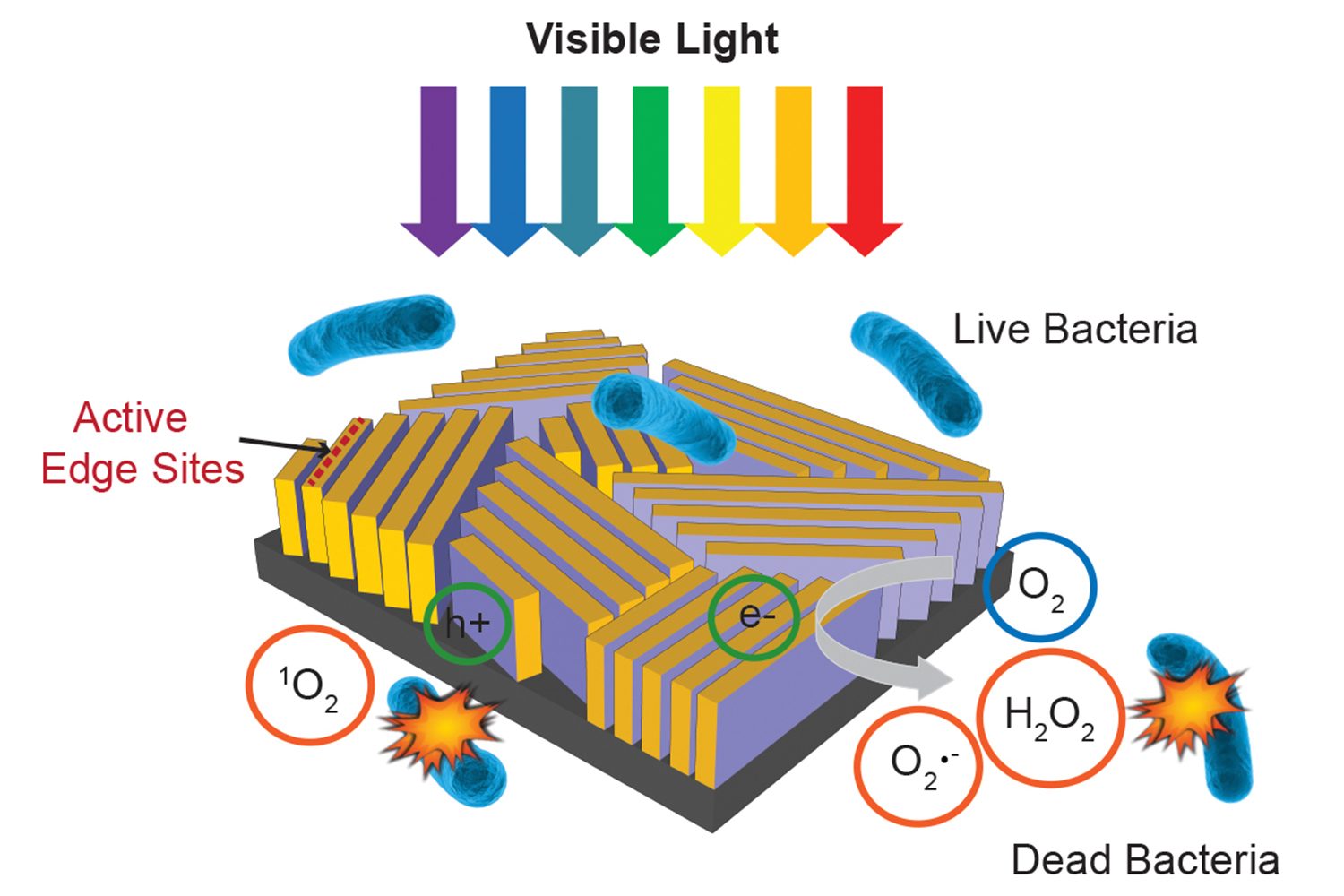
water_disinfection_v01
C. Liu et al., Nature Nanotechnology

“Our device looks like a little rectangle of black glass,” lead author and PhD researcher Chong Liu said in a press release. “We just dropped it into the water and put everything under the sun, and the sun did all the work.”

Although their experiments killed 99.999 percent of bacteria in 20 minutes, Cui admits that the device need further research and development. For one thing, the trials only tested the device on small amounts of water and three strains of bacteria. In other words, the experiments lacked the complex mixture of contaminants often found in the real world.

However, Cui remains optimistic: “It’s very exciting to see that by just designing a material you can achieve a good performance. It really works.”

Dyllan Furness
Former Contributor
Dyllan Furness is a freelance writer from Florida. He covers strange science and emerging tech for Digital Trends, focusing…
DJI’s first 360° drone offers 8K video recording and a freakishly long transmission range
From omnidirectional obstacle sensing to 42 GB of onboard storage, the Avata 360 is DJI doing what DJI does best: raising the bar for everyone else.
DJI Avata 360° drone.

DJI has officially entered the 360° drone arena with the launch of the Avata 360. It’s the company’s first-ever fully immersive FPV drone, and a direct shot at the Antigravity A1, a rival built by an Insta360-incubated brand. Looks like the drone wars just got more interesting. 

What makes the Avata 360 worth looking at?

Read more
I transferred all my chats from other AI apps to Gemini — and it works flawlessly
Google Gemini Graphics Featured

You know that moment when AI assistants like ChatGPT, Gemini, or Claude suddenly lose the plot mid-conversation and start hallucinating like they’re absolutely sure they’re right? Yeah…it’s equal parts funny and painfully annoying. My usual reaction is switching between apps, hoping one of them gets it right. But the real problem is that I have to start over every single time. It feels like I’m stuck in a loop explaining my life story to different AIs, one after the other.

Now with Gemini, I can now jump in from other AI apps without that whole reset conversation. Finally, the Google gods have blessed us. I tried it out expecting the usual hiccups, but it was surprisingly smooth and quick.

Read more
Google expands Search Live globally with voice and camera AI
The feature is now available in 200+ countries with multilingual support
Google Search Live

Google is taking another big step toward turning Search into a full-blown AI assistant. The company has officially expanded Search Live globally, making the feature available in over 200 countries and territories, along with support for dozens of languages.

https://twitter.com/google/status/2037201891130523917

Read more