Watts and lumens — they both describe lightbulbs, but do you know what they actually mean? Did you know that wattage is no longer a reliable way to tell how bright a bulb is? Do you know what makes lumens a worthwhile successor? Let’s talk about the two most famous light specs, and how they affect your search for the best bulbs on the market.
Watts
Watts are a measurement of energy, specifically the energy needed to power electronic devices like lightbulbs. Watts are all about real power, which means they measure the rate at which energy is consumed. One watt equals one joule per second (you can go down that physics rabbit hole if you want to). So, a 100-watt bulb that you turn on for 10 hours uses around 100 watts constantly, or 1,000 “watt hours.” This is also known as a kilowatt, which is a common measurement for the expenditure of energy in your house.
Interestingly, watts do not measure brightness, nor does the number of watts say anything about brightness at all. However, for a long time dimmer bulbs required a lower number of watts than brighter bulbs, so we got used to using watts as a sort of shortcut to describe brightness. This is quickly changing in today’s market, however.
Lumens
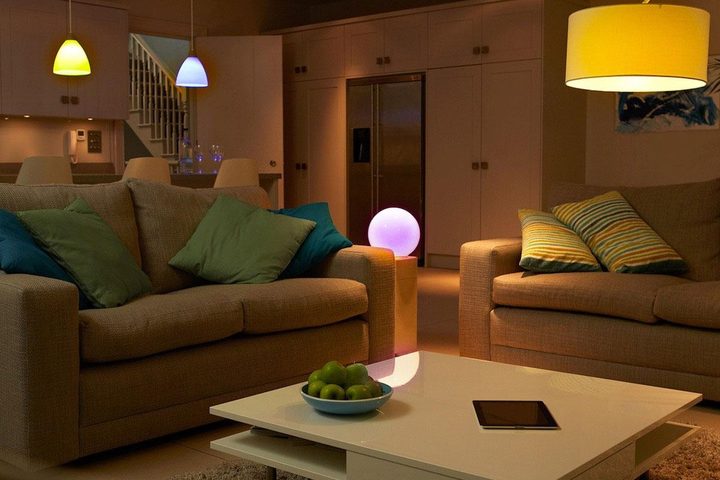
Lumens are a measurement of brightness. They tell you the visible light intensity that is produced by a bulb or other lighting device. Lumens also take into account how the light is projected. A bulb with a hood that only shines light in a single direction will technically produce far fewer lumens than that same bulb shining light in every direction at once. In science-speak, the luminous flux produced by one candela across a solid angle of one steradian equals one lumen. There are many other ways to measure brightness — lux, nits, etc. — but lumens are particularly useful for measuring light in common products like bulbs.
Technology aside, lumens have a close-to-linear relationship with watts. In other words, a certain amount of watts will produce a certain amount of lumens in brightness for a given bulb. However, bulbs and diodes don’t stay the same forever: Some — particularly the brightest bulbs — will decrease in lumens over time as they wear out, no matter how many watts of energy they’re using. This wear and tear affects projector bulbs in particular, and we’ll talk a little more about that below.
How does this help you? Let’s go by device
Lightbulbs
Lumens are quickly becoming a more useful measurement for products like lightbulbs. Why is this? Because the market is now more varied, and products have grown far more efficient. In the old days, you had certain categories of incandescent lightbulbs that were measured in watts, and those watts could also be used to tell the brightness. A 60-watt bulb would always produce a certain amount of light, a 100-watt bulb would be reliably brighter, and so on and so forth. Today, that’s no longer the case. LEDs, fluorescents, and more-efficient incandescents all have varying levels of wattage, and that wattage is no longer tied to brightness. Which is brighter today, a 40-watt fluorescent or a 60-watt incandescent? There’s no reliable way to tell.
As a result, manufacturers are now focusing more on lumens as a way to tell customers how bright a bulb is. The FTC, in particular, has worked to create new labels with a “Brightness” heading that provides the lumens for customers. Look for these labels, and try to judge bulbs by lumens instead of watts. If you want to match up the brightness of new bulbs with old bulbs, Energy Star has a quick reference chart that roughly matches up old watt numbers with lumens.
Projectors
Projector lamps have long been referred to in terms of lumens, because brightness is very important when it comes to the quality of a projector image. Too few lumens at too far a distance, and the picture won’t look real. A tiny pocket projector may only produce a few hundred lumens, while a large professional version may produce more than 4,000. If you are look for a quality projector, the sweet spot is currently somewhere between 2,000 and 3,000 lumens, though some models go higher.

If you are shopping for a projector bulb, you’ll also want to pay attention to the life of the lamp, which is measured in hours. This is not the number of hours that the bulb is expected to last. You see, those ultra-powerful bulbs cannot keep producing the same number of lumens forever, no matter how efficient they are. Eventually their physical components begin to degrade and the brightness starts to fade, thus the lumens drop over time. The hours provided in lamp specs are more of a half-life, basically the manufacturer saying, “This is how long the lamp will last before you can really tell that it’s not as bright anymore.” Most projector lamp bulbs tend to last a couple years before they reach this point, but it depends how often you use them.
Screens
Screen brightness is sort of the odd man out here. First, displays output light in a variety of ways, which depends on the type of screen you’re utilizing (LCD, LED, OLED, etc.). Second, they produce light across a surface area, not from a single source. Third, you can usually adjust the brightness to where you want it, so it’s not as important of a spec. Screen brightness is typically measured in nits or cs/m2 (candela per square meter).
When shopping for a screen, you can certainly look for luminance measurements, but ultimately your eye is the best test. If you like how the screen looks, you can calibrate it to a specific brightness when you take it home.
Other factors, including light color and “temperature”
There’s another important light spec to consider when buying bulbs or similar products — the light temperature, which is measured in Kelvins. While this is traditionally a measurement of heat, that temperature is also somewhat related to the appearance or shade of light that our eyes see, so it’s used as rough guide to color.

The lowest bulb temperatures make the light look reddish (think candles), while the higher temperatures tend to make light look white or bluish (think sunlight at noon). In other words, bulbs with higher Kelvin ratings tend to produce clearer, more natural-looking light… up to a point. Too high on the scale, and the light starts to look a bit garish or unnatural, which is a problem that some fluorescent lights have. Look at the Kelvin ratings to better understand how the light will appear to the human eye.