  1. Home
  2. Emerging Tech
  3. Health & Fitness
  4. News

Graphene’s latest miracle? The ability to detect cancer cells

Add as a preferred source on Google

This is a great year for graphene researchers, who have identified astonishing new applications for the amazing wonder material seemingly every week.

The latest? The fact that it turns out to be pretty darn good at cancer detection, thereby hinting at the possibility of a future noninvasive tool for early diagnosis.

Recommended Videos

The work was carried out by scientists at the University of Illinois at Chicago, who placed brain cells (astrocytes) taken from mice onto a graphene sheet, comprising a one-atom-thick layer of carbon atoms, and found that the sheet was able to distinguish between a single cancerous cell (glioblastoma or GMB cell) and a normal cell.

“What we’ve shown is that a graphene-based system can detect the activity of a cell, and by doing that we can differentiate between a cancer cell and a normal cell,” Vikas Berry, associate professor and head of chemical engineering at UIC, told Digital Trends. “That’s because a cancer cell is hyperactive and has a different biochemistry on its surface and degree of activity that it exhibits. Based on the activity of the cell, we are able to make our differentiation.”
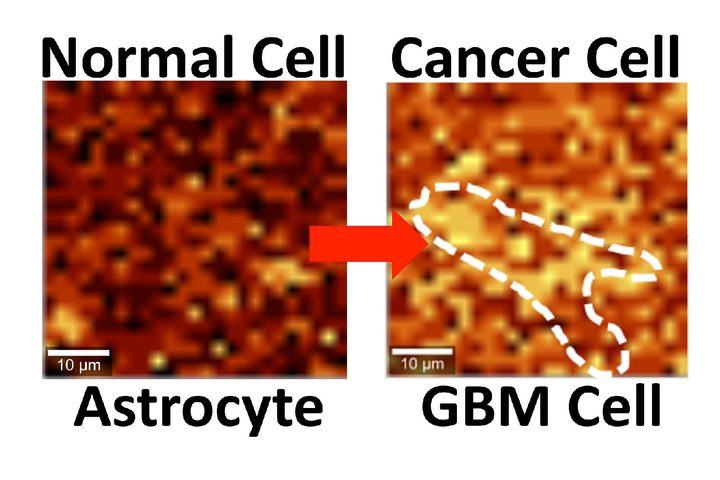
Image used with permission by copyright holder

The amazing cancer-detecting abilities of graphene relate to its impressive electrical conductivity. When exposed to a hyperactive cancerous cell, the electric field around the cell pushed away electrons in the graphene’s shared electron cloud. This changes the vibration energy of the carbon atoms: something which can be studied using ultra-high resolution vibration energy mapping. As a result, the researchers were able to tell what kind of cell the graphene was interfacing with.

“It’s an incredibly sensitive mechanism for detection,” Berry continued.

It’s exciting stuff, and could have significant real-world impacts. At present, however, it’s still a long way from clinical use. However, the researchers are hoping to expand beyond mouse trials to human patient biopsies in the future. They also hope that the same approach could be used to distinguish between different types of bacteria, and also identify sickle cells.

Luke Dormehl
I'm a UK-based tech writer covering Cool Tech at Digital Trends. I've also written for Fast Company, Wired, the Guardian…
DJI ‘s first 360° drone offers 8K video recording and a freakishly long transmission range
From omnidirectional obstacle sensing to 42 GB of onboard storage, the Avata 360 is DJI doing what DJI does best: raising the bar for everyone else.
DJI Avata 360° drone.

DJI has officially entered the 360° drone arena with the launch of the Avata 360. It’s the company’s first-ever fully immersive FPV drone, and a direct shot at the Antigravity A1, a rival built by an Insta360-incubated brand. Looks like the drone wars just got more interesting. 

What makes the Avata 360 worth looking at?

Read more
I transferred all my chats from other AI apps to Gemini — and it works flawlessly
Google Gemini Graphics Featured

You know that moment when AI assistants like ChatGPT, Gemini, or Claude suddenly lose the plot mid-conversation and start hallucinating like they’re absolutely sure they’re right? Yeah…it’s equal parts funny and painfully annoying. My usual reaction is switching between apps, hoping one of them gets it right. But the real problem is that I have to start over every single time. It feels like I’m stuck in a loop explaining my life story to different AIs, one after the other.

Now with Gemini, I can now jump in from other AI apps without that whole reset conversation. Finally, the Google gods have blessed us. I tried it out expecting the usual hiccups, but it was surprisingly smooth and quick.

Read more
Google expands Search Live globally with voice and camera AI
The feature is now available in 200+ countries with multilingual support
Google Search Live

Google is taking another big step toward turning Search into a full-blown AI assistant. The company has officially expanded Search Live globally, making the feature available in over 200 countries and territories, along with support for dozens of languages.

https://twitter.com/google/status/2037201891130523917

Read more