
Update: Google Home can now speak its first language outside of English, and it’s Canadian French.
Google’s using artificial intelligence to accomplish incredible feats like predicting the properties of new molecules, discovering new drugs, and improving DNA sequencing. But it’s also using AI smarts to improve the Google Assistant, its answer to Apple’s Siri assistant and Amazon’s Alexa. At Google’s I/O developer conference in San Francisco, Google announced improvements across the Assistant platform on smartphones, Google’s eponymous Google Home smart speaker, and more.
Starting on May 18 with smartphones, voice won’t be the only way to interact with the Assistant. Now, you can text message the Assistant about upcoming calendar appointments, nearby restaurants, and more, making for a more comfortable experience in public places like elevators and crowded train stations, Google said. That feature is now live, so if you have Google Assistant you should be able to activate it then tap the small keyboard icon in the bottom left-hand corner.
Dovetailing with the new texting feature, Google has improved the Assistant with native Google Lens integration. The Google Lens, a computational vision engine the company unveiled on Wednesday, can analyze and describe photos better than human beings, in some cases. Here, Google’s using Lens to parse photos — once you invoke it in the Google Assistant, you can point it at a sign in a foreign language to get an instant translation, or at a marquee above an auditorium to get links to the venue’s ticket platform. It’s even smart enough to surface pictures of items on a restaurant menu.
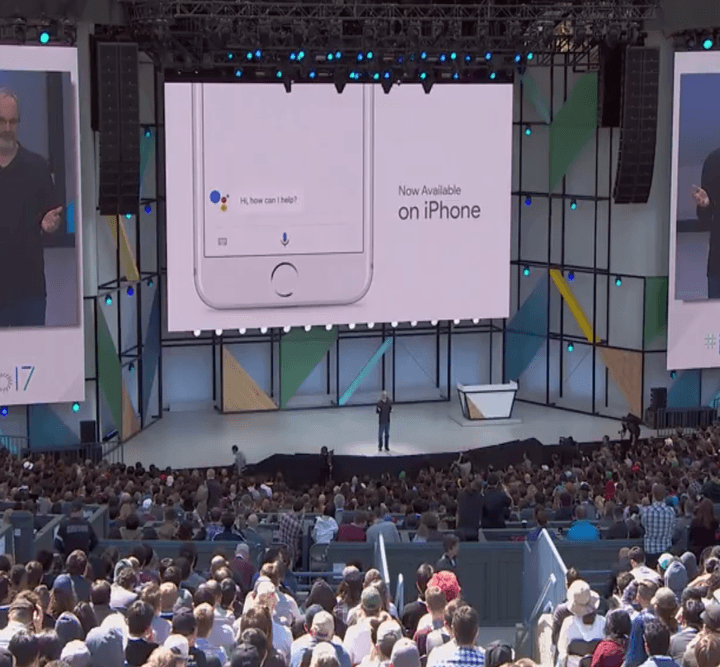
The Assistant’s already available on more than 100 million devices, Google said, but it’ll soon come to a new platform: Apple’s iPhone. Starting this week, you can interact with the Assistant via the new app for iOS. Like the Assistant on Android phones and Google Home, it can save reminders, track your flight statuses, and more.
That debut is in addition to new hardware. Google said it’s working with Panasonic, LG, Onkyo, Sony, and other partners to build the Assistant into future speakers, TVs, and the like.
Those devices will be able to understand more languages. At I/O, Google announced that the Assistant will gain support for Italian, Spanish, Korean, French, German, Japanese, German, and other dialects at some point in 2017, and now we know that point has come. Users are now reporting that you can easily switch into Canadian French, a language previously unannounced, by navigating to Assistant Language under device settings in the smart home hub’s control app. Folks over at The Android Soul also claimed to be able to switch languages simply by saying, “Ok Google, speak to me in Canadian French.”
This is excellent timing for Google Home, as the device will launch in Canada on June 26. Canadian French is now the first language that Assistant supports outside of English.
Some of those apps will support the Assistant’s new payments platform. Now, apps like Panera can handle orders via voice — you can ask the Assistant to add items to your cart, switch the payment method, and place the order. You don’t need to enter your credit card information or name — Google pulls those details from a cloud-stored account.
Finally, Google said it’s working with hardware partners like August, LG, and GE — 70 in all — to bring Assistant support to more smart home devices.
The Assistant announcements follow Google Home improvements. In the coming weeks, Google’s Home speaker will gain opt-in reminders, improved support for Cast-enabled devices like Google’s Chromecast, and the ability to call any number in the United States or Canada for free.


