  1. Home
  2. Emerging Tech
  3. News

New ‘synthetic tongue’ can best whisky sommeliers at guessing your Scotch

Add as a preferred source on Google

Once robots steal all of our jobs, we’ll be able to sit around and become experts on things like fine whiskies, which no artificial being is ever going to be able to appreciate as we can. Right?

Well, don’t tell the folks at Germany’s Heidelberg University and the Netherlands’ University of Groningen. That’s because they’ve developed a “synthetic tongue” that uses 22 different fluorescent dyes to accurately distinguish between different whiskies. When the tongue comes into contact with a whisky, it’s able to determine its “flavor profile” based on the subtle changes in brightness exhibited by the dyes. In a test, the tongue was able to recognize the brand, origin, blending state, age, and taste of 33 whiskies. No word on whether it exhibited slurred speech.

Recommended Videos

“Whiskies are complex mixtures, and their chemical composition is quite similar,” Professor Dr. Andreas Herrmann of the University of Groningen told Digital Trends. “For consumers who are non-professional experts, for similar whiskeys it is very hard to taste the difference. We are super-excited about our ‘tongue’ because it has an extremely sensitive tasting ability, probably even better than most of the sommeliers [out there].”
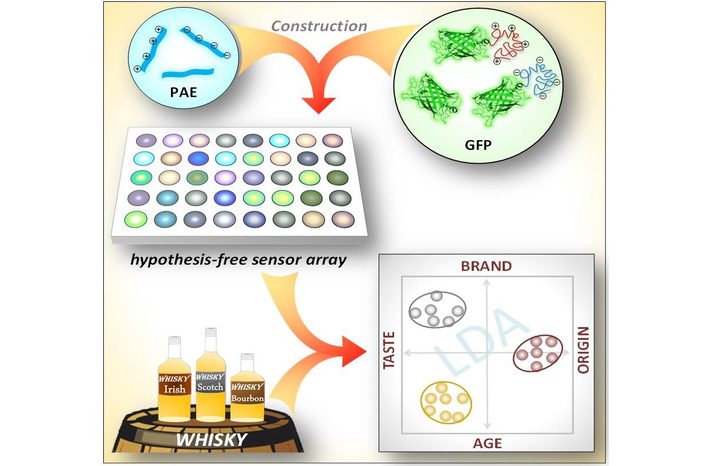
Image used with permission by copyright holder

But why develop a whisky-tasting synthetic tongue, since it’s never going to appreciate whisky in the way that we can? Well, it turns out that it has less to do with appreciating whisky than with uncovering fake whiskies among the good stuff. That’s not going to mean much if you’re talking about a cheap $17 bottle of Jim Beam, but it means a whole lot more if you’re buying a crate of expensive bottles to sit in your air-conditioned underground alcohol bunker — or wherever rich people store bottles that cost more than our entire year’s rent.

“Fake whiskies are always annoying customers,” Herrmann continued. “But there is no convenient and accurate method in the market to detect counterfeiting rapidly and without expensive equipment. We are thus thinking about tailoring our artificial tongue to address this problem.”

Next up, the researchers plan to develop new “tongues” for tasting red wines and a range of drugs. “We envision strong potential for commercialization because the dyes and supercharged fluorescent proteins are easy to make, and the protocols are inexpensive,” Herrmann said.

So whisky and drug taster is another human job gone over to the robot side. Can’t engineers leave us with anything good?

Luke Dormehl
I'm a UK-based tech writer covering Cool Tech at Digital Trends. I've also written for Fast Company, Wired, the Guardian…
Coursera wants users to learn through shorter, faster content
Coursera wants online learning to feel more like TikTok
Coursera

Online learning platform Coursera is taking a page straight out of TikTok’s playbook. The company has launched a new AI-powered feed designed to serve short-form educational content in a scrollable, personalized format, signaling a major shift in how digital learning platforms may try to keep users engaged.

The feature introduces bite-sized video lessons, clips, and explainers curated through artificial intelligence based on a user’s interests, learning habits, career goals, and previous course activity. Instead of committing to hour-long lectures or full certification programs upfront, users can now discover short educational snippets designed to make learning feel more casual, accessible, and addictive.

Read more
AI fitness coach senses the muscle mechanics as you exercise and prevents rookie injuries
Most fitness apps offer encouragement dressed up as coaching, but BioCoach offers anatomy-specific corrections, and I could see it becoming a smartphone app real soon.
Woman exercises with her Apple Watch and Dexcom G7.

During the pandemic, the US Consumer Product Safety Commission recorded a 48% spike in at-home exercise injuries. You might think that the culprit was bad equipment, but it was bad form. People had no coach around to correct it.  

Researchers at Drexel University and Michigan State University have built a prototype that addresses exactly that problem, in real time, using your phone camera, and there’s real potential for it to become a legitimate fitness app in future (via Tech Xplore).

Read more
Google’s new AI app wants to replace endless scrolling with stories about your own life
Dreambeans is Google's most direct argument yet that the problem with social media isn't the content, it’s the infinite feed.
Adult, Female, Person

Most apps are designed to keep you on them as long as possible, especially content consumption apps where you scroll a never-ending feed of content. 

Dreambeans, a new experimental app from Google Labs, does the opposite. It gives you a small collection of AI-illustrated stories each morning and sends you off to live your actual life.

Read more