
The term “exoskeleton” conjures up sci-fi scenes – think Sigourney Weaver in Aliens, or Tom Cruise and Emily Blunt battling aliens on repeat in Edge of Tomorrow. Soldiers will surely man these mechanical machines someday, but many of the first exosuits will be developed for civilian use, from first responders pulling through rubble to laborers who could use a little extra support for their heavy lifting.
By 2020, robotics company Sarcos hopes to see workers climb into its line of fully-powered exoskeletons, designed to give people superhuman strength and endurance, while allowing them to repetitively lift large objects and minimize risk of injury. The company demoed some of its machines at its headquarters in Salt Lake City last week.
“We’re focused developing robots to augment human safety and productivity,” Ben Wolff, CEO of Sarcos, told Digital Trends. “This idea that we’ve got the ability to have a human either wearing or remotely operating a machine so that there’s always a human mind engaged in the decision-making process that is then instructing a robot that is stronger, with more stamina and greater precision, doing the real work.”


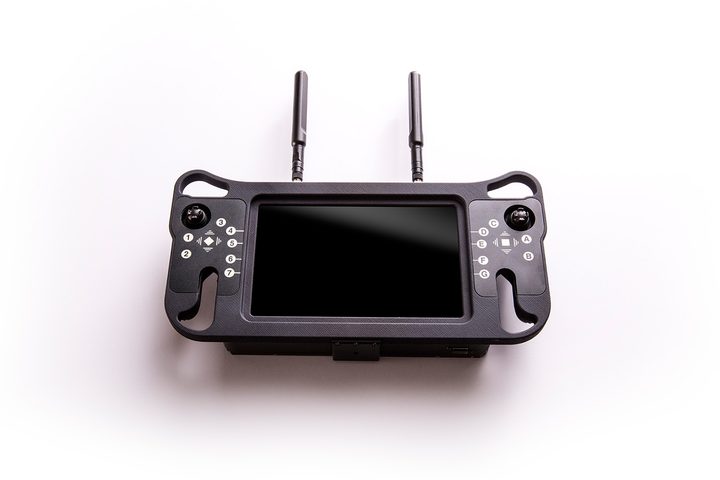
Sarcos plans to offer three exoskeletons over the next few years, each giving wearers a different degree of strength and endurance support. The Guardian XO will let wearers lift 80 pounds, the Guardian XO Max will max out at 200 pounds, and the Guardian GT — a monster of a machine with seven-foot arms — will handle upwards of 1,000 pounds. Both the GT and XO Max can be controlled by an operator who is either remote or riding in the machine.
To keep wearers safe, the Salt Lake City company has developed a patented system it calls “get out of the way control,” which will make sure the suit doesn’t accidentally squish a person inside.
“The suit and your body interact like two opposing magnets.”
“Imagine the suit and your body interacting with one another in the way that two opposing magnets would,” Wolff explained. “Through its sensor system, the suit is programmed to maintain a very small but very specific amount of distance from contact with your body. As a result, as you begin to move, swing your leg forward, it immediately moves to keep the front of the machine leg away from the front of your leg.”
Automation is bound to impact every worker in every industry. But rather than going fully automated, many tasks — particularly those that are performed in unstructured environments — may instead be performed by human workers augmented by machines. The goal here is to maintain a human’s cognitive flexibility with a machine’s strength and resilience.
“As soon as you move into a more unstructured environment where … you’re on a construction site and have to lift heavy items from one floor to the next in a one-off activity, not a lot of high repetition, that’s where it becomes far more challenging to find how automation to take control,” Wolff said. “The number of algorithms, sensors, awareness that a machine has to have to deal with the thousands of different variables…is simply far too advanced to rely on a computer and algorithm to help a robot decide what it needs to do.”
“For now,” he added, “let’s take the best of what a human being can offer, such as wisdom, judgement, intelligence, and instincts, and combine that with the best of what a robot can offer, in terms of strength, endurance, and precision.”
Like all companies that specialize in building the future, Sarcos is looking to stand out from competitors and thinks its full-body, fully-powered, and untethered machines will be a game changer. Hyundai, for example, is developing a full-body suit that needs to be tethered for full power, while companies like Panasonic and SuitX are developing smaller and untethered suits, which help give a wearer physical support and added strength, but don’t restrict the wearer’s freedom to roam.
Sarcos hasn’t offered an exact price for its exoskeletons yet, but Wolff says, “The cost to the user would be roughly equivalent to the cost of a fully-loaded salary employee in the $50,000 per year range … The one human operator plus our robot would cost roughly that of two human employees, but will allow for far fewer injuries and enhanced productivity.”
The company hopes to have the XO suits ready for commercial sale in 2019 and is currently taking preorders for custom-built GTs.


