


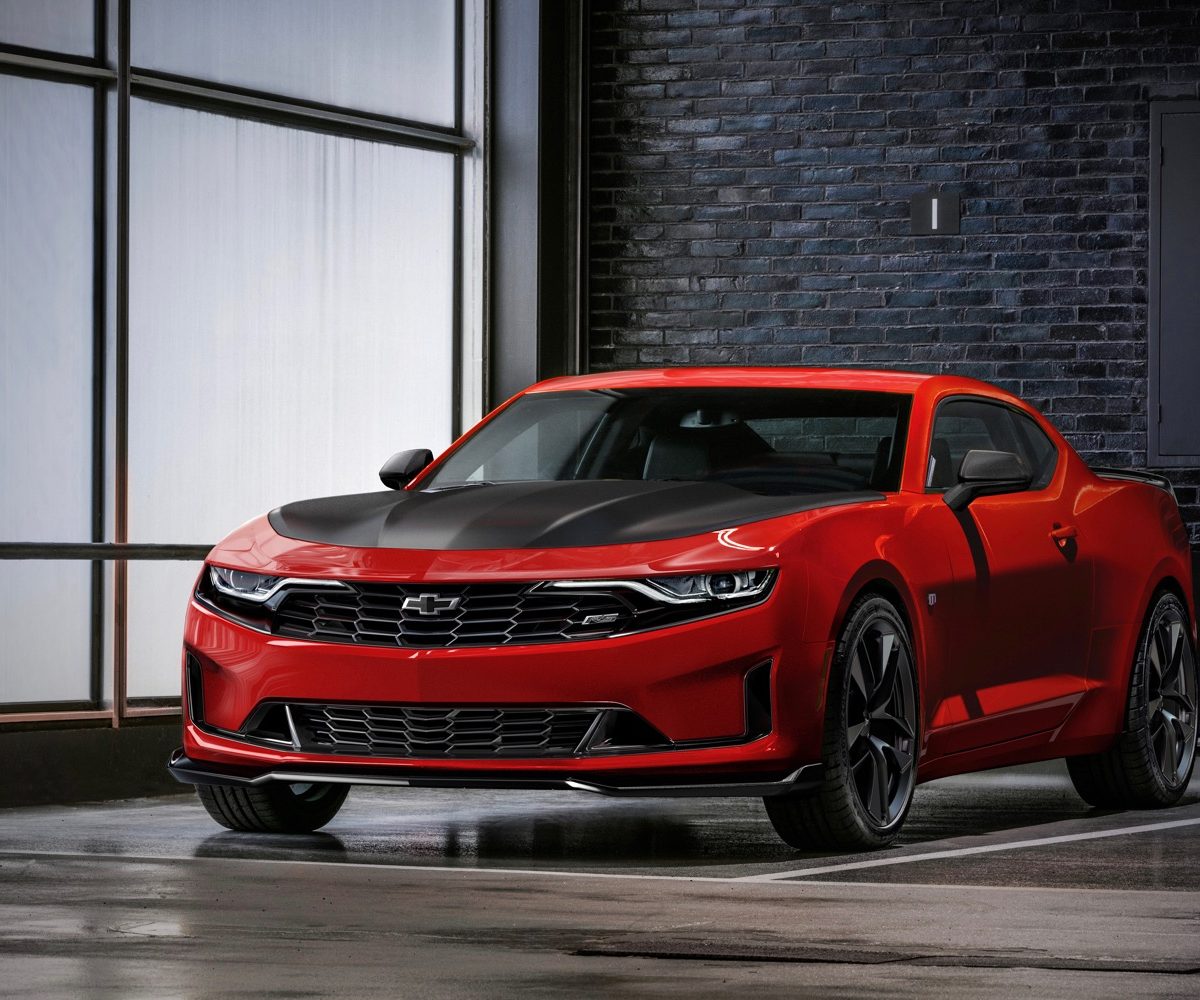
After revealing updated versions of the Malibu, Cruze, and Spark, Chevy took the wraps off a face-lifted Camaro. Like its more pedestrian siblings, the 2019 Chevrolet Camaro boasts a restyled front fascia, as well as a handful of tweaks and changes under the skin.
Chevy is committed to giving its cars a new look, but in the case of the Camaro, the automaker may have fixed something that wasn’t broken. With its oddly shaped headlights and excess of detailing, the 2019 Camaro’s face is decidedly alien looking, and not as clean as the outgoing models. But Chevy does claim the mess of grille openings and vents were designed to optimize airflow, both to maximize cooling and address drag and lift.
For 2019, the Camaro also gets a handful of new tech features pulled from the General Motors parts bin. GM’s Rear Camera Mirror — previously seen on the Chevy Bolt EV and Cadillac CT6 — streams video from a rearview camera through the mirror. A new infotainment system (with standard 7-inch or optional 8-inch touchscreens) has a more intuitive interface, Chevy says. The Camaro also gets a forward collision warning system for the first time.
Chevy will offer the same lineup of four, six, and eight-cylinder engines, but buyers can now get the 1LE performance package with the base 2.0-liter turbocharged four-banger, which makes 275 horsepower and 295 pound-feet of torque. Previously available only on V6 and V8 models, the 1LE package adds upgraded suspension and tires, a Brembo brake package, driver-selectable Track and Competition modes, a suede flat-bottom steering wheel and shift knob, and available Recaro bucket seats.
The 6.2-liter V8 Camaro SS gets an optional 10-speed automatic transmission co-developed with Ford, and also offered in the rival Mustang. The SS also gets new launch control and line lock, which locks the front brakes to make burnouts easier. It’s a feature Ford has offered on the Mustang for several years now.
Chevy didn’t mention any other mechanical changes, so the SS’s V8 should still produce 455 hp and 455 lb-ft of torque. The Camaro is also available with a 3.6-liter V6, which should produce the same 355 hp and 284 lb-ft it did in the 2018 models. Chevy didn’t mention any changes to the high-performance Camaro ZL1, either. The ZL1 currently sports a 6.2-liter supercharged V8 rated at 650 hp and 650 lb-ft.
The 2019 Chevrolet Camaro goes on sale later this year. Pricing will be announced closer to launch.


