
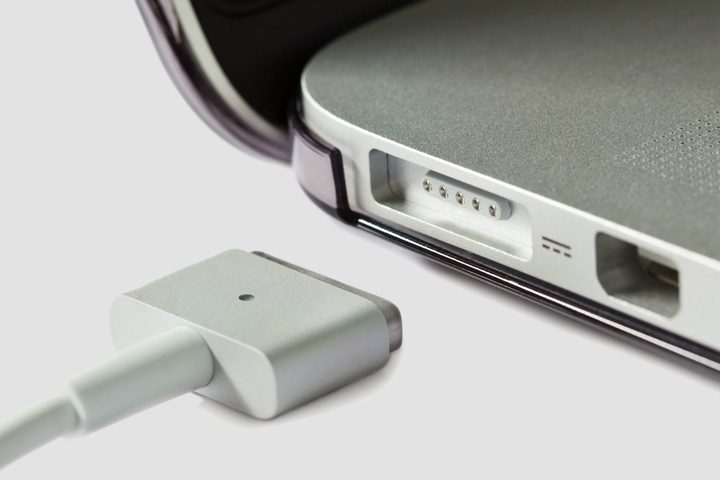
When Apple launched the MacBook, it decided to embrace the future by ditching all legacy ports — even the beloved MagSafe charging connector — in favor of adopting the lone USB-C port. As it turns out, Apple didn’t need to abandon the MagSafe port when it went all-in with USB-C.
A patent filing with the United States Patent Office from early 2016 reveals that Apple had been working on an adapter that would allow the company to still fully embrace the USB-C port while still delivering the benefits of a magnetic MagSafe connector. The MacBook — and by proxy, the MacBook Pro — would still ship with the standard USB-C port, but Apple’s patent filing with the shows that a magnetic adapter could be plugged into the USB-C port to deliver the functionality of a MagSafe connector.
“An illustrative embodiment of the present invention may provide a connector adapter having a connector insert and a magnetic connector receptacle,” Apple said of its innovation in its patent application. “The magnetic connector receptacle on the adapter may receive a corresponding magnetic connector insert that may be connected to a charger through a cable. The connector insert of the adapter may be inserted into a connector receptacle on an electronic device.”
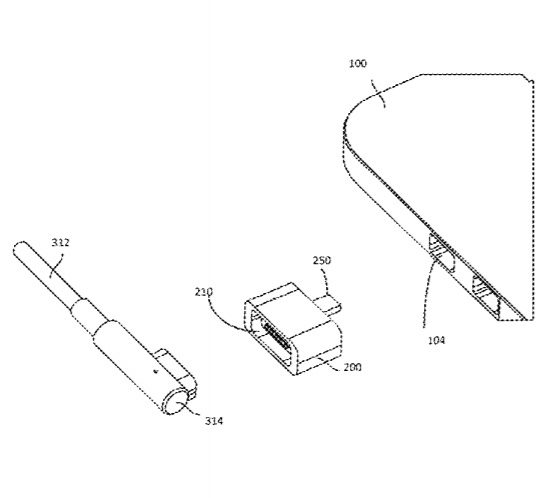
The end that is inserted into the device could be fitted for micro USB, USB-C, or other types of port. The adapter itself could be constructed in a number of ways with various different materials. The non-conductive housing could be made from “silicon or silicone, rubber, hard rubber, plastic, nylon, elastomers, liquid-crystal polymers (LCPs), ceramics, or other nonconductive material or combination of materials” using “injection or other molding, 3-D printing, machining, or other manufacturing process,” Apple said, while the conductive portion would be made from metals.
Such a solution wouldn’t be as elegant as having a dedicated MagSafe charging port on the device, like on the MacBook Air and older MacBook Pro, but it would give users access to all their ports for connecting other peripherals and accessories when the laptop isn’t charging. The adapter works in a similar manner to Grffin’s magnetic adapter and USB Type-C cable, a third-party accessory that retails for $40, Forbes reported.
Apple’s MagSafe connector was well loved because it made charging effortless. When you need to recharge Apple’s older MacBook Pro, the magnets guide the cable to the port and snaps into place. However, the main draw with MagSafe is that if someone trips over your power cord, the magnets would unlatch and break away from your laptop. The alternative is that your expensive laptop would fly to the ground.
Given that Apple’s invention is for an adapter for the USB-C port, rather than a native solution that’s built into the company’s notebook, perhaps someday Apple would release this accessory as yet another dongle. A previous Apple patent revealed the company was working on stackable MagSafe accessories.


