1. Home
  2. Emerging Tech
  3. News

Black holes devour nearby stars and spew brilliant X-rays during outburst phase

Add as a preferred source on Google

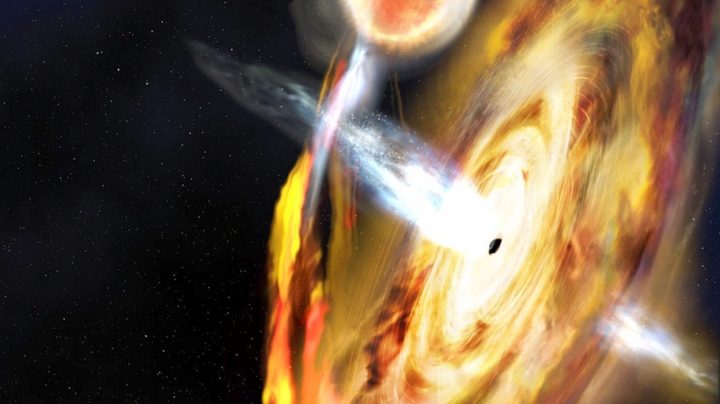
Using data collected from the International Space Station (ISS), physicists have been investigating an explosion of X-ray light that originated from a black hole in an outburst phase. The data suggests that during an outburst, black holes consume huge amounts of stellar material and shrink in size by a factor of ten.

The data was gathered from a black hole named MAXI J1820+070 which was detected on March 11, 2018 using the Monitor of All-sky X-ray Image (MAXI) instrument aboard the ISS. The MAXI is an X-ray detection system which monitors for X-ray outbursts like the ones given off by black holes in their outburst phase. “This boomingly bright black hole came on the scene, and it was almost completely unobscured, so we got a very pristine view of what was going on,” Jack Steiner, a research scientist in the Massachusetts Institute of Technology (MIT)’s Kavli Institute for Astrophysics and Space Research, said in a statement.

Recommended Videos

An outburst is a phase in the evolution of a black hole in which it emits extremely energetic bursts of X-rays while absorbing vast amounts of gas and dust from a nearby star. As the black hole consumes matter, its corona — the highly energized electrons which surround the black hole — shrinks massively from around 100 kilometers in diameter (62 miles) to just 10 kilometers (6.2 miles) in a period of a month.

Once the MAXI instrument observed the outburst, scientists turned to another instrument aboard the ISS, NASA’s Neutron star Interior Composition Explorer (NICER) to obtain more details about the amount and timing of incoming X-ray photons. When a black hole consumes large amounts of matter, this material settles in the accretion disk and generates heat as it spins closer to the black hole. When the material reaches temperatures of millions of degrees, the energy shines out as X-rays.
X-ray echoes, mapped by NASA’s Neutron star Interior Composition Explorer (NICER), revealed changes to the accretion disk and corona of black hole MAXI J1820+070. NASA’s Goddard Space Flight Center

“This is the first time that we’ve seen this kind of evidence that it’s the corona shrinking during this particular phase of outburst evolution,” Steiner said. “The corona is still pretty mysterious, and we still have a loose understanding of what it is. But we now have evidence that the thing that’s evolving in the system is the structure of the corona itself.”

Georgina Torbet
Georgina has been the space writer at Digital Trends space writer for six years, covering human space exploration, planetary…
DJI’s first 360° drone offers 8K video recording and a freakishly long transmission range
From omnidirectional obstacle sensing to 42 GB of onboard storage, the Avata 360 is DJI doing what DJI does best: raising the bar for everyone else.
DJI Avata 360° drone.

DJI has officially entered the 360° drone arena with the launch of the Avata 360. It’s the company’s first-ever fully immersive FPV drone, and a direct shot at the Antigravity A1, a rival built by an Insta360-incubated brand. Looks like the drone wars just got more interesting. 

What makes the Avata 360 worth looking at?

Read more
I transferred all my chats from other AI apps to Gemini — and it works flawlessly
Google Gemini Graphics Featured

You know that moment when AI assistants like ChatGPT, Gemini, or Claude suddenly lose the plot mid-conversation and start hallucinating like they’re absolutely sure they’re right? Yeah…it’s equal parts funny and painfully annoying. My usual reaction is switching between apps, hoping one of them gets it right. But the real problem is that I have to start over every single time. It feels like I’m stuck in a loop explaining my life story to different AIs, one after the other.

Now with Gemini, I can now jump in from other AI apps without that whole reset conversation. Finally, the Google gods have blessed us. I tried it out expecting the usual hiccups, but it was surprisingly smooth and quick.

Read more
Google expands Search Live globally with voice and camera AI
The feature is now available in 200+ countries with multilingual support
Google Search Live

Google is taking another big step toward turning Search into a full-blown AI assistant. The company has officially expanded Search Live globally, making the feature available in over 200 countries and territories, along with support for dozens of languages.

https://twitter.com/google/status/2037201891130523917

Read more