  1. Home
  2. Emerging Tech
  3. News

Flying observatory discovers role of stellar winds in star formation

Add as a preferred source on Google

New research using NASA’s Stratospheric Observatory for Infrared Astronomy (SOFIA) suggests that the formation of stars can be regulated by stellar winds, shedding new light on how stars are born.

Previously, it was believed that cosmic processes such as supernovae were responsible for regulating the way in which new stars formed. Now according to the new research, it seems that the stellar winds that are generated when a star is born may prevent new stars from forming nearby. Stellar winds are fast moving flows of material that are ejected outwards from a star, and this new data shows that they can blow away the materials that are required to create new stars, preventing stars from being born too close to other newborn stars in a process called feedback.

Recommended Videos

The findings come from observations of the Orion Nebula, one of the most photographed objects in the night sky and the closest stellar nursery to Earth. Using infrared light, scientists are able to peer through the clouds of dust and gas shrouding the nebula to observe the process of star birth happening within. They saw that a baby star called Theta1 Orionis C (θ1 Ori C) was generating strong stellar winds which were sweeping up large amounts of material from the cloud around the star, “like a snow plow clearing a street by pushing snow to the road’s edges.”
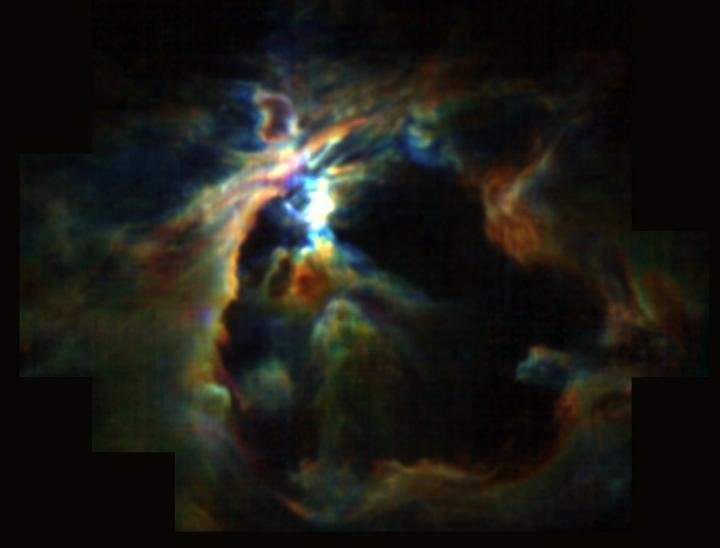
The powerful wind from the newly formed star at the heart of the Orion Nebula is creating the bubble (black) and preventing new stars from forming in its neighborhood. At the same time, the wind pushes molecular gas (color) to the edges, creating a dense shell around the bubble where future generations of stars can form. NASA/SOFIA/Pabst et al.

“The wind is responsible for blowing an enormous bubble around the central stars,” lead author Cornelia Pabst, Ph.D. student at the University of Leiden, the Netherlands, said in a statement. “It disrupts the natal cloud and prevents the birth of new stars.”

SOFIA is a flying observatory in a modified Boeing 747SP jetliner aircraft which can fly above 99 percent of the water vapor in Earth’s atmosphere, allowing instruments like the German Receiver for Astronomy at Terahertz Frequencies (GREAT) to detect infrared light that would otherwise be blocked by the vapor. The GREAT instrument measured the spectral signature of ionized carbon to determine the speed of gas moving in the distant nebula “like a police officer uses a radar gun,” according to co-author Alexander Tielens.
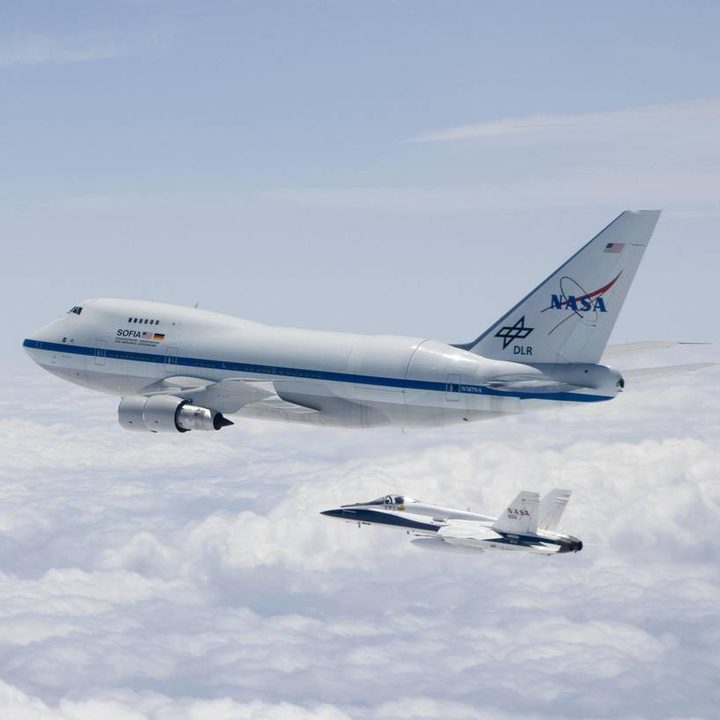
NASA’s SOFIA airborne observatory is shadowed by a NASA F/A-18 safety chase aircraft during its second checkout flight near Waco, Texas on May 10, 2007. NASA

The findings are published in Nature.

Georgina Torbet
Georgina has been the space writer at Digital Trends space writer for six years, covering human space exploration, planetary…
DJI’s first 360° drone offers 8K video recording and a freakishly long transmission range
From omnidirectional obstacle sensing to 42 GB of onboard storage, the Avata 360 is DJI doing what DJI does best: raising the bar for everyone else.
DJI Avata 360° drone.

DJI has officially entered the 360° drone arena with the launch of the Avata 360. It’s the company’s first-ever fully immersive FPV drone, and a direct shot at the Antigravity A1, a rival built by an Insta360-incubated brand. Looks like the drone wars just got more interesting. 

What makes the Avata 360 worth looking at?

Read more
I transferred all my chats from other AI apps to Gemini — and it works flawlessly
Google Gemini Graphics Featured

You know that moment when AI assistants like ChatGPT, Gemini, or Claude suddenly lose the plot mid-conversation and start hallucinating like they’re absolutely sure they’re right? Yeah…it’s equal parts funny and painfully annoying. My usual reaction is switching between apps, hoping one of them gets it right. But the real problem is that I have to start over every single time. It feels like I’m stuck in a loop explaining my life story to different AIs, one after the other.

Now with Gemini, I can now jump in from other AI apps without that whole reset conversation. Finally, the Google gods have blessed us. I tried it out expecting the usual hiccups, but it was surprisingly smooth and quick.

Read more
Google expands Search Live globally with voice and camera AI
The feature is now available in 200+ countries with multilingual support
Google Search Live

Google is taking another big step toward turning Search into a full-blown AI assistant. The company has officially expanded Search Live globally, making the feature available in over 200 countries and territories, along with support for dozens of languages.

https://twitter.com/google/status/2037201891130523917

Read more