  1. Home
  2. Emerging Tech
  3. News

Curiosity rover learns a new trick: Measuring the gravity of mountains

Add as a preferred source on Google

NASA’s Curiosity rover has provided scientists with unexpected insight into the gravity on Mars by using the rover’s sensors as a makeshift gravimeter.

The Curiosity rover has accelerometers for measuring acceleration and gyroscopes for measuring orientation and angular velocity on board, just like the sensors in a smartphone which tell you where you are on a map and in which direction you are facing. The very accurate sensors on the Curiosity are used to navigate the surface of Mars and point its other instruments in the right direction. While these instruments weren’t designed for measuring gravity, scientists realized that they could use them to gather data on the mountain that Curiosity is currently exploring, called Mount Sharp.

Recommended Videos

The inspiration for the gravity measurement technique came from a lunar mission almost 50 years ago. Back on the Apollo 17 mission to the Moon in 1972, astronauts were able to measure the lunar gravity using a tool they had on board their buggy called a gravimeter. While there are no astronauts to collect data on Mars, researchers realized that there were tools in the Curiosity that they could combine together to get the same information about Mars as they had on the moon.
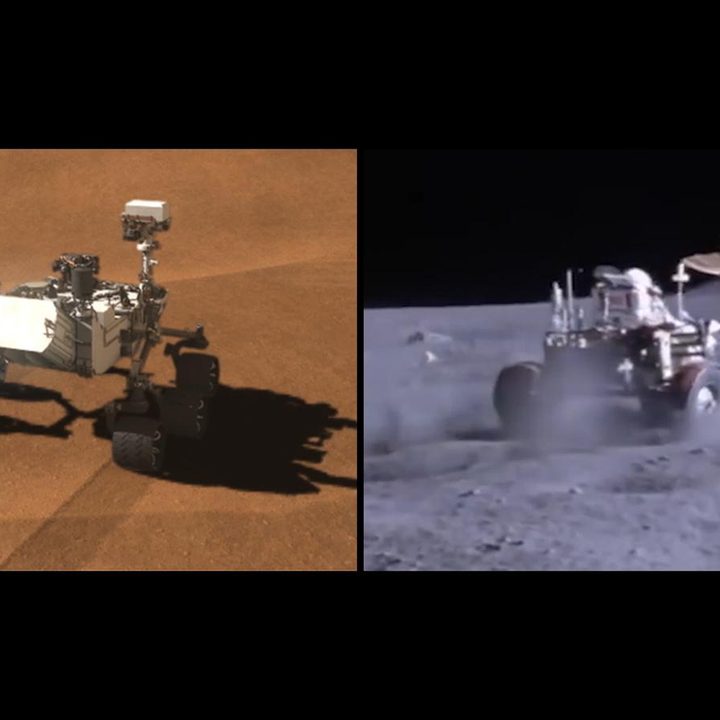
Side-by-side images depict NASA’s Curiosity rover (left) and a moon buggy driven during the Apollo 16 mission. NASA/JPL-Caltech

Mount Sharp is one of the largest mountains on Mars, and it is positioned strangely within the huge 96-mile-wide Gale Crater. The mountain rises 18,000 feet from the crater’s floor, and scientists still aren’t sure how it developed, though they think it could be due to the crater having been filled with sediment and compacted downwards.

When the Curiosity is stationary, the accelerometers detect the gravitational pull of the planet on the rover. And when Curiosity is ascending a slope, as it has been since 2014, researchers can see how much additional gravity is added by the mountain. The answer turns out to be less than expected, meaning that Mount Sharp is less dense than previously believed.

A Mars Buggy and a Moon Buggy

“The lower levels of Mount Sharp are surprisingly porous,” lead researcher Kevin Lewis of Johns Hopkins University said in a statement. “We know the bottom layers of the mountain were buried over time. That compacts them, making them denser. But this finding suggests they weren’t buried by as much material as we thought.”

“To me, Mars is the uncanny valley of Earth,” he added. “It’s similar but was shaped by different processes. It feels so unnatural to our terrestrial experience.”

The findings are published in Science.

Georgina Torbet
Georgina has been the space writer at Digital Trends space writer for six years, covering human space exploration, planetary…
Edge browser on mobile gets a huge upgrade that makes it a worthy pick over Chrome
Edge mobile gets smarter just before Chrome’s big Gemini moment
Microsoft Edge on a phone

Chrome is still the default browser for many smartphone users, but Microsoft’s latest Edge update gives them a practical reason to try something else.

Microsoft has announced a major Copilot update for Edge across desktop and mobile. The rollout comes ahead of Google’s Gemini-powered Chrome upgrade for Android, which is expected in June, giving Edge a chance to stand out on phones before Chrome’s next big AI push.

Read more
After flubbing with Siri, Apple plans to host AI agents on the App Store
One problem is about money Apple won't commit to not charging. The other is about AI agents Apple can't figure out how to control. WWDC needs to solve both.
Electronics, Mobile Phone, Phone

Apple is currently facing a Siri problem that has nothing to do with Siri at all. With WWDC 2026 just weeks away, The Information reports the company is actively courting developers to integrate their apps with the new Siri coming in iOS 27. 

The mechanism powering the overhauled Siri, App Intents, is an API that lets Siri execute actions inside third-party apps without you actively opening them, which sounds quite useful, I’d say. However, some of the world’s largest developers are dragging their feet on it, not because it’s tough, but because Apple left the door open on charging for it later.

Read more
EV batteries just need some AI top-up nudge, and they get a big 23% life boost, finds research
Charging fast and lasting long seemed impossible. A new AI trick says otherwise.
EV Charging

EV battery charging technology has always had to find the right balance between charging speed and battery longevity. If the charging speed is too fast, it wears down the battery. If the charging is too slow, nobody is happy. 

Researchers Meng Yuan from Victoria University of Wellington and Changfu Zou from Chalmers University of Technology in Sweden may have cracked this long-standing problem using an AI technique called deep reinforcement learning, and the results are pretty encouraging.

Read more