
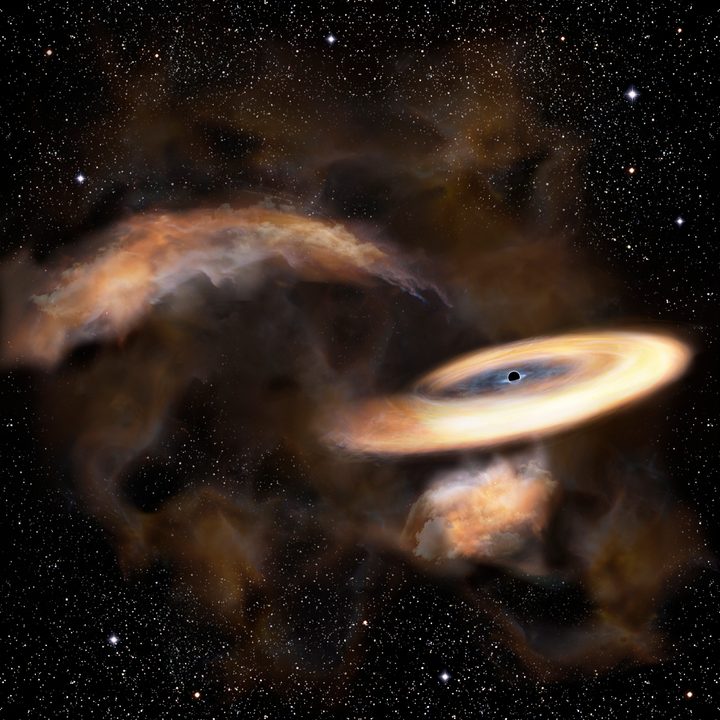
Something that has puzzled astronomers about black holes is how they merge and grow, as they have found both small black holes and very large ones — but no intermediate ones. The smallest black holes discovered have been around five times the mass of our sun, and the largest are hundreds of millions of times the mass of the sun. The missing intermediates are in the range of hundreds or thousands of times the mass of the sun.
Hunting black holes is difficult because they do not emit any light, although some do give out bursts of energy which can be detected. However, others — called ‘quiet’ black holes — give out very little energy and are almost invisible.
Now a team of Japanese astronomers has located one such quiet intermediate black hole by observing not the black hole itself, but a cloud of gas near the center of the galaxy which was moving strangely. They looked 25,000 light-years away from Earth at the HCN–0.009–0.044 gas cloud using an instrument called ALMA (Atacama Large Millimeter/submillimeter Array) in Chile and saw that it swirled as if it was being pulled around by the gravity of a massive body.
This meant the team was able to locate the black hole even though it was impossible to observe it directly. “Detailed kinematic analyses revealed that an enormous mass, 30,000 times that of the Sun, was concentrated in a region much smaller than our Solar System,” leader of the research team, Shunya Takekawa of the National Astronomical Observatory of Japan, said in a statement. “This and the lack of any observed object at that location strongly suggests an intermediate-mass black hole.”
The future isn’t looking rosy for this particular black hole, however — it is likely to be gobbled up by a larger black hole in the same way that it consumes other matter. “It is significant that this intermediate mass black hole was found only 20 light-years from the supermassive black hole at the Galactic center,” Tomoharu Oka, a professor at Keio University and co-leader of the team, explained in the same statement. “In the future, it will fall into the supermassive black hole; much like gas is currently falling into it.”
Takekawa and his team want to use this same methodology to search for other black holes which could be lurking stealthily in the darkness of the galaxy. “By analyzing other anomalous clouds, we hope to expose other quiet black holes,” he said.
The findings are published in The Astrophysical Journal Letters.


