  1. Home
  2. Emerging Tech
  3. News

NASA’s Mars InSight lander is facing a rocky road as its drill hits a rock

Add as a preferred source on Google

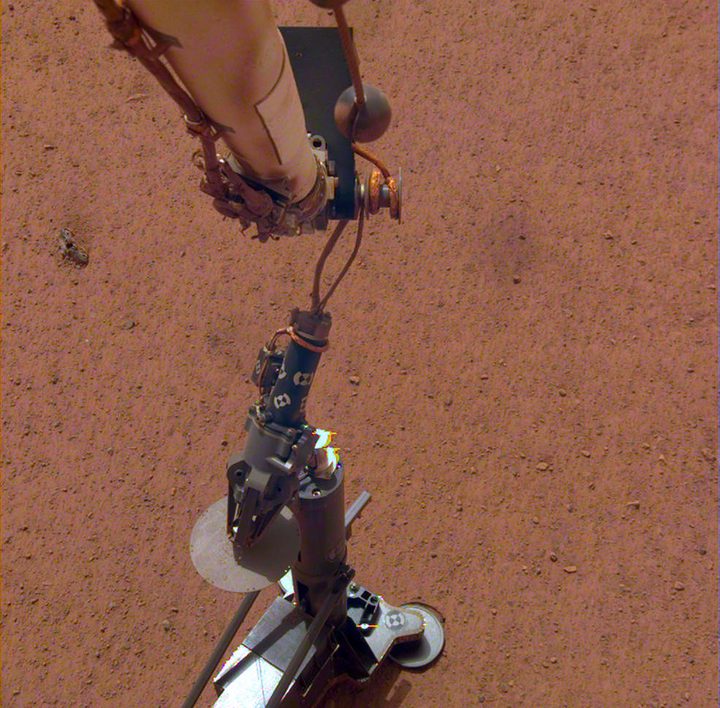
NASA’s InSight lander set its heat probe, called the Heat and Physical Properties Package (HP3), on the Martian surface on February 12. NASA/JPL-Caltech/DLR

The InSight lander on Mars has run into trouble this week with its project to drill down into the surface to measure heat from inside the planet. The lander is equipped with a probe, part of the Heat and Physical Properties Package, or HP3 instrument, that was to dig up to 16 feet down into the surface so it could collect accurate data on temperatures.

Recommended Videos

The drilling began on Thursday February 28 and continued without issues for the first few days. But once the probe had reached approximately three quarters of the depth it was aiming for, it stopped. The InSight team tried to restart with a second bout of drilling on Saturday March 2 but to no avail, and the probe didn’t reach any deeper. Data now suggests that the probe is tilted at an angle of 15 degrees.

The scientists responsible for the probe believe that it may have hit a rock, or possibly gravel. As there were few rocks on the surface of the drilling site, the team had hoped that there wouldn’t be rocks beneath the surface either. But they knew there was a risk that they would get unlucky a hit a rock which impeded drilling.

The tip of the probe, called the mole, was designed to push aside smaller rocks or to weave around larger ones, and this capacity worked well in testing before the probe was launched. But for now the team has decided to stop drilling and see what data they can gather from the probe’s current location.

“The team has … decided to pause the hammering for about two weeks to allow the situation to be analyzed more closely and jointly come up with strategies for overcoming the obstacle,” HP3 Principal Investigator Tilman Spohn of the German Aerospace Center (DLR) wrote in a blog post. “In the meantime, we are planning on carrying out thermal conductivity measurements for the first time on Mars … A lot to do and still a lot of excellent science to be expected from HP3 and from InSight!”

Georgina Torbet
Georgina has been the space writer at Digital Trends space writer for six years, covering human space exploration, planetary…
Edge browser on mobile gets a huge upgrade that makes it a worthy pick over Chrome
Edge mobile gets smarter just before Chrome’s big Gemini moment
Microsoft Edge on a phone

Chrome is still the default browser for many smartphone users, but Microsoft’s latest Edge update gives them a practical reason to try something else.

Microsoft has announced a major Copilot update for Edge across desktop and mobile. The rollout comes ahead of Google’s Gemini-powered Chrome upgrade for Android, which is expected in June, giving Edge a chance to stand out on phones before Chrome’s next big AI push.

Read more
After flubbing with Siri, Apple plans to host AI agents on the App Store
One problem is about money Apple won't commit to not charging. The other is about AI agents Apple can't figure out how to control. WWDC needs to solve both.
Electronics, Mobile Phone, Phone

Apple is currently facing a Siri problem that has nothing to do with Siri at all. With WWDC 2026 just weeks away, The Information reports the company is actively courting developers to integrate their apps with the new Siri coming in iOS 27. 

The mechanism powering the overhauled Siri, App Intents, is an API that lets Siri execute actions inside third-party apps without you actively opening them, which sounds quite useful, I’d say. However, some of the world’s largest developers are dragging their feet on it, not because it’s tough, but because Apple left the door open on charging for it later.

Read more
EV batteries just need some AI top-up nudge, and they get a big 23% life boost, finds research
Charging fast and lasting long seemed impossible. A new AI trick says otherwise.
EV Charging

EV battery charging technology has always had to find the right balance between charging speed and battery longevity. If the charging speed is too fast, it wears down the battery. If the charging is too slow, nobody is happy. 

Researchers Meng Yuan from Victoria University of Wellington and Changfu Zou from Chalmers University of Technology in Sweden may have cracked this long-standing problem using an AI technique called deep reinforcement learning, and the results are pretty encouraging.

Read more