  1. Home
  2. Emerging Tech
  3. News

Methane on Mars confirmed — but there’s probably no life there

Add as a preferred source on Google

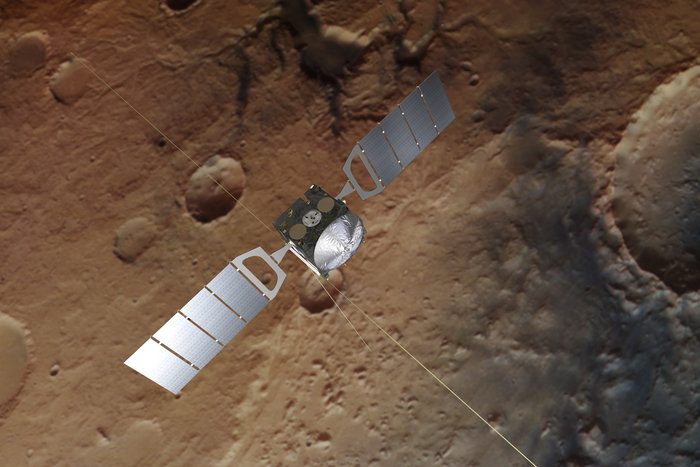
Artist’s impression of Mars Express. The background is based on an actual image of Mars taken by the spacecraft’s high resolution stereo camera. Spacecraft image credit: ESA/ATG medialab; Mars: ESA/DLR/FU Berlin, CC BY-SA 3.0 IGO

A new piece of the puzzle of the disappearing methane on Mars has been revealed. Data collected from orbit by the European Space Agency (ESA)’s Mars Express mission has been examined to look for correlations with data collected from the surface by the Curiosity rover.

Recommended Videos

Previously, the Curiosity data had indicated that methane was present in the Martian atmosphere, but this methane wasn’t detected by the Mars Express. Now a reanalysis of the satellite data shows that methane was present at just one location one day after the Curiosity’s readings were taken.

The analysis used a new observational technique which collected several hundred measures in a short time period. This technique is more accurate than previous techniques and which was able to pinpoint just 15 parts of methane per billion by volume of the atmosphere.

Although the Mars Express and Curiosity data sets now seem to concord more than they did before, the source of the detected methane is still a mystery.

“Our new Mars Express data, taken one day after Curiosity’s recording, change the interpretation of where the methane originated from, especially when considering global atmospheric circulation patterns together with the local geology,” Marco Giuranna from the National Institute for Astrophysics, Institute for Space Astrophysics and Planetology in Rome, Italy, and lead author of the paper, said in a statement.

Scientists believe the methane could have been trapped in ice below the Martian surface and risen up through tectonic faults. Alternatively, meteorite impacts could have have caused cracks which released gas that was beneath the surface.
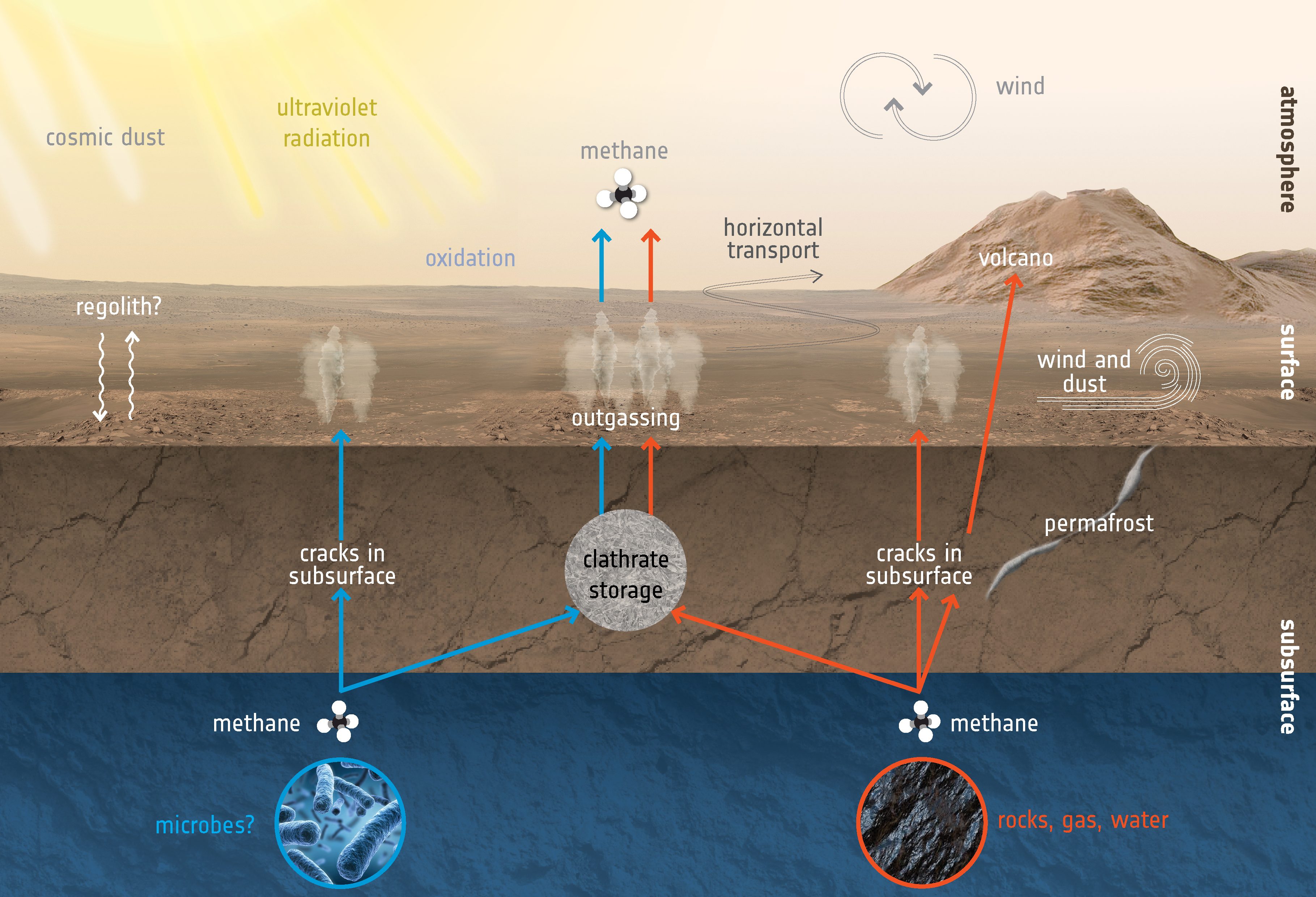
This graphic depicts some of the possible ways methane might be added or removed from the Martian atmosphere. ESA

Overall, the current evidence suggests that methane is present on Mars due to occasional geological events which release small amounts of the gas that were trapped beneath the surface, possibly thousands of years ago. It seems that methane is not, as some had considered, constantly replenished across the planet. So Mars may once have been habitable, but it seems increasingly unlikely that there is life there now.

More information on this topic is expected to be gathered by the Trace Gas Orbiter craft, part of the ExoMars mission, which is currently collecting data on the composition of the Martian atmosphere and which may reveal more about where this mysterious methane comes from.

The findings are publish in Nature Geoscience.

Georgina Torbet
Georgina has been the space writer at Digital Trends space writer for six years, covering human space exploration, planetary…
Edge browser on mobile gets a huge upgrade that makes it a worthy pick over Chrome
Edge mobile gets smarter just before Chrome’s big Gemini moment
Microsoft Edge on a phone

Chrome is still the default browser for many smartphone users, but Microsoft’s latest Edge update gives them a practical reason to try something else.

Microsoft has announced a major Copilot update for Edge across desktop and mobile. The rollout comes ahead of Google’s Gemini-powered Chrome upgrade for Android, which is expected in June, giving Edge a chance to stand out on phones before Chrome’s next big AI push.

Read more
After flubbing with Siri, Apple plans to host AI agents on the App Store
One problem is about money Apple won't commit to not charging. The other is about AI agents Apple can't figure out how to control. WWDC needs to solve both.
Electronics, Mobile Phone, Phone

Apple is currently facing a Siri problem that has nothing to do with Siri at all. With WWDC 2026 just weeks away, The Information reports the company is actively courting developers to integrate their apps with the new Siri coming in iOS 27. 

The mechanism powering the overhauled Siri, App Intents, is an API that lets Siri execute actions inside third-party apps without you actively opening them, which sounds quite useful, I’d say. However, some of the world’s largest developers are dragging their feet on it, not because it’s tough, but because Apple left the door open on charging for it later.

Read more
EV batteries just need some AI top-up nudge, and they get a big 23% life boost, finds research
Charging fast and lasting long seemed impossible. A new AI trick says otherwise.
EV Charging

EV battery charging technology has always had to find the right balance between charging speed and battery longevity. If the charging speed is too fast, it wears down the battery. If the charging is too slow, nobody is happy. 

Researchers Meng Yuan from Victoria University of Wellington and Changfu Zou from Chalmers University of Technology in Sweden may have cracked this long-standing problem using an AI technique called deep reinforcement learning, and the results are pretty encouraging.

Read more