  1. Home
  2. Emerging Tech
  3. News

Practically perfect in every way: Hubble shows galaxy with amazing symmetry

Add as a preferred source on Google

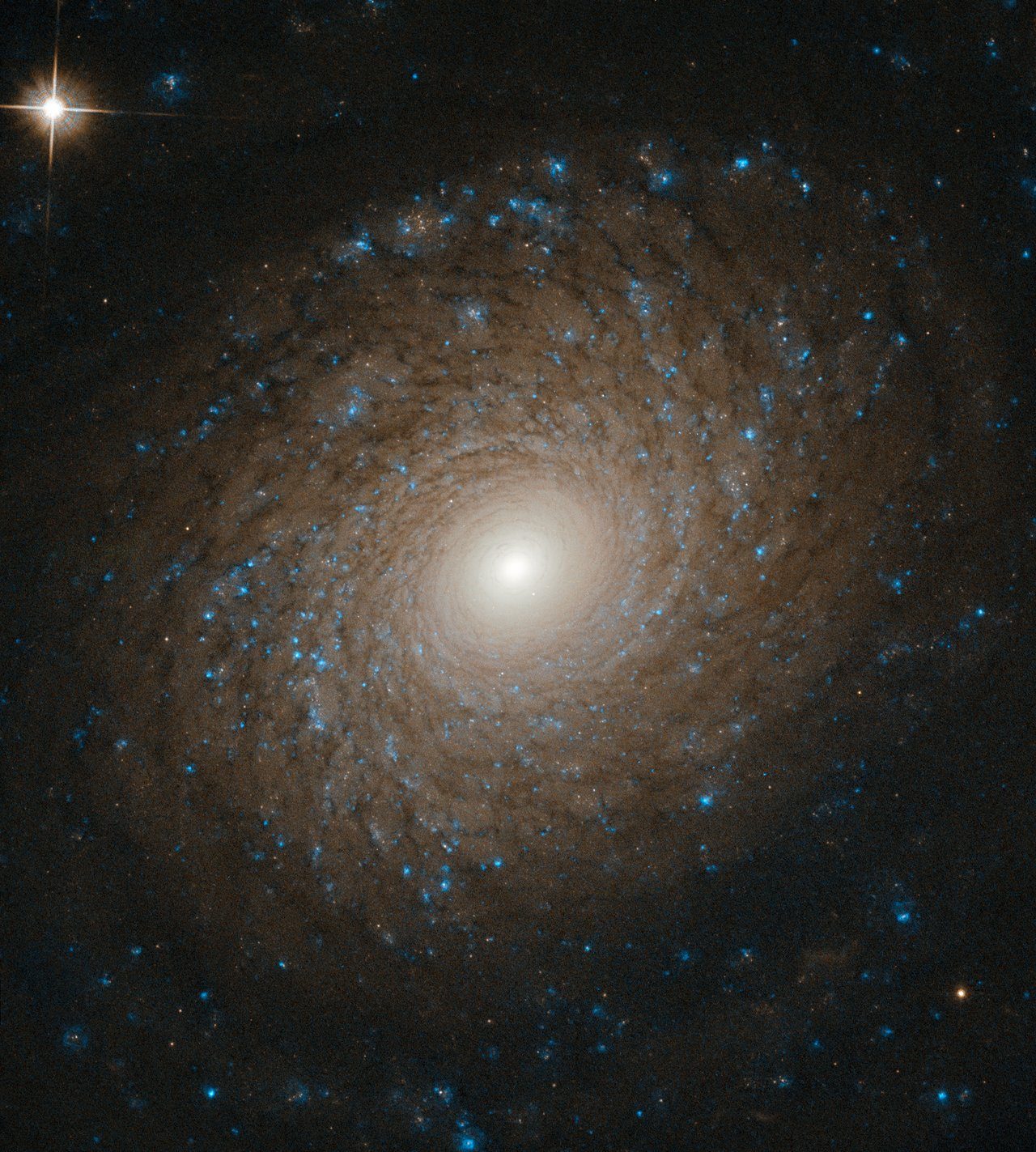
This Hubble Picture of the Week shows spiral galaxy NGC 2985 in the constellation of Ursa Major (The Great Bear). ESA/Hubble & NASA, L. Ho

This week’s Hubble image shows the spiral galaxy NGC 2985, located over 70 million light-years away in the constellation of Ursa Major (The Great Bear). It is an archetypal spiral galaxy, like our Milky Way, meaning it has arms of stars reaching out from its center. The galaxy is about 95,000 light-years across with a supermassive black hole at its center that is 160 million times the mass of our Sun.

Recommended Videos

Hubble scientists describe NGC 2985 as having “near-perfect symmetry,” showing tightly wound spiral arms which converge in the center of the galaxy as its brightest point. As the spiral arms reach out into space, they gradually fade and dissipate.

The outer spiral arm is so large that it encircles the galaxy, forming a “pseudo ring” around it. The outer part of the galaxy is relatively stable, unlike the center where collisions are common and instability is high. It is theorized that the instability of the center portion is due to the presence of molecular clouds, also known as stellar nurseries. These regions are opaque clouds with a higher density of hydrogen and other gases and dust. This dust forms into clumps, which are the very first stages of star formation.

The molecular clouds are more dense than the interstellar medium in which they float, and within the clouds the dust blocks out light. So the interior of the clouds are very cold and dark. This means that deep within the cloud, instabilities can occur because of the low temperature and density. Scientist are still trying to understand how these conditions lead to the formation of unusual particles like hydroisocyanic acid (HNC), which normally converts to the more stable hydrocyanic acid (HCN).

This color image was created by combining a number of different images taken in different spectrums. Hubble’s Advanced Camera for Surveys (ACS) took a number of separate exposures showing wavelengths in the visible and near-infrared portions of the spectrum. The colors were determined by assigning different hues to the monochromatic images, with individual filters applied. The bright blue dots in the image represent regions of busy activity and star formation.

Georgina Torbet
Georgina has been the space writer at Digital Trends space writer for six years, covering human space exploration, planetary…
DJI’s first 360° drone offers 8K video recording and a freakishly long transmission range
From omnidirectional obstacle sensing to 42 GB of onboard storage, the Avata 360 is DJI doing what DJI does best: raising the bar for everyone else.
DJI Avata 360° drone.

DJI has officially entered the 360° drone arena with the launch of the Avata 360. It’s the company’s first-ever fully immersive FPV drone, and a direct shot at the Antigravity A1, a rival built by an Insta360-incubated brand. Looks like the drone wars just got more interesting. 

What makes the Avata 360 worth looking at?

Read more
I transferred all my chats from other AI apps to Gemini — and it works flawlessly
Google Gemini Graphics Featured

You know that moment when AI assistants like ChatGPT, Gemini, or Claude suddenly lose the plot mid-conversation and start hallucinating like they’re absolutely sure they’re right? Yeah…it’s equal parts funny and painfully annoying. My usual reaction is switching between apps, hoping one of them gets it right. But the real problem is that I have to start over every single time. It feels like I’m stuck in a loop explaining my life story to different AIs, one after the other.

Now with Gemini, I can now jump in from other AI apps without that whole reset conversation. Finally, the Google gods have blessed us. I tried it out expecting the usual hiccups, but it was surprisingly smooth and quick.

Read more
Google expands Search Live globally with voice and camera AI
The feature is now available in 200+ countries with multilingual support
Google Search Live

Google is taking another big step toward turning Search into a full-blown AI assistant. The company has officially expanded Search Live globally, making the feature available in over 200 countries and territories, along with support for dozens of languages.

https://twitter.com/google/status/2037201891130523917

Read more