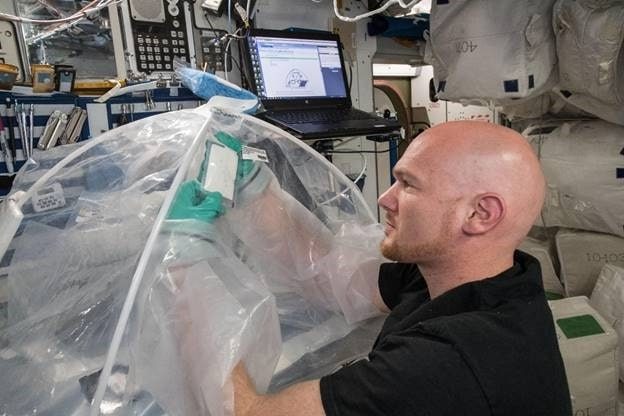
Concrete is a material used everywhere on Earth due to its strength and relatively light weight. That makes it a useful candidate for a material to build structures in space as well. But you can’t simply mix up cement in space the same way you do on Earth and expect to reach the same result. The astronauts on board the International Space Station (ISS) have been performing experiments to see how concrete reacts during the hardening process in microgravity, and how this affects its microstructure and material properties.
“On missions to the moon and Mars, humans and equipment will need to be protected from extreme temperatures and radiation, and the only way to do that is by building infrastructures on these extraterrestrial environments,” principal investigator Aleksandra Radlinska of Pennsylvania State University explained in a statement. “One idea is building with a concrete-like material in space. Concrete is very sturdy and provides better protection than many materials.”
The project is called the Microgravity Investigation of Cement Solidification (MICS) project, and it involved mixing concrete in space for the first time. The researchers tested a number of variations of cement powder using different additives and ratios of powder to water. They found some key differences in the hardening process from what would happen on Earth, in particular, that the space concrete ended up being more porous which will likely make it slightly less strong.
“Even though concrete has been used for so long on Earth, we still don’t necessarily understand all the aspects of the hydration process. Now we know there are some differences between Earth- and space-based systems and we can examine those differences to see which ones are beneficial and which ones are detrimental to using this material in space,” Radlinska said. “Also, the samples were in sealed pouches, so another question is whether they would have additional complexities in an open space environment.”
It’s good news that mixing concrete in space is possible at all, even if the result is not quite the same as it would be on Earth. Eventually, concrete and other materials could be used to produce lightweight and strong habitats in space, and current research will improve the cement processing techniques to make the finished material more reliable.
The findings are published in the journal Frontiers in Materials.