  1. Home
  2. Space
  3. Emerging Tech
  4. News

Watch NASA astronauts conduct the first-ever all-woman spacewalk

The historic spacewalk lasted 7 hours and 17 minutes

Add as a preferred source on Google
 

NASA astronauts and International Space Station (ISS) residents Christina Koch and Jessica Meir have made history by performing the first ever all-woman spacewalk. Starting bright and early at 7:50 a.m. ET on Friday, October 18, the pair ventured outside the International Space Station in order to perform repairs to the station’s power system.
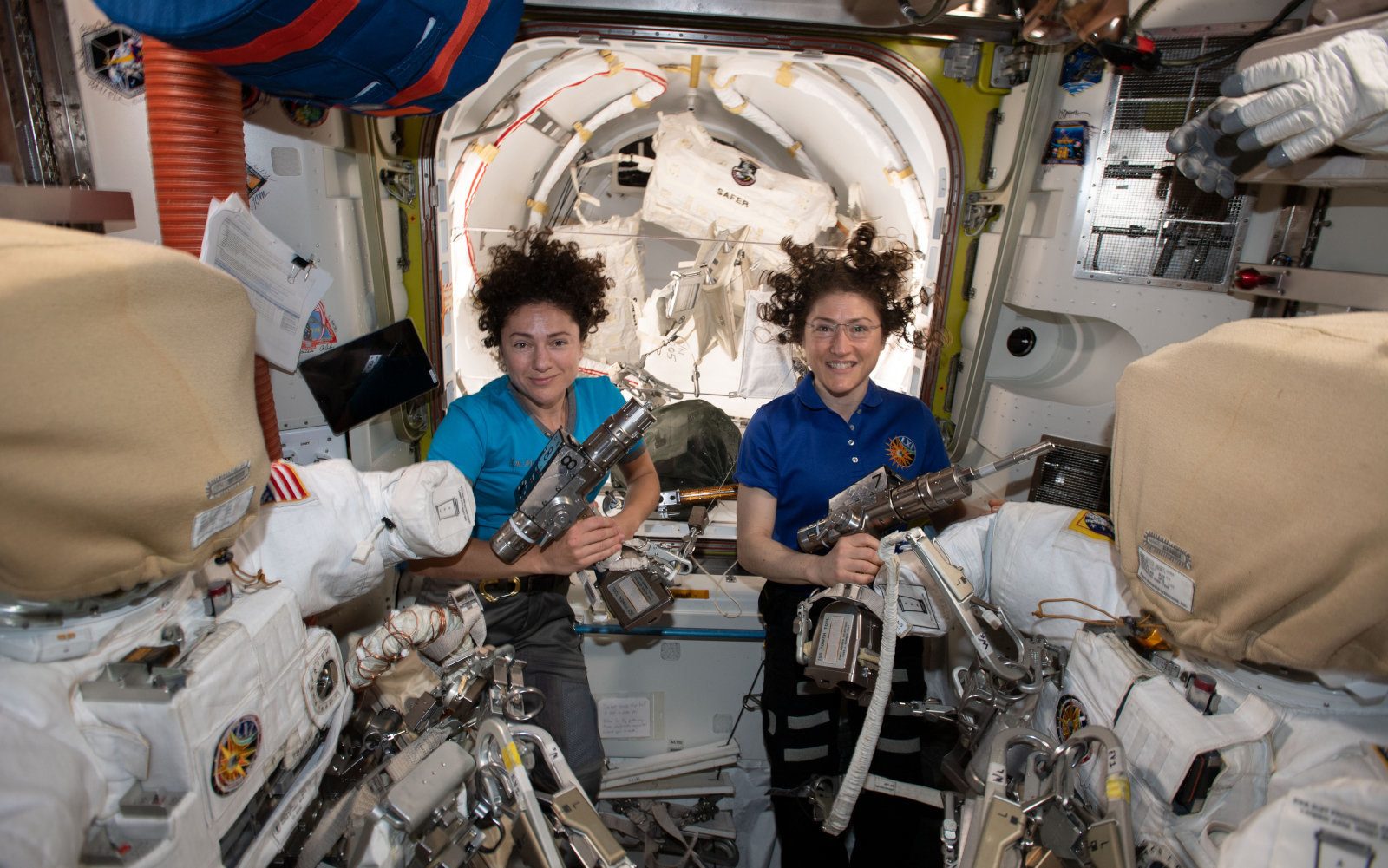
Astronauts Jessica Meir (left) and Christina Koch (right) made history by performing the first-ever all-woman spacewalk. Image used with permission by copyright holder

Spacewalks are a true test of endurance, with this walk spanning five or six hours and requiring constant attention and focus. This particular spacewalk is the first performed by two women, both members of the Expedition 61 crew on the ISS, although plenty of women have taken spacewalks in the past alongside men — today was the 43rd spacewalk to include a female crew member.

NASA Astronauts Complete All-Woman Spacewalk

An all-woman spacewalk was planned previously, when Koch and previous ISS crew member Anne McClain were scheduled to work together on a spacewalk in March, but that event had to be scrapped due to spacesuit sizing issues. Now, with two women aboard the ISS and a whole series of spacewalks planned over the next weeks, it was finally time for two women to step into the vacuum of space together.

Recommended Videos

Koch and Meir replaced a battery charge/discharge unit as part of a wide-scale upgrade to the power systems on the ISS. New lithium-ion batteries were been installed on the outside of the station recently, but one charge/discharge unit failed to activate and needed to be swapped out. This unit forms part of the system which collects energy from the sun’s rays and stores it to power the station.

When asked what this achievement meant, Koch pointed out the importance of inspiring other women to get involved in space research. “In the end, I do think it’s important, and I think it’s important because of the historical nature of what we’re doing,” she said in an interview. “In the past women haven’t always been at the table. It’s wonderful to be contributing to the space program at a time when all contributions are being accepted, when everyone has a role. That can lead in turn to increased chance for success. There are a lot of people who derive motivation from inspiring stories of people who look like them, and I think it’s an important story to tell.”

Georgina Torbet
Georgina has been the space writer at Digital Trends space writer for six years, covering human space exploration, planetary…
Artemis II crew preps for lunar orbit – and Orion’s cosmic commode
'It's the one place we can go during the mission where we can actually feel like we’re alone.'
The Orion spacecraft's toilet.

Four astronauts are about to embark on a historic voyage that will take them around the moon in a spacecraft about the size of a large camper van.

During the Artemis II mission, NASA astronauts Reid Wiseman, Victor Glover, and Christina Koch, and the Canadian Space Agency’s Jeremy Hansen, will spend 10 days inside the Orion capsule after being blasted to space by the SLS rocket from the Kennedy Space Center in Florida, hopefully next week.

Read more
It’s here! NASA reveals full livestream schedule for crewed moon mission
The coverage starts on Friday.
NASA's SLS lunar rocket on the launchpad at the Kennedy Space Center, with the moon shining brightly in the background.

The excitement is building with NASA now just a few days away from sending four astronauts on a voyage around the moon.

On Wednesday, the space agency shared its schedule for coverage of the final buildup and main event, including a Q&A with the astronauts this Friday, blast off on Wednesday, April 1, and regular updates as the crew make their way to the moon.

Read more
Peek inside NASA’s Mars habitat where humans train for life on the red planet
Four volunteers are staying in isolation for more than a year.
A scene inside NASA's Mars simulation habitat.

NASA has offered a sneak peek inside its Mars simulation habitat where four volunteers have now spent 150 days isolated from the outside world.

By living within the confines of the 1,700-square-foot Mars Dune Alpha habitat at the Johnson Space Center in Houston, Ross Elder, Ellen Ellis, Matthew Montgomery, and James Spicer are helping NASA to better prepare for long-duration missions that will take humans into deep space.

Read more