  1. Home
  2. Phones
  3. Android
  4. Mobile
  5. News

Huawei P40 may have a large camera module, but it won’t launch with Google apps

Add as a preferred source on Google

Huawei may not have had the best 2019, but hopes are high for 2020 — and the new Huawei P40 flagship range is going to be leading the charge. Previous statements by Huawei’s Richard Yu had said we should expect a new design we’ve never seen before — but if the latest leaks are to be believed, that may not be the case. According to renders from Steve Hemmerstoffer and 91Mobiles, the Huawei P40 and P40 Pro may embrace the chunky camera module we’re expecting to dominate phone designs in 2020.

It’s clear details are still relatively scarce for this phone, and that’s represented in the dark nature of the renders presented by Hemmerstoffer and 91Mobiles. The renders don’t shed any light — literally — on the front of the phone, so it’s unclear whether Huawei has moved significantly away from the notches used on the Huawei P30 range. Instead, all of the attention is on the back of the phone, and specifically the camera module.
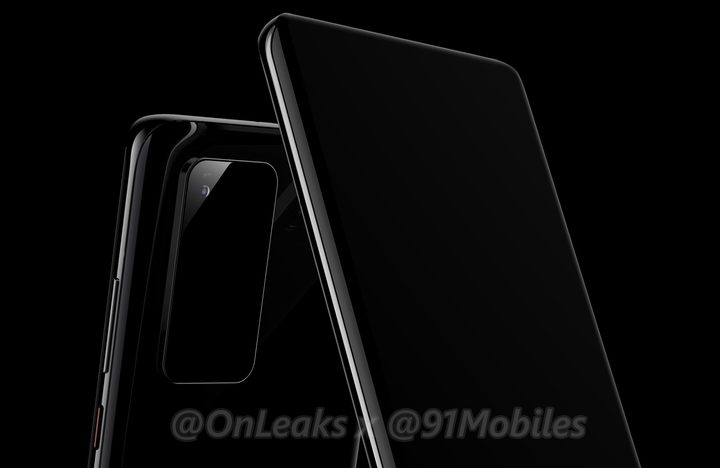
Credit: 91Mobiles/@OnLeaks

Like many phone designs we’re anticipating this year, the Huawei P40 range seems to be using a rectangular camera module to contain the large number of sensors and lenses expected from a modern flagship phone. This double line of lenses forming a rectangle is becoming one of the most popular ways to arrange a camera module, and we’ve seen it on the Pixel 4 and iPhone 11 Pro range, and we’re anticipating seeing it on the Samsung Galaxy S11 and Galaxy Note 10 Lite in 2020.

Recommended Videos

In fairness to Huawei, it was one of the first manufacturers to adopt a camera module that wasn’t just some variant on a single line, with the Huawei Mate 20‘s squared module being one of the first phones to adopt a square module. But regardless of who did it first, it looks like 2020 will be filled with squared and rectangular camera modules.

However, it seems Huawei’s troubles are unlikely to be linked to an unoriginal design. Instead, it looks like software could be a major issues in certain markets, thanks to continued issues with the trade war between the U.S. and China. While it’s confirmed the P40 will launch with the latest version of EMUI over Android 10, it won’t have access to Google’s Play services. So there’ll be no access to the Google Play Store, Gmail, Google Drive, or any of the mod cons you’d expect from an Android phone. While this won’t trouble Huawei’s Chinese userbase, it may well put off many of the fans Huawei has gained outside of its home country.

Mark Jansen
Former Mobile Evergreen Editor
Mark Jansen is an avid follower of everything that beeps, bloops, or makes pretty lights. He has a degree in Ancient &…
The Honor 600 Pro shows Samsung what an affordable flagship should look like
The Honor 600 Pro outguns the Galaxy S25 FE on nearly every front. Samsung should be paying attention.
Honor 600 Pro vs Galaxy S25 FE featured

Samsung has had a comfortable run with its Fan Edition line. The formula has always been straightforward: take the flagship experience, trim a few corners, drop the price, and watch buyers line up. For years, it worked because nobody was doing it better. The Galaxy S25 FE is proof that Samsung still knows how to execute that formula. It's also proof that the formula is no longer enough.

Enter the Honor 600 Pro. A phone that, on paper and in the hand, makes the Galaxy S25 FE look like Samsung stopped trying.

Read more
Felt the wrath of network dead zones? AT&T, T-Mobile, and Verizon are coming together to save you, soon
AT&T

In a rare move, America’s three biggest wireless carriers - AT&T, T-Mobile, and Verizon - have agreed in principle to work together on a new joint venture aimed at reducing wireless dead zones across the United States. The initiative focuses heavily on satellite-based connectivity and direct-to-device (D2D) communication technology, which could eventually allow smartphones to stay connected even in areas where traditional cellular towers cannot reach.

The companies say the partnership will pool spectrum resources and create a shared platform designed to improve coverage in rural regions, national parks, highways, remote areas, and locations affected by natural disasters. Existing partnerships with satellite providers will remain in place, but the new venture aims to create a more unified ecosystem for future satellite-powered mobile connectivity.

Read more
After flubbing with Siri, Apple plans to host AI agents on the App Store
One problem is about money Apple won't commit to not charging. The other is about AI agents Apple can't figure out how to control. WWDC needs to solve both.
Electronics, Mobile Phone, Phone

Apple is currently facing a Siri problem that has nothing to do with Siri at all. With WWDC 2026 just weeks away, The Information reports the company is actively courting developers to integrate their apps with the new Siri coming in iOS 27. 

The mechanism powering the overhauled Siri, App Intents, is an API that lets Siri execute actions inside third-party apps without you actively opening them, which sounds quite useful, I’d say. However, some of the world’s largest developers are dragging their feet on it, not because it’s tough, but because Apple left the door open on charging for it later.

Read more