  1. Home
  2. Emerging Tech
  3. News

3D printing lets hospitals make ventilator substitutes with common equipment

Add as a preferred source on Google
Materialise 3D Prints Non-Invasive PEEP Masks to Alleviate Ventilator Shortage

Many hospitals around the world currently have an alarming shortage of mechanical ventilators, which they can use to treat COVID-19 patients. Responding to this crisis, Belgian 3D printing company Materialise has developed a 3D-printable device that transforms standard equipment available in the majority of hospitals into a mask that can help coronavirus patients get the oxygen they desperately need into their lungs. The company’s smart solution promises to create high positive pressure in patients’ lungs without the use of a traditional ventilator.

Recommended Videos

“The 3D-printed connector converts this standard equipment into a non-invasive PEEP mask that can be connected to [an] oxygen supply to facilitate breathing for coronavirus patients,” Bram Smits, external communication manager for Materialise, told Digital Trends. “This solution gives patients an extended period of time before mechanical ventilators are required for treatment, and helps transition them off ventilators earlier, freeing up these devices for patients in critical need. By using standard medical equipment, including a non-invasive ventilation (NIV) mask, a filter, and a PEEP valve, the solution is simple and familiar to use for medical professionals.”

Like many 3D printing companies and professionals, the folks at Materialise say they were spurred into action by their realization that additive manufacturing can help right now in a way that few other industries can.
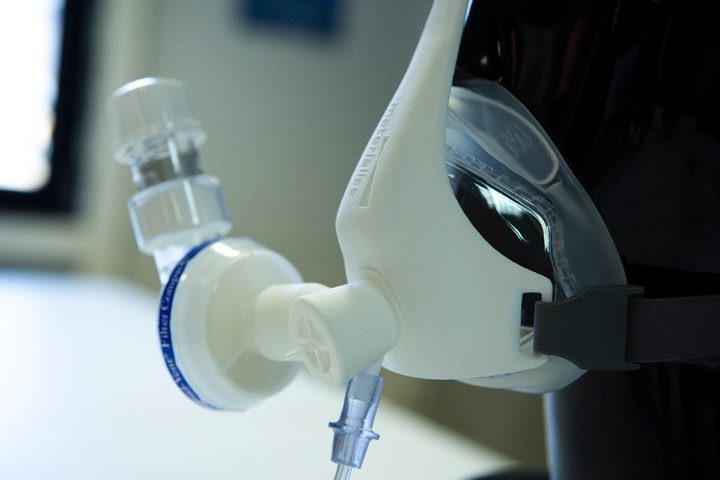
PEEP mask 1
Materialise

“We looked at various routes, including printing parts for ventilators and printing protective mouth masks,” Smits continued. “We contacted clinicians to better understand what the medical need of the patients was. In these conversations, we understood that the need was to have a solution for patients that need more oxygen and positive pressure before they need to be intubated — and this in a way that the medical staff was protected as well, avoiding air contamination as much as [possible].”

Creating their solution — including prototyping, testing, and iterating — took just a single week. Of course, while 3D printing makes it fast to create medical devices, it’s still crucial that they comply with regulations to ensure safety of patients and caregivers. Currently, the team at Materialise is supporting a clinical trial to put the technology through its paces.

As to what this means for patients, Smits said, “We hope to have it tested, registered, and available on the market by mid-April.”

Luke Dormehl
I'm a UK-based tech writer covering Cool Tech at Digital Trends. I've also written for Fast Company, Wired, the Guardian…
I see Apple skipping the AI hellfire, but shaping Siri as the most flexible assistant
iPhone with Active Siri

When Apple introduced Siri back in 2011, the world freaked out. A personal assistant on a phone with conversational chops elicited an audible gasp from the audience, and plenty of fear. "That it’s a sinister, potentially alien artificial intelligence that’s bound to kill us all," CNN's coverage surmised. It was a one-of-a-kind advancement, something Apple was delivering consistently back then.

And then it fell off. Now, Siri has a reputation for being, well… not exactly the sharpest voice assistant, especially in a pool of next-gen generative AI assistants such as Claude, Gemini, and ChatGPT. Anyone who’s tried asking it a tricky question knows exactly what I mean — it's a drag to talk with Siri, and more importantly, get work done. But things are starting to shake up. Bloomberg's Mark Gurman, a prolific all-things-Apple eavesdropper, shared yesterday that Siri might soon open its doors to third-party AI tools in a major iOS update. That’s right! Apple’s walled garden could finally be cracking.

Read more
DJI’s first 360° drone offers 8K video recording and a freakishly long transmission range
From omnidirectional obstacle sensing to 42 GB of onboard storage, the Avata 360 is DJI doing what DJI does best: raising the bar for everyone else.
DJI Avata 360° drone.

DJI has officially entered the 360° drone arena with the launch of the Avata 360. It’s the company’s first-ever fully immersive FPV drone, and a direct shot at the Antigravity A1, a rival built by an Insta360-incubated brand. Looks like the drone wars just got more interesting. 

What makes the Avata 360 worth looking at?

Read more
I transferred all my chats from other AI apps to Gemini — and it works flawlessly
Google Gemini Graphics Featured

You know that moment when AI assistants like ChatGPT, Gemini, or Claude suddenly lose the plot mid-conversation and start hallucinating like they’re absolutely sure they’re right? Yeah…it’s equal parts funny and painfully annoying. My usual reaction is switching between apps, hoping one of them gets it right. But the real problem is that I have to start over every single time. It feels like I’m stuck in a loop explaining my life story to different AIs, one after the other.

Now with Gemini, I can now jump in from other AI apps without that whole reset conversation. Finally, the Google gods have blessed us. I tried it out expecting the usual hiccups, but it was surprisingly smooth and quick.

Read more