  1. Home
  2. Space
  3. Emerging Tech
  4. News

How NASA’s VIPER rover will tackle the problem of moon dust

Add as a preferred source on Google

NASA is preparing to send astronauts back to the moon by 2024 as part of the Artemis program. But there’s one challenge of lunar exploration we haven’t solved yet: How to deal with moon dust.

The surface of the moon is covered in loose soil, also known as regolith, which kicks up clouds of dust whenever anything is moved over it. This dust gets everywhere and sticks to absolutely everything, because of the ultraviolet radiation from the sun which positively charges dust particles and makes them sticky. The particles also remain sharp due to the lack of wind erosion, making them abrasive.

Recommended Videos

This dust can gum up electronics and stop them from working, and may be dangerous to the health of astronauts. NASA has been searching for solutions to this issue for years, and now it has a strategy for dealing with the dust when it comes to its newest lunar rover, the Volatiles Investigating Polar Exploration Rover, or VIPER, which will hunt for water on the moon from 2023 ahead of the arrival of Artemis astronauts.
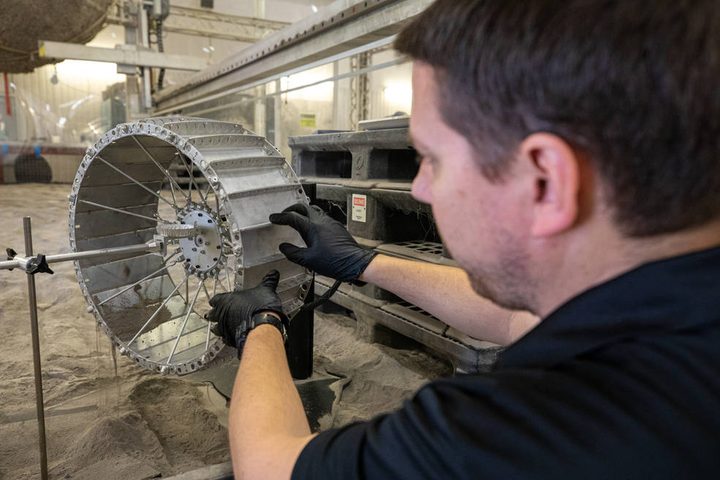
Robotics engineer Jason Schuler performs a preliminary test to prepare for dust testing of various seals for the wheel motors on NASA’s Volatiles Investigating Polar Exploration Rover, or VIPER
Researchers at NASA’s Kennedy Space Center are testing the various types of seals for electric motors that drive the Volatiels Investigating Polar Exploration Rover, or VIPER, wheels at Swamp Works. NASA

One of the challenges for VIPER is that the engineers aren’t sure what type of dust it will encounter — whether it will be light and fluffy or compacted and heavy. Therefore, the rover is designed to be highly maneuverable, able to drive sideways and diagonally, and this agility means it can cope with different surfaces.

To test out dust protection, the engineers took one of the rover’s wheels and placed it in a “dust chamber,” an open-topped acrylic box which is full of simulated dust and fans to blow it about. The wheel was protected by a flexible covering which acts as heat insulation and dust protection, then the fans were turned on and moved to simulate the worst possible conditions for dust.

Once the test was over, the engineers found that there was dust all over the outer covering, but none had managed to penetrate to the inside of the rover wheel. This suggests that the covering may be effective at protecting the delicate electronics inside the rover from the abrasive dust. As further protection against dust, the team is also testing out various different types of seals for the wheels’ electrical motors.

Georgina Torbet
Georgina has been the space writer at Digital Trends space writer for six years, covering human space exploration, planetary…
Artemis II crew preps for lunar orbit – and Orion’s cosmic commode
'It's the one place we can go during the mission where we can actually feel like we’re alone.'
The Orion spacecraft's toilet.

Four astronauts are about to embark on a historic voyage that will take them around the moon in a spacecraft about the size of a large camper van.

During the Artemis II mission, NASA astronauts Reid Wiseman, Victor Glover, and Christina Koch, and the Canadian Space Agency’s Jeremy Hansen, will spend 10 days inside the Orion capsule after being blasted to space by the SLS rocket from the Kennedy Space Center in Florida, hopefully next week.

Read more
It’s here! NASA reveals full livestream schedule for crewed moon mission
The coverage starts on Friday.
NASA's SLS lunar rocket on the launchpad at the Kennedy Space Center, with the moon shining brightly in the background.

The excitement is building with NASA now just a few days away from sending four astronauts on a voyage around the moon.

On Wednesday, the space agency shared its schedule for coverage of the final buildup and main event, including a Q&A with the astronauts this Friday, blast off on Wednesday, April 1, and regular updates as the crew make their way to the moon.

Read more
Peek inside NASA’s Mars habitat where humans train for life on the red planet
Four volunteers are staying in isolation for more than a year.
A scene inside NASA's Mars simulation habitat.

NASA has offered a sneak peek inside its Mars simulation habitat where four volunteers have now spent 150 days isolated from the outside world.

By living within the confines of the 1,700-square-foot Mars Dune Alpha habitat at the Johnson Space Center in Houston, Ross Elder, Ellen Ellis, Matthew Montgomery, and James Spicer are helping NASA to better prepare for long-duration missions that will take humans into deep space.

Read more