
Unless you’re brand new to the streaming world, there’s one thing everyone knows about Netflix: It’s an on-demand service. There are no channels or scheduled guides, and no live coverage of events. But that might soon change. The streaming giant has just launched a new feature called Direct as a trial available only in France. Direct is a live TV streaming channel with a prepopulated schedule of Netflix content. You simply fire it up and start watching.
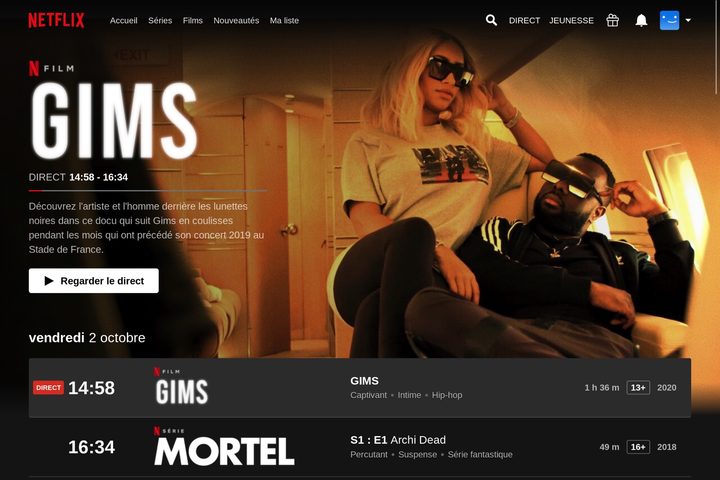
Technically, Direct isn’t live TV — the shows that are streamed via Direct are being pulled from the same catalog of content that French Netflix subscribers have always had access to. It’s the video-streaming equivalent of a radio station on Apple Music or Sonos Radio, but with the benefit of being able to see what’s coming up next in the playlist. And just like radio stations, there’s no way to skip forward or back with Direct; you join the stream in progress and let it wash over you.
The radio station analogy fits another aspect of Direct. Unlike the many curated recommendations Netflix users get based on their personal viewing habits, Direct is the same experience for everyone who tunes in.
Direct began rolling out in France on November 5, and Netflix expects to make it available across that country by the end of the month. At the moment, it’s a web-only feature — you can’t access Direct via a smart TV app, a streaming device, or a smartphone app — which suggests that Netflix is using this period to test Direct’s popularity.
If Direct proves successful, it could signal the start of a new chapter in Netflix’s evolution. The company has been a mainstay of the cord-cutting community for years, but it has never attempted to provide a true cable substitute such as Hulu + Live TV, Sling TV, or YouTube TV.
Could Netflix create its own version of these services, acting as yet another carrier for the big TV power brokers like Disney, NBCUniversal, and ViacomCBS? No question about it: It has the money, the audience, and the infrastructure to do so. The real question is, does it want to?
Why compete for live TV?
Netflix has proven that it can attract and maintain a massive subscription audience that shows up more and more to watch original productions. From a pure content creation point of view, Netflix is already a TV powerhouse that can rival those other entities. It doesn’t need to create a carbon copy of existing live TV streaming services to survive — but the company might need to adjust its current approach to releasing content.
We’re already witnessing the start of streaming services taking refuge in the traditional weekly release of episodes as a way to stop people signing up, bingeing, then canceling. Disney+‘s Mandalorian has become the poster child for this approach.
Taken to its logical next step, new episodes of streaming shows wouldn’t just show up at a preordained time and day, they would show up first on Direct. Only after that “live” debut would they be made available on-demand, perhaps as much as 24 hours later.
Direct was launched in France because in that country, according to Netflix, “traditional TV consumption is very popular, [and] many viewers like the idea of programming that avoids having to choose what to watch.”
My guess is that tendency to want programmed entertainment is strong elsewhere, too. It explains the huge success of YouTube’s recommended video algorithms, and why, despite the abundance of incredible on-demand options, services like YouTube TV continue to grow.
So Direct may not signal Netflix’s intention to get into the traditional space of live TV streaming as others have done, but it’s the first real evidence we have that it’s willing to disrupt its own tried-and-true on-demand model, even if that means taking a page out of traditional TV’s playbook. And once those floodgates are open, you can bet we’ll start to see an increasing number of experiments as Netflix figures out how to contend with the onslaught of TV’s biggest players into the space that it single-handedly created.
Must-see TV is being upended, in other words. To see where it lands, tune in next week.


