In the early days of the COVID-19 pandemic, there was a real — and justified — concern that there weren’t enough face masks in circulation. Companies quickly sprang into action, manufacturing millions of these now instantly recognizable bits of protective gear. Jump forward to the first months of 2021, however, and people now have another concern: That we might have too many face masks, and that this could pose a potential environmental problem.
“The current COVID-19 pandemic is responsible for creating too much rubbish,” Jie Li, a professor in the school of engineering at Australia’s RMIT University, told Digital Trends. “The single-use disposable face masks can be seen in parks, streets, beaches, and almost everywhere. Since the masks are mainly made of nonbiodegradable plastics, these single-use masks will take as long as 450 years to break down in the environment. Urgent action is needed to address the emerging issues related to face mask generation.”
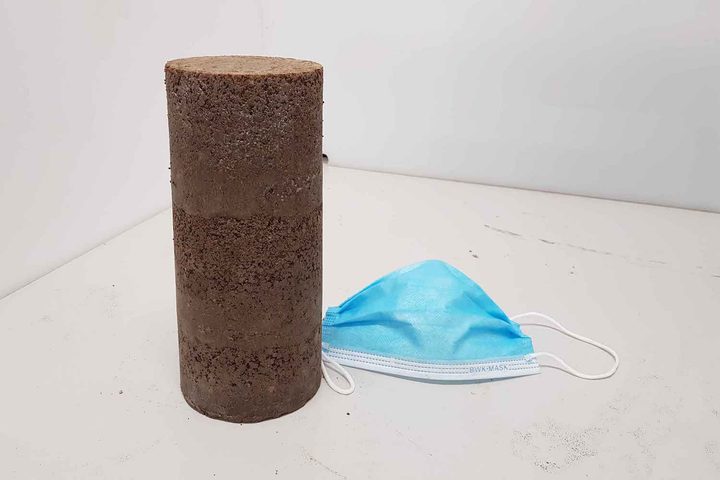
But RMIT University has a solution — and it involves recycling these disposable face masks into viable construction materials for new roads. The approach they came up with involves first disinfecting, then shredding the used masks into strips of around half a centimeter by two centimeters. The shredded material can then be mixed with processed building rubble — in a one part to 99 parts of processed rubble mixture — to create a blend that meets civil engineering safety standards.
The inclusion of the shredded face mask improves ductility (meaning the ability to undergo a physical change of form without breaking), flexibility, and strength of the construction material. Should the new mix be utilized to construct a two-lane road stretching a little over half a mile, the researchers claim that it would avoid 3 million masks from going to landfill.
“This study was [just] a preliminary study, and we just wanted to answer the questions of if we can [conceivably] use the face masks in roads, and what … the effects of [this would be],” Li said. “Our team is very keen, and looking to partner with local governments or industry who are interested in collecting masks and building a road prototype.”
A paper describing the work, tiled “Repurposing of COVID-19 single-use face masks for pavements base/subbase,” was recently published in the journal Science of the Total Environment.