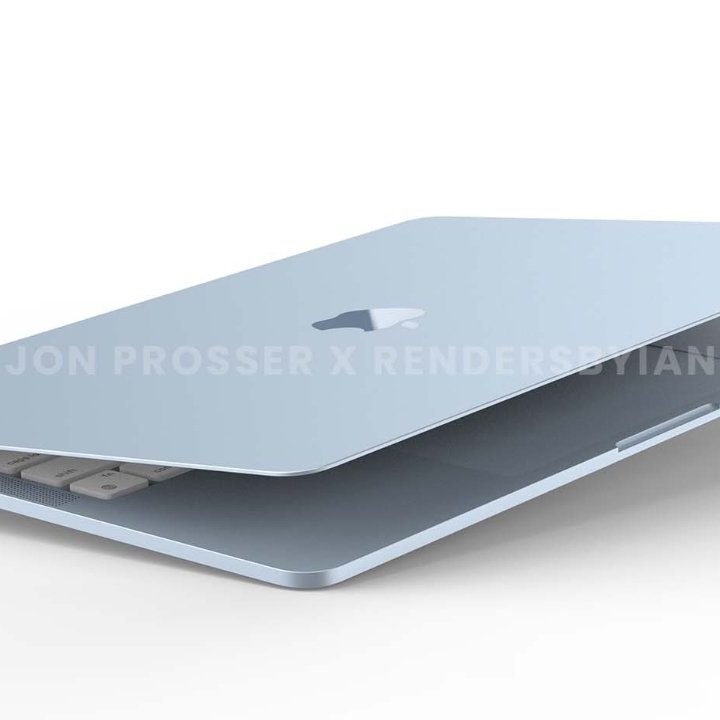
If you believe the latest leaks and renders, the next MacBook Air is about to take a lot of inspiration from the new iMac. The images come from leaker Jon Prosser’s Front Page Tech, and they show the new devices sporting the radical new design. According to Prosser, these are artist renderings he had made based on what he was shown from his own source.
The imagery shows several major changes to the current MacBook Air design, starting with your choice of one of seven available colors. The options appear to be Silver, Blue, Yellow, Orange, Pink, Purple, and Green. Sound familiar? Yep, these are the same options you get on the new iMacs. However, the depicted colors aren’t nearly as bold as what the iMac ended up sporting.
Before the launch of the iMac, Prosser leaked similar renders about the new color options. The actual colors of the iMac ended up being much bolder, and offered a different tone on the front side.
You don’t have to trust the source to see why these new color options are a likely possibility for the next MacBook Air. Apple rarely devises an entire new design scheme without plans to roll it out on other products. Matching the MacBook Air with the 24-inch iMac feels like the right fit, especially if Apple is interested in distinguishing these products from the Pro-level options.

The bezel and keyboard color is also a major departure from the current MacBook Air. The renders show very thin, white bezels, as well as white keycaps. The imagery bears a lot of resemblance to the Razer Book 13, which features a silver chassis and white keyboard. The white bezels were one of the most divisive design elements of the new iMacs.
It’s common to see ultrathin bezels on future product renderings, and Prosser admits that the size of the bezels were largely a guess based on what he was shown. In this case, though, it wouldn’t be hard to believe. Other 13-inch laptops with 16:10 displays already feature bezels this thin, including the Dell XPS 13andr Razer Book 13. The new iMac has a large bottom bezel, but that’s a design restraint of the all-in-one form factor, which forced Apple to stuff the components into the space below the screen to keep the back thin.

Of course, these renderings also show a much thinner chassis, which Prosser says is just tall enough to fit the USB-C port. Apple’s first M1 MacBook Air reused the same chassis as the Intel-based MacBook Air. Despite being completely fanless, the chassis was large enough to fit fans inside, meaning a thinner MacBook Air that’s designed around the M1 is fairly believable. Prosser says the new MacBook Air, though, will come with the second-generation M2 chip.
We don’t know for sure when the next MacBook Air will come out. The next-generation M-chips have already gone into mass production, pointing to a launch in the next few months, possibly at the Worldwide Developers Conference in June, or perhaps in the fall.
The current MacBook Air was updated in October 2020 with the inclusion of the M1 chip, alongside the MacBook Pro and Mac Mini.