  1. Home
  2. Computing
  3. Legacy Archives

IBM’s Watson To Compete in Jeopardy This Fall

Add as a preferred source on Google

It’s been over a year since we last heard from Watson, IBM’s in-house supercomputing project designed to be a question-ansewring system rather than a mere search engine: the idea behind Watson is to take an actual question, expressed in everyday vernacular, and pull up the actual answer to that question, not just a list of resources where it thinks related information might be available. Now, word comes from the New York Times that Watson is gearing up to make its debut on the classic television quiz show Jeopardy this fall…and it will be competing against flesh-and-blood trivia buffs in real time.
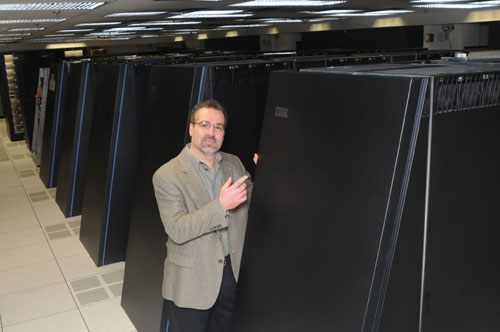
Image used with permission by copyright holder

Although initial plans were announced last year, Jeopardy producers have finally given the green light to the matches. Like regular Jeopardy contestants, Watson will have to answer in the form of a question, and the system “knows” only the information available to it locally in its electronic corpus of data: Watson won’t be connected to the Internet and won’t be allowed to Google. In IBM’s mock Jeopardy set, Watson is receiving the questions as text data at the same time human players get them, and Watson is answering questions using speech synthesis. It’s not clear whether Watson gets some extra time by receiving questions as text: in real life, Jeopardy players have to speed-read questions from a distance (and kinda try to tune out host Alex Trebek), but can only buzz in once the host is done reading.

Recommended Videos

Watson’s technology is more than a search engine: although engineers at IBM have loaded up Watson’s hardware (and there is a lot of hardware) with copious amounts of digital information, Watson does more than merely locate documents or files that might have information related to a question: Watson has to parse the clue, figure out the specific item of information targeted by the question, then apply its knowledge base to ferret out exactly that bit of information. Such question-answering systems have been attempted by computer scienctists for decades; however, real-time trivia contests like Jeopardy have always been considered a tough nut to crack due to the breadth of questions, along with the show’s consistent use of puns, wit, visual and musical clues, and oddball categories that often have players associating very disparate bits of knowledge.

It isn’t the first time IBM has thrown supercomputers at tough problems: IBM famously took on chess grandmaster Gary Kasparov over a decade ago with Deep Blue…and won.

Geoff Duncan
Former Contributor
Geoff Duncan writes, programs, edits, plays music, and delights in making software misbehave. He's probably the only member…
AI may have just won a literary prize. My heart weeps seeing it poison our love for books.
updated book and AI photo

I had a hard time processing this news. As someone who has been deeply in love with stories since childhood and who grew up on the works of Arthur Conan Doyle, Terry Pratchett, J.R.R. Tolkien, and other such venerable authors, seeing an AI-written story win a prestigious writing award is hard to digest. 

If you are unaware, the winners for the Commonwealth Short Story Prize for 2026 were announced, and three of the five winning regional stories have been found to be entirely or partially written by AI. Or at least that seems to be the consensus among readers. As a reader and an amateur fiction writer, this hurt me deeper than any other tale of AI corroding our lives.

Read more
Canva and Adobe are coming to Gemini, and they want to make everything chatty
Adobe and Canva are plugging into Google’s assistant, betting that creative work starts with a prompt, not an app icon
Art, Collage, Photography

Canva and Adobe are moving deeper into Google Gemini, giving the assistant a bigger role before users ever open a design app.

Adobe says its "Adobe for creativity" connector is coming to Gemini in the coming weeks, giving users a way to describe tasks and send them through Adobe tools for imaging, design, and video. Canva is already rolling out its Connected App for Gemini in select English-language markets, with full availability coming soon.

Read more
AI can pass the Turing Test in live chats and appear more human than us. I am spooked now
UC San Diego researchers found GPT-4.5 was judged human 73% of the time in live conversations
Image of a human woman next to an AI-generated face with Real or Fake text at the bottom.

AI can pass the Turing Test in live chats, and the latest result lands with a chill. In a UC San Diego study, GPT-4.5 outperformed real participants at convincing judges there was a person on the other side.

The setup was harder to shrug off than a standard benchmark. Judges reacted to real-time exchanges rather than static prompts, then made a fast call based on conversation alone.

Read more