
Apple’s focus has recently been on its iPad and iPhone product lines, but the company has finally turned its attention to its mainstream desktop computer line, announcing speedier, updated iMacs with powerful graphics and options including SSD drives, a quad-core processor…and they’re available with a new Magic Trackpad that gives uses the option to use notebook-like multitouch gestures to control their apps and computers.

“We took the world’s best all-in-one and made it even better,” said Apple senior VP of worldwide product marketing Philip Schiller, in a statement. “With the latest processors, high-performance graphics and signature aluminum and glass design, customers are going to love the latest iMac.”
Apple’s all-in-one iMacs come with built-in displays—to all appearances, they’re little more than displays. Apple’s updated iMacs maintain their 21.5-inch and 27-inch screen sizes: the 21.5-inch models have a 1,920 by 1,080-pixel native resolution while the 27-inch models stretch out to 2,560 by 1,440 pixels. The new iMacs also sport ATI Radeon HD discrete graphics (ranging from the Radeon HD 4670 with 256 MB of video memory up to the Radeon HD 5750 with 1 GB of video memory), a minimum of 4 GB of RAM (supports up to 16 GB), 500 to 1 TB SATA hard drives (a 256 GB SSD option is available for the 27-inch iMac as a primary or secondary drive), and the usual raft of iMac features: 8× DVD±RW Super Multi Drive, 802.11n and Bluetooth wireless networking, gigabit Ethernet, an SD slot (now supports SDXC), four USB 2.0 ports, a FireWire 800 port, integrated iSight camera, Mini DisplayPort output, and 17-watt integrated speakers.
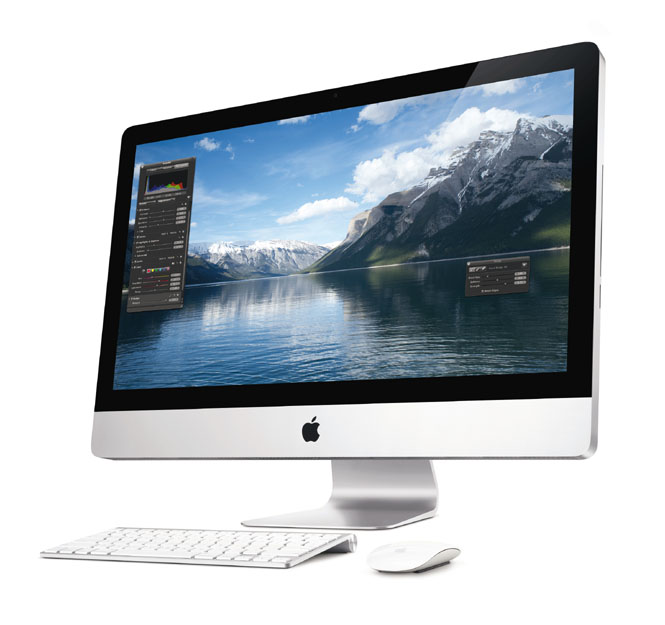
Apple is offering four primary iMac configurations; each can be customized (to a degree) via build-to-order options. At the low end, the $1,199 21.5-inch iMac sports a 3.06 GHz Core i3 processor, 500 GB hard drive, 4 GB of RAM, and ATI RAdeon HD 4760 graphics; $1,499 will step up to a 3.2 GHz Core i3 processor (a 3.6 GHz Core i5 is available as an option), a 1 TB drive, and ATI Radeon HD 5670 graphics with 512 MB of video RAM. Moving to the 27-inch displays, $1,699 will buy a 3.2 GHz Core i3 system with 4 GB of RAM, a 1 TB hard drive, and $1,999 will get a 2.8 GHz quad-core Core i5 with the Ati Radeon HD 5750 graphics controller and 1 GB of video memory. The 27-inch models can be customized with a 3.6 GHz Core i5 or a 2.93 GHz Core i7 processor, respectively.
The iMacs are retaining their stunning displays with wide viewing angles and glossy screens; however, media fans may notice one thing missing from the iMacs and their options: Blu-ray drives. Although there are third-party Blu-ray drives available for Macs, Apple has yet to ship Blu-ray as a standard or optional components with its machines.

With the new iMacs, Apple is also introducing the Magic Trackpad—although it can be used with any Mac, not just the new iMacs. The Magic Trackpad is designed to enable desktop computer users to have all the input capabilities of trackpad-equipped notebook computers, using multitouch gestures to to click, scroll, swipe, and even rotate items within applications that support multitouch. The Magic Trackpad communicates via Bluetooth (no cabled option, for folks who don’t like swapping batteries) and features a glass surface and aluminum frame that matches Apple’s existing keyboard lines: it’s available for $69.


