  1. Home
  2. Computing
  3. Legacy Archives

IBM’s Watson gets job in health care

Add as a preferred source on Google

It didn’t take long for IBM’s demonstration of the question-answering prowess in the Jeopardy-winning Watson system to find some backers: IBM has announced a deal with Nuance Communications to apply Watson’s Deep Question Answering technology the healthcare field. The research partnership will also address one of the key shortcomings Watson demonstrated on Jeopardy, combining Watson’s analytical skills with speech recognition technology so the system can understand what people say, rather than having to have queries posed to it as pure text.
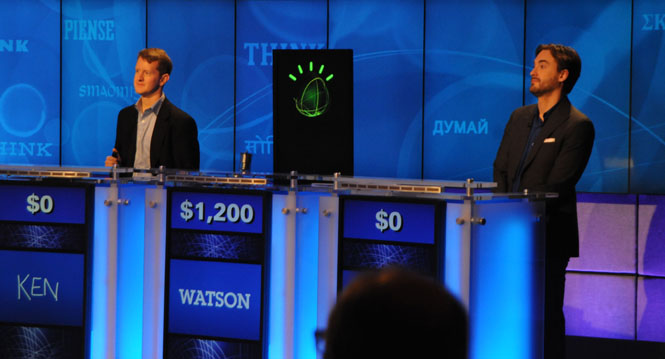
Image used with permission by copyright holder

“Combining our analytics expertise with the experience and technology of Nuance, we can transform the way that healthcare professionals accomplish everyday tasks by enabling them to work smarter and more efficiently,” said IBM senior VP and director of research Dr. John E. Kelly III, in a statement. “This initiative demonstrates how we plan to apply Watson’s capabilities into new areas, such as healthcare with Nuance.”

Recommended Videos

The Columbia University Medical Center and the University of Maryland School of Medicine will also work on the project. Nuance and IBM hope to have the direct products based on the technology ready to come to market in 18 to 24 months. The project will also leverage Nuance’s Clinical Language Understanding solutions to improve Watson’s understanding of medical vocabulary and terminology.

The healthcare industry’s interest in Watson comes from the system’s seeming ability to quickly process information available in natural language—rather than deliberately encoded for computer processing—and make rapid, high-level connections between key items of information from disparate sources. The technology could be applied to help healthcare professional keep up with the vast amounts of clinical data and scientific research being published in the healthcare field every day; looking forward, Watson technology could be applied to some of the applications that have along been envisioned for so-called “strong AI” systems, like drug interactions and real-time diagnoses.

[Image: IBM]

Geoff Duncan
Former Contributor
Geoff Duncan writes, programs, edits, plays music, and delights in making software misbehave. He's probably the only member…
AI may have just won a literary prize. My heart weeps seeing it poison our love for books.
updated book and AI photo

I had a hard time processing this news. As someone who has been deeply in love with stories since childhood and who grew up on the works of Arthur Conan Doyle, Terry Pratchett, J.R.R. Tolkien, and other such venerable authors, seeing an AI-written story win a prestigious writing award is hard to digest. 

If you are unaware, the winners for the Commonwealth Short Story Prize for 2026 were announced, and three of the five winning regional stories have been found to be entirely or partially written by AI. Or at least that seems to be the consensus among readers. As a reader and an amateur fiction writer, this hurt me deeper than any other tale of AI corroding our lives.

Read more
Canva and Adobe are coming to Gemini, and they want to make everything chatty
Adobe and Canva are plugging into Google’s assistant, betting that creative work starts with a prompt, not an app icon
Art, Collage, Photography

Canva and Adobe are moving deeper into Google Gemini, giving the assistant a bigger role before users ever open a design app.

Adobe says its "Adobe for creativity" connector is coming to Gemini in the coming weeks, giving users a way to describe tasks and send them through Adobe tools for imaging, design, and video. Canva is already rolling out its Connected App for Gemini in select English-language markets, with full availability coming soon.

Read more
AI can pass the Turing Test in live chats and appear more human than us. I am spooked now
UC San Diego researchers found GPT-4.5 was judged human 73% of the time in live conversations
Image of a human woman next to an AI-generated face with Real or Fake text at the bottom.

AI can pass the Turing Test in live chats, and the latest result lands with a chill. In a UC San Diego study, GPT-4.5 outperformed real participants at convincing judges there was a person on the other side.

The setup was harder to shrug off than a standard benchmark. Judges reacted to real-time exchanges rather than static prompts, then made a fast call based on conversation alone.

Read more