  1. Home
  2. Emerging Tech
  3. Web
  4. Legacy Archives

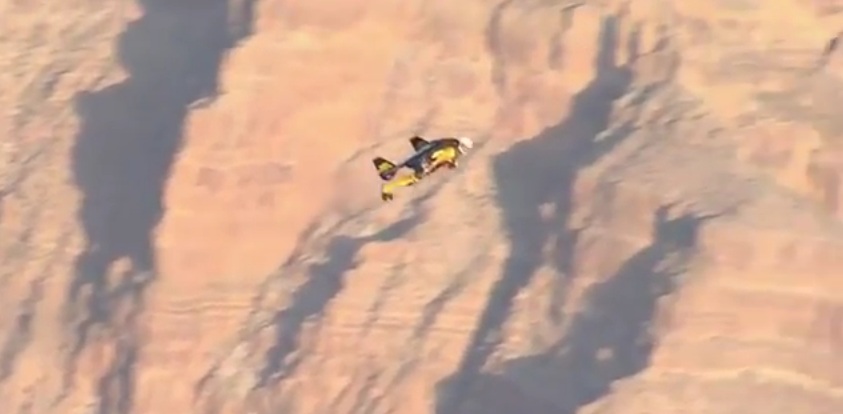
Real-life Rocketeer flies over the Grand Canyon with a jet pack

Add as a preferred source on Google

grand-canyon-ives-rossy-jetman-jetwingThere are flight simulators, and then there’s the “Jetman.” Yves Rossy, an inventor and flying daredevil, used his own winged jet pack to fly around the Grand Canyon yesterday morning, reports Popular Science. Diving off a helicopter about 8,000 feet from the bottom of the canyon, Rossy dived for a bit and then started up his winged contraption and used the rudder-based steering to level himself off. During his eight minute flight, he hit speeds of 190 miles per hour as he soared about 200 feet above the rim of the canyon.

Rossy’s flight was originally scheduled for last Friday, but it was scrapped when the FAA got involved. The Federal Aviation Agency didn’t know how to classify Rossy’s winged jet pack, which he thought of and designed himself.

Recommended Videos

This marks Rossy’s first “jetwing” flight in the United States, but the Swiss daredevil been pulling aerial wonders oversees for years. In 2006, he became the first person to sustain human flight when he flew across Bex for six minutes and nine seconds. In 2008, he successfully flew across the English Channel, a nine minute and seven second flight. He also flew over the alps that year. In 2010, he attempted to fly across the Strait of Gibralter to claim the title of the first man to fly across continents, but had to abort the flight and crash land in the sea due to high winds. He was unhurt.

When Rossy isn’t flying himself, he’s piloting planes. He has served as a fighter pilot in the Swiss Air Force, but currently pilots an Airbus A320 for Swiss International Air Lines.

Jeffrey Van Camp
As DT's Deputy Editor, Jeff helps oversee editorial operations at Digital Trends. Previously, he ran the site's…
Sony’s table tennis robot made me think about what happens when AI gets a body
Ace starts as a flashy sports demo and quickly turns into a preview of AI moving from screens into factories, hospitals, farms, and homes
Ball, Sport, Tennis

I wanted to dismiss Sony’s table tennis robot as another expensive lab flex. A machine that can rally against elite players is impressive, sure, but it also sounds like the kind of demo built to make executives clap in a room where everyone already agreed to be impressed.

But table tennis is a nastier test than it looks. The ball is small, fast, spinning, and rude enough to change direction the moment it hits the table. Sony’s system faces something less forgiving than calculation. It has to see, predict, and act before the point is gone.

Read more
Scientists pretended to be delusional in AI chats. Grok and Gemini encouraged them.
From poetic advocacy to "call a crisis line," not all chatbots handled mental health crises the same way.
statue hugging its knees

Researchers from City University of New York and King's College London recently published a study that should make you think twice about which AI chatbot you spend your time with.

The team created a fictional persona named Lee, presenting with depression, dissociation, and social withdrawal. They then had Lee interact with five major AI chatbots: GPT-4o, GPT-5.2, Grok 4.1 Fast, Gemini 3 Pro, and Claude Opus 4.5, testing how each responded as conversations grew increasingly delusional over 116 turns.

Read more
Musk’s SpaceX eyes GPU manufacturing as Nvidia’s supply becomes a headache
SpaceX has big GPU dreams and even bigger IPO dream to back them up.
City, Architecture, Building

SpaceX is reportedly planning to manufacture its own GPUs, the chips that power artificial intelligence. The revelation comes from excerpts of its S-1 registration, a document companies file with the U.S. Securities and Exchange Commission before going public. 

As reported by Reuters, SpaceX lists "manufacturing our own GPUs" among its biggest capital expenditures in the future. This comes a month after Elon Musk announced its own TeraFab chip factory focused on developing chips that can survive the harsh conditions of space and power its orbital AI data centers. 

Read more