  1. Home
  2. Emerging Tech
  3. Web
  4. Legacy Archives

$100,000 jetpack flies to 5000 ft, successfully deploys parachute

Add as a preferred source on Google

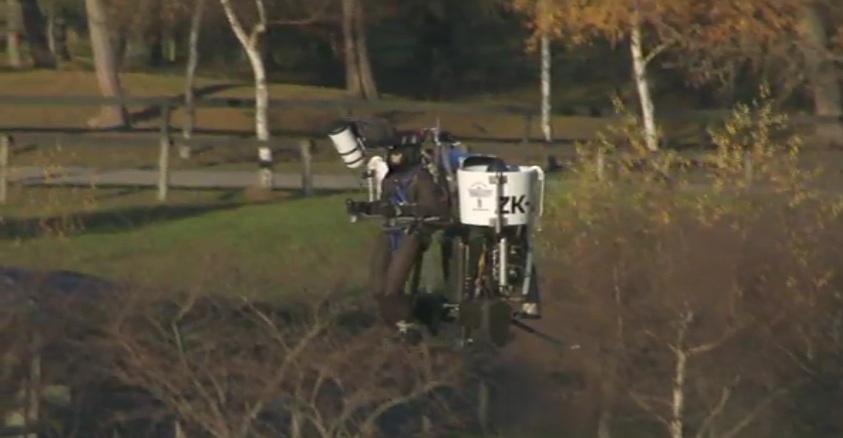
jetpack-martin-aircraft-companyJames Bond got his first jetpack in 1965. It’s been half a century, but it looks like the rest of us might finally get our chance to fly. On May 21, the Martin Aircraft Company successfully piloted its latest prototype jetpack to an altitude of 5,000 feet (1,500 meters) for nearly 10 minutes above Canterbury, New Zealand, achieving a climb rate of 800 feet per minute (4 meters per second). The feat is all the more impressive considering their previous test jetpacks never flew higher than 50 feet.

“This successful test brings the future another step closer,” said the jetpack’s inventor, Glenn Martin.

Recommended Videos

Martin is hoping to commercialize his new jetpack, which comes with a feature jetpacks have needed for years: a parachute. Strapping yourself to a rocket and blasting into the sky has always looked fun, but its dangers are fairly obvious. If the engine cuts out, you would fall like a rock. Martin hopes to change this when he sells his flying machine for a cool $100,000.

This flight comes only weeks after another daredevil who calls himself the ‘Jetman’ successfully flew his own winged jetpack through the Grand Canyon. However, while he flew for some time, that particular jetpack needs to be released from a plane or helicopter to operate. Martin may have a leg up (literally), as his jetpack is capable of lifting off and landing on its own.

The Back to the Future movies imagined that we’d already have flying cars by now. We still don’t, but if you have $100K saved up, you may not need one.

Jeffrey Van Camp
As DT's Deputy Editor, Jeff helps oversee editorial operations at Digital Trends. Previously, he ran the site's…
Scientists pretended to be delusional in AI chats. Grok and Gemini encouraged them.
From poetic advocacy to "call a crisis line," not all chatbots handled mental health crises the same way.
statue hugging its knees

Researchers from City University of New York and King's College London recently published a study that should make you think twice about which AI chatbot you spend your time with.

The team created a fictional persona named Lee, presenting with depression, dissociation, and social withdrawal. They then had Lee interact with five major AI chatbots: GPT-4o, GPT-5.2, Grok 4.1 Fast, Gemini 3 Pro, and Claude Opus 4.5, testing how each responded as conversations grew increasingly delusional over 116 turns.

Read more
Musk’s SpaceX eyes GPU manufacturing as Nvidia’s supply becomes a headache
SpaceX has big GPU dreams and even bigger IPO dream to back them up.
City, Architecture, Building

SpaceX is reportedly planning to manufacture its own GPUs, the chips that power artificial intelligence. The revelation comes from excerpts of its S-1 registration, a document companies file with the U.S. Securities and Exchange Commission before going public. 

As reported by Reuters, SpaceX lists "manufacturing our own GPUs" among its biggest capital expenditures in the future. This comes a month after Elon Musk announced its own TeraFab chip factory focused on developing chips that can survive the harsh conditions of space and power its orbital AI data centers. 

Read more
Autonomous cars were supposed to free us from traffic hell. Research says otherwise
The self-driving dream might just be a traffic nightmare in disguise.
Self driving car from Waymo

Self-driving cars promised a future where you sit back, relax, and glide past the gridlock while the car handles everything. A new study from the University of Texas at Arlington has some bad news for that fantasy. According to research, widespread adoption of autonomous vehicles could actually make traffic significantly worse.

Professors Stephen Mattingly and Farah Naz conducted a meta-analysis on how self-driving cars could affect vehicle miles traveled (VMT). Their findings showed an average 5.95% increase in vehicle miles traveled. Non-shared autonomous vehicles pushed that figure even higher, to nearly 7%. 

Read more