
OlliOlli World delights as a side-scrolling skateboarding game where players travel through the land of Radlandia in order to become a skate wizard and enter the mystical land of Gnarvana. It puts players into a flow state where they tune out of everything else and focus solely on its mesmerizing gameplay. As the game pulls this off so well, it’s not surprising that developers got caught up in that feeling when designing OlliOlli World‘s masterful levels.
“When you’re designing a level, you’re entering a flow state as you build this thing,” Senior Designer Sam Robinson told Digital Trends in an interview prior to OlliOlli World‘s launch. “So then the next thing you decide to implement is what you feel is right. It’s almost like you stop making conscious decisions. You may put a slope in, so then you put a ramp, and then that takes you to an unexpectedly high place, so now you’ll put something up there.”
He added: “It’s almost like the game is telling you how it wants to be laid out as you’re making it.”
OlliOlli World is one of the first critically acclaimed indie games of 2022, with fantastic levels matching the quality of games like Celeste or Sonic Mania. I wanted to learn just what makes the game tick, and Sam Robinson revealed how the structure of OlliOlli World’s levels ensures players will never want to put the game down.
The secret formula
Robinson told Digital Trends that he knows exactly what makes an excellent OlliOlli World level: Its identity. “Identity makes the level feel like a character in the world,” he said. “Even before it has been altered and is still in its gray box state. You can look at it and go, ‘I know what that level is.'”
“When you’re designing a level, you’re entering a flow state as you build this thing …”
One of the main parts of a level’s identity is its structure. The developers nailed down a three-act design that consistently yields fantastic results, making it the secret formula behind the game’s success.
“A level is 60 seconds long and will be split into three acts,” Robinson said. “There’ll be two checkpoints between them. In the first act, I would introduce something that hasn’t been done in the previous level — it might be a different-shaped grind or an uphill grind — and then that becomes the identity of the level. I’ll mutate and remix that for the second act, and then for the third act, I’ll make it a bit more extreme and outlandish. It’s technically harder in the second and third act, but because they’ve learned how to deal with it in the first act, they’re ready for it.”
According to Robinson, the designers can then break down each act into an entry section, trick section, and exit section. Overall, the nine sections of each level ensure that OlliOlli World has a gradual difficulty curve that is constantly building on what players know. Robinson even used this formula when designing the procedurally generated levels of Gnarvana, as the game can stitch these nine parts together to make entire levels.
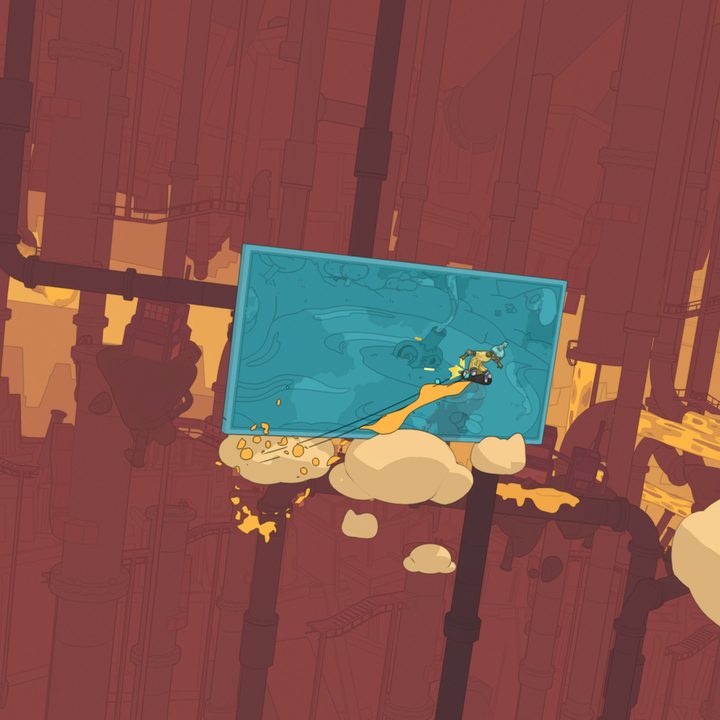
It also sets boundaries, so the developers at Roll7 understand when levels don’t work. “A level is only 60 seconds long and may take longer if you respawn or slam, so if I make a level that’s one minute and thirty seconds, it feels way longer than a normal level,” he said. Speed is also an important factor that Roll7 considered with both handcrafted and procedurally generated levels.
“When you’re entering and exiting a section, the speed should always be the same,” he said. “I could slow the player down in the trick section, but I’d need to speed them back up again. As long as it’s always acting out at the specific speed I set, it should work.”
Taking the gnarly route
Slowly but surely, the game gets more and more complex with layers upon layers of mechanics. A key pillar of the game’s development was “exploration,” so OlliOlli World levels have multiple routes. Those offshoots are called “gnarly routes” that reward player skills. Finding the right way to implement these was challenging for the development teams.
“Once we introduced branching paths, we couldn’t just stop doing branching paths because the player will expect that it’s going to carry on,” Robinson said. “The tricky thing early on was figuring out where was a reasonable place to branch paths. We figured out that right after a checkpoint is a good place to do it because if they go the gnarly route, and they have regrets about taking that direction, they can at least go back and change their mind to go with the critical route.”

Gnarly routes are also part of OlliOlli World‘s difficulty curve, which the developers intentionally wanted to be more accessible than previous games in the series.
“I remember I got to the end of OlliOlli 2, and it was so difficult to play through,” Robinson said. “I consider myself a competent gamer, and I couldn’t get through the last world at all. When I joined this company, they conveyed to me that they weren’t happy with the difficulty spiking in that game because it means people won’t play 50% of the game. They didn’t want to do that this time; they wanted to make it completely accessible and welcoming to everyone.”
“It’s quite challenging to make levels that make you feel like a badass but are also holding your hand at the same time.”
This impacted mechanics like having less punishing manuals. It also influenced level design, which accommodates for skill throughout its three acts and the mainline, as well as gnarly routes within them. Working with the art team was also a significant factor in the design. Gnarly routes couldn’t make levels too visually cluttered, and level layouts couldn’t overwhelm artists with too many kinds of platforms and shapes.
Nothing but Sunshine
OlliOlli World features five distinct worlds to skate through, and Robinson’s favorite is Sunshine Valley, the first place players will see. He not only got to collaborate with fellow designers on it but also thought it balanced tutorials and thrills well.
“It’s quite challenging to make levels that make you feel like a badass but are also holding your hand at the same time,” he said. “Sunshine Valley uses a minimal amount of mechanics because the game introduces new ones in every chapter. It is mainly about grinds, moving platforms, and seesaws. Clover Brook, the next chapter, introduces wall rides, so designing all of Sunshine Valley without wall rides was challenging but rewarding once I’d done it. It’s also a wholesome place and a lovely, glorious town.”

From Sunshine Valley to the procedurally generated levels of Gnarvana, OlliOlli World is a joy throughout. And thankfully, this whole creation process was enjoyable for the development team.
“It has been really refreshing working on this project because it has just gone so smoothly throughout the whole thing,” Robinson said. “When you make a game, it’s in milestones, and every milestone has been delivered on time. We reached alpha on time, we reached beta on time, and breezed through all the submissions. It was relatively stress-free, which is unusual.”
Robinson hopes players enjoy playing the game as much as he does, and if early reviews are any indication, they will certainly like OlliOlli World and its excellent levels.
“It’s just a super good universe,” he concludes. “It’s very vibrant. It’s very upbeat. Even when you’re slamming, there’s a banana dancing in the background. It’s just been a joy to work inside of and play in. I’m looking forward to getting it out there and people enjoying it because I think people will really love it.”
OlliOlli World launches on February 8 for PC, PS4, PS5, Xbox One, Xbox Series X, and Nintendo Switch.


