
Intel finally lifted the curtain on its discrete Arc Alchemist graphics cards in a special livestream on Wednesday. The first cards showing up are specifically for laptops, and they’re from the lowest class of GPUs Intel is offering. From what little we know right now, though, they should have Nvidia and AMD worried.
Before getting to performance, let’s look at the Arc Alchemist mobile range.
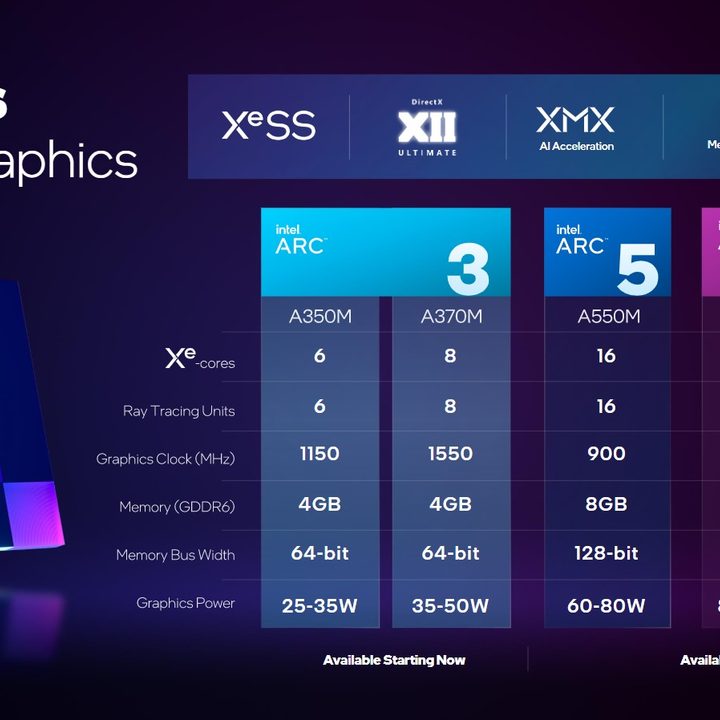
As was anticipated based on rumors about Arc Alchemist, Intel is leading the launch with its Arc 3-class GPUs. There are two models here, both targeting thin and light laptops that need a discrete graphics card. Intel highlighted the Samsung Galaxy Book 2 as one of the first models available (it was unintentionally shown off ahead of the announcement).
Moving up the range, there’s the Arc 5 and Arc 7, which will arrive in early summer. The flagship A770M chip could be targeting Nvidia’s RTX 3080 Ti mobile. Both come with 16GB of memory and a 256-bit bus, which hints at how high Intel’s range may go. Intel hasn’t made that comparison, however.
Intel says Arc 3 GPUs are competing with cards like the RX 6500M and RTX 3050. In practice, that means gaming at 1080p with medium settings, targeting at least 60 frames per second (fps). Intel’s first-party benchmarks show that 60 fps at 1080p is possible with Arc 3 GPUs.

We always recommend waiting for third-party benchmarks before drawing any conclusions about performance. Intel’s tests are enticing, though, showing respectable performance in even demanding titles like Hitman 3 and Doom Eternal.
Compared to Nvidia’s mobile offerings, Intel is taking an interesting approach with Arc Alchemist. Nvidia allows laptop designers a range of power limits for its graphics cards, which makes a huge difference in performance. That’s why the RTX 3080 Ti in the Gigabyte Aero 16 doesn’t perform as well as the one in the MSI Raider GE76. Intel is offering a range as well, but the company clarified that the listed specs are for the lowest graphics power possible. That means most cards should run faster than Intel’s listed specs.
Like the desktop range, all Arc Alchemist mobile graphics cards support hardware ray tracing, variable rate shading, and Intel’s XeSS upsampling technology. XeSS isn’t coming at launch, however; despite revealing new games that will support the feature, like Ghostwire Tokyo and Shadow of the Tomb Raider, Intel said the feature won’t arrive until early summer.
Along with the graphics cards themselves, Intel announced more details about the software supporting them. Intel Arc Control is a one-stop shop for drivers, tuning, and game settings, according to Intel. It functions as an overlay, similar to Nvidia GeForce Experience. Unlike GeForce Experience, however, Arc Control doesn’t require users to log in.
It’s mainly a vessel for drivers, but Intel said Arc Control will also show performance data about your system and provide tools for streamers. You can stream directly from the software and use A.I.-enhanced camera features like background blur, background replacement, and auto framing. Intel also said users can adjust performance here with desktop graphics cards, suggesting that there will be controls for overclocking.
The first Intel Arc Alchemist laptops are available to purchase today, and Intel says several more models will release before the other cards arrive this summer.


