

The uncanny valley is a theory that attempts to explain the feeling of uneasiness or creepiness we’ve all experienced when we see a video game, movie, or robot that looks extremely human. Video games, movies, and robotics are continually present us with creations that look more and more human-like. Have you ever seen The Polar Express or Final Fantasy: The Spirits Within? Or perhaps you’ve played one of the many hyper-realistic video games out today or seen creepy Japanese androids. It’s often endearing when we see things act human, like the toys in Toy Story or R2D2, but the more human they look, the harder it is to not notice and get creeped out by the small ways they are not human. This uneasiness, or unlikability, is amplified with movement.
The phenomenon has often been explained using the graph below, which shows that there’s a point when our brain stops seeing something as a cute creation that mimics humanity and starts instead counting out its flaws and making us feel mighty unpleasant.
 Scientists now believe they’ve figured out what causes the uncanny valley response. Researchers at the University of California, San Diego, used an MRI to scan the brains of 20 people as they were shown 12 videos of a hyper-realistic android robot doing things like waving, nodding, drinking water, and picking up a piece of paper, reports Science Daily. Then they were shown those same actions performed by a human that looked identical to the android (many androids are built in the image of their creator, it seems). Finally, the subjects watched that same android perform the tasks again, but this time without any of the fake skin or eyes–meaning the androids looked a lot less human and more robotic.
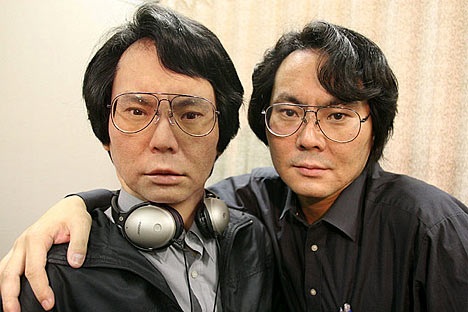 The results suggests that the uneasiness we feel could be caused by a “perceptual mismatch between appearance and motion.” Basically, the brain seemed to negatively react like crazy when the robotic motions of the android didn’t match its human-like appearance.
“The brain doesn’t seem tuned to care about either biological appearance or biological motion per se,” said Saygin, an assistant professor of cognitive science at UC San Diego. “What it seems to be doing is looking for its expectations to be met — for appearance and motion to be congruent.”
Unfortunately, we still don’t entirely know why our brain hates this inconsistency, but if movies and video games are any indication, our brains may be able to get used to the oddness of our human-like creations in time. Games like L.A. Noire have found success by somewhat reducing the uncanny valley effect by drastically improving the facial and body animation of its characters. Faster animation in motion-capture CGI films like the upcoming Spielberg film The Adventures of Tintin are also working around this odd phenomenon. Unfortunately, we don’t quite know if our brains will ever truly accept fake humanoids until they are completely indistinguishable from ourselves.
Have you experienced the uncanny valley? Does it not bother you anymore? Has it never bothered you?


