Survival crafting games have a habit of coming out of nowhere and being really enjoyable and popular. In 2021, Valheim took the gaming world by storm. This year, V Rising’s vampiric take on the formula is one of 2022’s biggest gaming surprises. Inflexion Games and Tencent’s Level Infinite hope that Nightingale is the next one of those hits. This first-person survival crafting game makes players a Realmwalker, someone who forages, fights, creates, and survives in the Faewild realms of their own creation in hopes of finding the titular, mythical city of Nightingale.
While the game looks like it’s in good shape, it has had an unusual development as it started as a cloud game under Improbable before completely shifting into a more traditional survival game. Still, throughout all of those changes, Aaryn Flynn was at the game’s helm. Flynn made a name for himself at BioWare, where he was a programmer on games like Baldur’s Gate 2 and Jade Empire before becoming General Manager of the studio in between Dragon Age: Origins and Mass Effect: Andromeda.
Nightingale is Flynn’s first game since leaving BioWare. Digital Trends spoke to Inflexion Games’ CEO Aaryn Flynn at Summer Game Fest Play Days to learn more about how his BioWare experiences influenced Nightingale, how the game will stand out in the crowded survival crafting genre, and just how much of that original cloud gaming vision remains.
Digital Trends: Nightingale is much different than anything you worked on at BioWare. What are some of the biggest lessons you took from BioWare for this game?
Arynn Flynn: One of the things we made sure we did, having learned some things at BioWare, was that around the topic of worldbuilding. We created a world of our own creation, full of interesting characters and relatable elements. That’s why we chose a contemporary fantasy setting. When you do something more like high fantasy or sci-fi, you have to establish the rules of that universe more fully, so players understand them. With contemporary fantasy, we get more relatability from the get-go, and from there, we can layer on great worldbuilding, interesting characters, and stories to engage with.
What are the biggest challenges you’ve encountered switching from creating traditional RPGs to a survival game?
We’ve definitely learned a lot and are still learning. One of the most important elements in a survival game, in my mind, is player autonomy. Players get to go where they want to go and do what they want to do while engaging with the building and crafting. We need to make sure the player always feels like they always have options and have something to do is fundamental to the experience.
When you think about it, great role-playing games also offer choice, right? And so we’re trying to adjust a lot of the lessons we learned about giving players meaningful choices but put it closer to the gameplay and things that are important to survival crafting players. It’s been an interesting challenge for us, but hopefully, players will really appreciate what we did.
How has the recent success of games like Valheim and V Rising influenced the development of Nightingale?
The success of Valheim and V Rising is very encouraging and is really great for those wonderful teams and inspiring for our developers. Unlike Valheim, which has the rich Nordic lore to draw upon, and V Rising, where pretty much everyone knows what vampires are, we have to establish a lot more background information so players can appreciate the Victorian gaslamp setting.
That’s why we chose alternate history, where a lot of our world’s history is present, but we added in the complications of magic and the Fae. That ultimately become the fun of worldbuilding again.
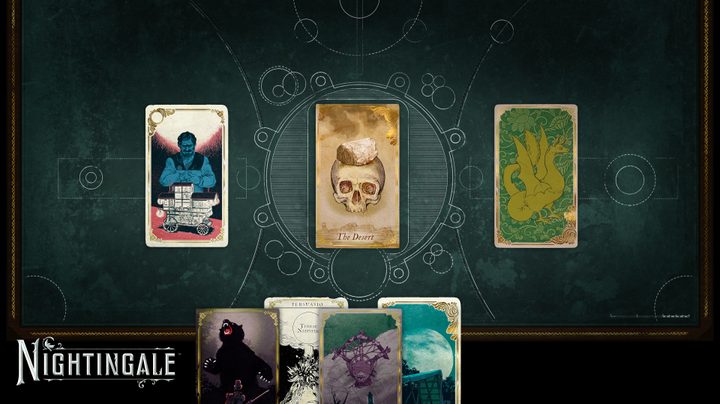
Could you explain the Realm Card system that lets players create realms to explore in more detail?
Realm cards are a way we give players more agency in their experience. We procedurally generate Nightingale’s realms, so all of the realms you see in our trailers were created by our software stack after our environment artists worked hard to create the components of it. The Realm Cards allow players to manipulate, control, and change those things from a huge pallet of options. It lets players choose things like what biome they’re going to go to, whether it’s daytime or nighttime, what weather challenges there are, and what bonuses or buffs there might be.
When you open a portal and go through it, what’s on the other side is reflective of what you played with the Realm Cards. It’s also very social because if we were playing together, you could put a card down, I could put a card down, and they will be mixed together. So it encourages cooperative play and becomes the way we offer more agency to our players.
So, does that make it a survival game where you’re supposed to be constantly moving, or can players settle down and build if they want to?
We definitely want you to settle down so you don’t have to move your estate. I think a lot of players will want to do that and keep growing it. One thing players can do is go through realms and bring back resources to continue building their estate. Or, you can leave your estate behind to build another one in a new realm with some friends. Both options are available to you.
How has Nightingale evolved since Inflexion made the transition from Improbable to Tencent and Level Infinite?
The core gameplay is very much the same, but the big thing we did was that we stopped investing in Improbable’s technology and a shared world experience that had hundreds and hundreds of players simultaneously in it. It was pretty cool, but it became less of a priority for us as we wanted to give players a small group cooperative experience that survival crafting players love.
So, is there any cloud gaming technology left in Nightingale at this point?
No, it’s all gone now. That’s been good for us because it gets us to focus on what’s best for the player and makes Nightingale less technologically complicated to build.
This is the first brand new IP you’ve worked on in some time, so what’s the process been like making a new world from scratch?
It’s a privilege to get to do that. There are so many storied franchises in the industry now, so a lot of game developers can spend their time on one franchise for their whole careers. The fact that Inflexion’s developers and myself have got to invest in the early days of a really exciting new intellectual property that can have long-term potential is really awesome.
Nightingale will enter early access later this year.