  1. Home
  2. Computing
  3. News

GPT-4 claims to be 40% better at producing ‘factual responses’

Add as a preferred source on Google

GPT-4 is now official, having been announced by OpenAI on Tuesday with several updates focusing on accuracy, creative expression, and collaboration — along with a focus on safer and more accurate content.

ChatGPT Plus users will be able to try the new model today, along with developers through the API. OpenAI President and Co-Founder, Greg Brockman, plans to discuss with developers some of the capabilities and limitations of GPT-4 in a live stream demo at 1 p.m. PT.

GPT-4 Developer Livestream

Among its new features, the latest iteration of the GPT language model introduces several new modes of input capabilities. In addition to text, you can now upload images for analysis and receive answers via text. Additionally, GPT-4 can offer you a more creative text result from a more detailed prompt.

Recommended Videos

The language model also now supports up to 25,000 words of text, which suggests greater accuracy. Prior models could handle only about 1,000 words of text at a time and there are recommendations for giving prompts of 500 words at a time to keep the ChatGPT generator from getting confused.

GPT-4 was developed over the course of six months and was trained on Microsoft Azure AI supercomputers. OpenAI claims this training has made the model “safer and more aligned,” with it 82% less likely to respond to prompts for negative content and 40% more likely to generate desired information.

However, the brand notes that limitations, including “social biases, hallucinations, and adversarial prompts,” remain in the language model and are something that it continues to work on with “transparency, user education, and wider AI literacy.”
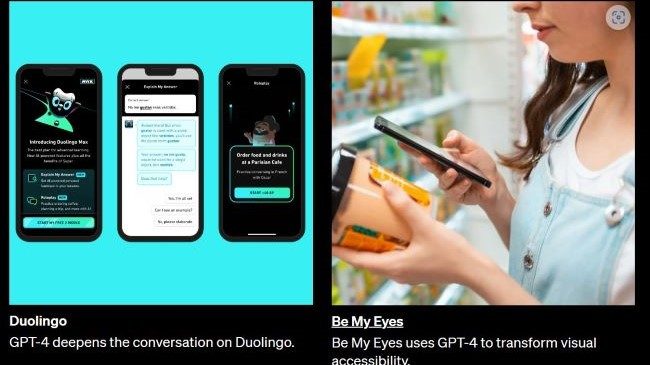
Some of the apps with features built with GPT-4.
Image used with permission by copyright holder

OpenAI detailed its collaboration with several brands that have built its app features using GPT-4, including Duolingo which has deepened language conversations, BeMyEyes, which has transformed visual accessibility, and Stripe, which has an updated user experience to combat fraud. Other brands and organizations include Morgan Stanley, Khan Academy, and the Government of Iceland.

Microsoft has also confirmed that its new Bing Search featuring an AI chatbot is based on GPT-4. The updated search engine debuted in February.

Fionna Agomuoh
Fionna Agomuoh is a Computing Writer at Digital Trends. She covers a range of topics in the computing space, including…
AI’s chip hunger could keep memory prices painfully high for years
Memory shortages may haunt your next phone, laptop, and GPU for years
Crucial Memory and SSD

While recent reports claimed that memory prices may not fall till 2027, it seems like the memory chip crunch isn't a short-term headache. And that's bad news for anyone hoping phone, laptop, and GPU prices will get cheaper again soon.

Reuters reports that SK Group chairman Chey Tae-won said the global chip wafer shortage is likely to last until 2030, with artificial intelligence demand continuing to outpace the supply. Chey said the current shortage could remain above 20%, largely because AI systems require huge amounts of high-bandwidth memory and therefore burn through a lot of wafers.

Read more
One of the most controversial US agencies is reportedly taste-testing Anthropic uber-powerful Mythos AI
The agency's reported use of Mythos highlights a widening split inside the US government over AI risk
Claude AI on an iPhone.

The US government's AI fight just got harder to square. The National Security Agency is reportedly using Anthropic's Mythos Preview even as senior Pentagon officials keep pushing to cut the company off over supply chain concerns. It shows how quickly real security needs can outrun official policy.

Since February, the Defense Department has been trying to block Anthropic and push vendors to do the same. Yet, according to an Axios report, the NSA appears to be moving ahead with one of the company's most powerful models anyway, suggesting cybersecurity demand is carrying more weight than the feud now playing out inside government.

Read more
AI streaming is going mainstream in China, whether audiences want it or not
IQiyi wants AI to make most of its content someday, and it's already starting.
man holding tablet watching iQiyi

China's Netflix, iQiyi, is making one of the biggest bets in streaming history. The company wants AI to create the bulk of its films and shows someday soon, and it's already restructuring its 16-year-old business to make that happen.

At its annual content showcase in Beijing, founder and CEO Gong Yu announced that iQiyi is pivoting its popular streaming platform into a social media destination built around AI-generated content. 

Read more