
The greatest sci-fi movies ever made not only introduce viewers to cutting-edge and otherworldly technologies but also do so in visually stunning ways. Whether by depicting futuristic cityscapes, creating gorgeous fictional landscapes, or masterfully using mind-bending special effects, these films rely heavily on what audiences see to create immersive viewing experiences.
From the groundbreaking cinematography of Stanley Kubrick’s 2001: A Space Odyssey to the immersive wonders of James Cameron’s Avatar, the sci-fi movies with the best visuals are influential masterpieces made to mesmerize. These films transport viewers to faraway galaxies and dystopian futures, making the unbelievable and extraordinary worlds real, at least for a while.
7. Her (2013)

Director Spike Jonze’s Her unfolds in a not-too-distant future version of Los Angeles, where Theodore Twombly (Napoleon‘s Joaquin Phoenix) is dealing with a broken heart and general loneliness. Theodore, who writes personal letters for other people for a living, soon develops a deep connection with an operating system named Samantha (Scarlett Johansson).
Her‘s distinctive aesthetic choices perfectly complement its subtle yet emotional story, with its soft pastel hues being the ideal match for Theodore and Samantha’s quiet conversations. A less noticeable but dominant aspect of the film is how it integrates familiar elements within its setting, from the characters’ cozy homes and clothing items to more alien features like exaggeratedly modernist buildings and tech that doesn’t exist just yet. In this way, Her manages to be a convincing movie about AI that feels ever so slightly out of reach, but seems right around the corner.
6. Gravity (2013)

Sandra Bullock stars as medical engineer Dr. Ryan Stone in Gravity, where, alongside experienced astronaut Matt Kowalski (George Clooney), she’s sent on her first shuttle mission in space. When the duo attempts a routine task, a catastrophic event puts their lives in danger and forces them to make hard choices if they hope to get back home.
Director Alfonso Cuarón’s heart-pounding sci-fi thriller was a spectacular surprise that took home the Oscars for Best Cinematography and Best Visual Effects, among many others, at the 86th Academy Awards. Gravity‘s CGI-dominant visuals were perfected over the course of three years, then combined with innovative rigs that Bullock and Clooney had to use to film their scenes. The result is a breathtaking portrait of space that highlights both its epic scale and terrifying darkness.
5. Inception (2010)
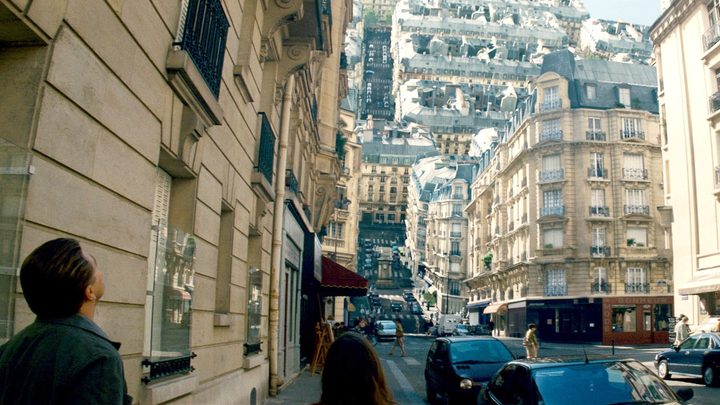
Director Christopher Nolan‘s mind-blowing blockbuster, Inception, took the world by storm when it premiered in 2010. It’s centered on a group of thieves led by “extractor” Dom Cobb (Leonardo DiCaprio), who can skillfully steal secrets from his targets’ subconscious minds. When he’s tasked with implanting an idea instead, he goes on the riskiest heist of his life.
An enduring masterpiece of the sci-fi and action genres, Nolan’s preference for practical effects paid off in a big way, with the film eventually winning four Oscars, including Best Cinematography and Best Visual Effects. Instead of relying heavily on CGI, the team behind Inception constructed complicated and inventive set pieces to create the movie’s dreamlike setting. These include the infamous rotating hallway that Joseph Gordon-Levitt had to master and the tractor-trailer disguised as a freight train pummeling through the street.
4. Dune (2021)
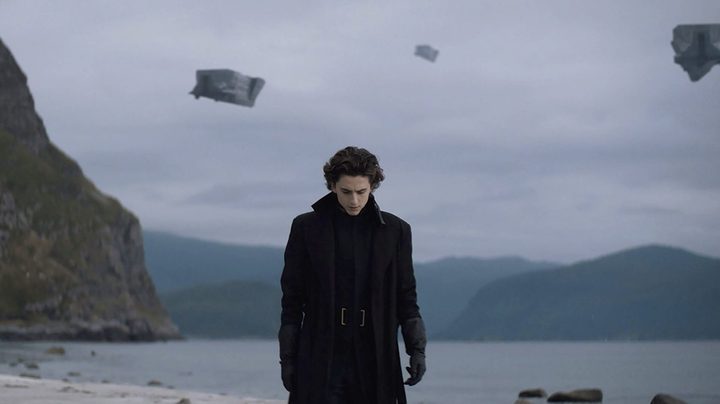
Based on Frank Herbert’s celebrated novel Dune, which has long been considered unadaptable, director Denis Villeneuve’s 2021 depiction of the sci-fi world did not disappoint. Starring Timothée Chalamet as Paul Atreides, the film follows him alongside the noble House Atreides as they move to the unforgiving desert planet of Arrakis. They’re soon caught in a major political conspiracy that threatens their lives.
Dune is a visual spectacle that boldly attempts to capture the grandeur of the source material, and for the most part, it works. Villeneuve’s adaptation clearly cares for each visual detail, from the expansive desert landscapes and rocky outcrops to the familiar ornithopters and intricate costumes. The result is a rich and alluring alien world that becomes an integral part of the story, never simply fading into the background. While there may never be a completely flawless adaptation of Herbert’s masterpiece, the 2021 film and its highly-anticipated sequel, Dune: Part Two, will hopefully be close.
3. Avatar (2009)

One of the most popular and profitable movies of all time, Avatar has become synonymous with 3D films. Directed by James Cameron, the pioneering epic sci-fi movie takes place on the lush moon of Pandora, where people’s attempt to extract a valuable resource leads to conflicts with the local inhabitants, the Na’vi people.
Cameron and his team set a new standard by depicting the enchanting world of Pandora with unprecedented realism, using new 3D technology and motion capture to bring the alien world and its community to life. From the bioluminescent flora that would glow as the protagonists walked by to the majestic floating mountains that obscured majestic flying creatures, Avatar uses its astounding visuals to make audiences believe that awesome new reality. It has since spawned a franchise that, while not as significant as the first, still serves as a testament to the 2009 film’s far-reaching impact.
2. Blade Runner (1982)

It’s hard to believe now that Blade Runner was a polarizing underperformer at the box office when it premiered in 1982. The iconic film directed by Ridley Scott has since become one of the greatest dystopian movies ever and is often cited alongside the most influential works of science fiction. Adapted from Philip K. Dick’s novel Do Androids Dream of Electric Sheep?, Blade Runner takes place in a future where synthetic humanoids, known as Replicants, are virtually indistinguishable from humans. Here, Rick Deckard (Harrison Ford) is forced to hunt escaped Replicants led by Roy Batty (Rutger Hauer).
Blade Runner‘s neo-noir story unfolds across a gritty cityscape where it constantly rains, which has since become inextricably linked with cyberpunk aesthetics. The movie’s futuristic world is so haunting because its dark and dangerous streets designed with consumerism in mind seem inevitable. Its sequel, Blade Runner 2049, may not be as impressive when it comes to storytelling, but its astounding visuals make it worth watching, too.
1. 2001: A Space Odyssey (1968)

Director Stanley Kubrick’s 2001: A Space Odyssey is a cinematic masterpiece that needs no introduction, as it is considered a pioneer of visual storytelling in the science fiction genre and in film as a whole. The epic sci-fi movie revolves around a group of astronauts and the sentient supercomputer HAL on their way to Jupiter to investigate an alien monolith.
From its opening scene to its astounding ending, Kubrick’s influential sci-fi movie continues to be studied and referenced in popular culture today. Its use of groundbreaking visual effects, in particular, brought a level of realism and spectacle that was unprecedented in its time. Notable novel visual aspects of the film include the legendary “Star Gate” sequence, the simulation of zero gravity by suspending actors from wires, its long takes with no dialogue, and its accurate portrayal of space flight. The fact that the ambitious movie is still worth watching over half a century after its premiere is a testament to its timeless quality.


