
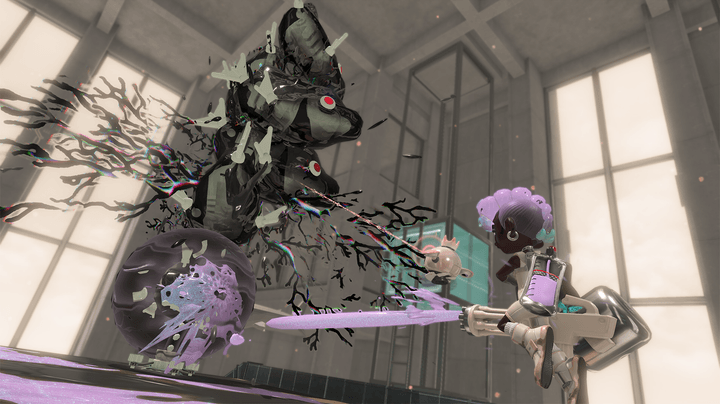
When I reviewed Splatoon 3 in 2022, I found myself impressed by what a robust suite of content it offered at launch. It had a solid single-player campaign, great competitive multiplayer, a killer PVE mode in Salmon Run, and even a fun card minigame. All of those disparate modes meshed together perfectly to make Splatoon 3 the kind of game you could pick away at for hundreds of hours. And with its latest DLC, called Side Order, that’s more true than ever.
The narrative-focused roguelite brings an entirely new experience to Splatoon. It has players trying to clear randomized runs through a 30-floor tower full of challenges. While that task can initially be cleared in a few hours, a robust postgame turns Side Order into a full-on game within a game. If Splatoon 3 wasn’t already the Switch game that offered the most bang for your buck, it is now. And that’s all thanks to an ingenious gameplay hook that’s proven to be Nintendo’s most valuable creation of the past decade.
Order in chaos
In the shooter’s latest DLC, players find themselves in a dystopian version of Inkopolis Square that’s devoid of color. At the center of it all is the ominous Spire of Order, which is ruled by a rogue machine that’s hell-bent on ridding the world of chaos. For those who remember Splatoon 2‘s final, world-changing Order versus Chaos Splatfest, it’s an excellent bit of narrative payoff that shows how players are tangibly shaping Nintendo’s inky world.
As a roguelite, Side Order offers some repetitive, but perfectly serviceable fun. Players pick a “Palette” before heading into the Spire, which gives them a specific weapon loadout. Each floor contains a micro challenge that has players destroying enemy spawn orbs, pushing giant eight-balls into slots, an more. Multiplayer modes are cleverly remixed here; one objective has players inking up a zone and protecting it from waves of enemies until enough time has passed. While those missions are shuffled and repeated in other runs, they’re bite-sized enough that it doesn’t feel like too much of a drag to revisit one I’ve done before.
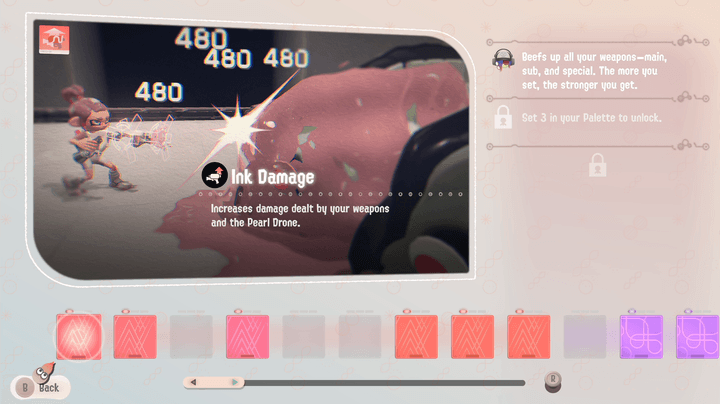
In-between floors, players pick up color chips that slot into their Palette. Each one offers a buff that makes them stronger through a run. Some give them more armor, while others allow a drone pal to hit enemies with passive damage. In my runs, I’ve struggled to find true synergies between chips, opting instead for grabbing whatever I can. That strategy seems to work just fine, as my first successful run came from randomly selecting 40 or so odd chips with little rhyme or reason. I couldn’t really feel a difference in my playstyle from upgrade to upgrade, but it clearly made a difference by the terrific final boss encounter.
Side Order isn’t a groundbreaking roguelite on par with God of War Ragnarok‘s standout Valhalla mode, but what’s impressive is how much mileage it provides a game that hardly needs the extra help. After clearing my first run, I began to see just how much time I could sink into Side Order if I felt so inclined. The larger goal is to complete the Spire with each Palette, all while earning “Priz” that can be spent to buy permanent boosts on future runs. Another earned currency lets me buy new collectibles for my locker. It’s every bit robust and replayable as Salmon Run.
I imagine I’d get pretty bored fast if I decided to grind it all at once, but that’s where Splatoon 3‘s already huge suite of content comes into play. If I only have two hours a day to log in and mess around, there’s a lot I can do. Perhaps I’ll try one run of Side Order, play a handful of ranked matches, and tinker with my Tableturf deck. That diverse array of well-constructed activities means that it’s hard to ever really get bored in Splatoon’s colorful playground. It’s something a lot of live service games strive to achieve, but outside of Fortnite, very few have.
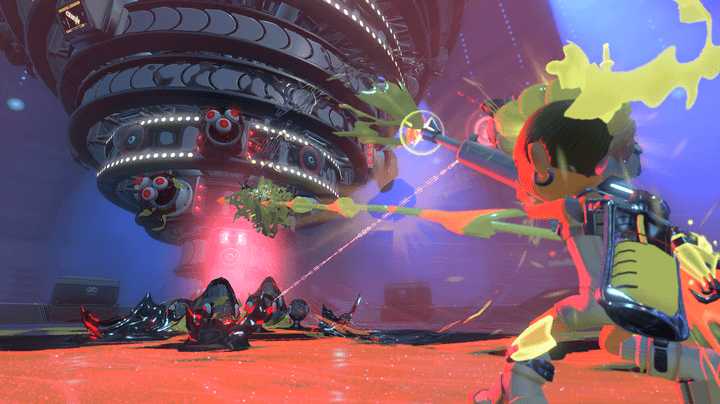
All of that is possible thanks to one thing: great design. While Splatoon’s paint-shooting system seemed a bit one-note in the series’ first game, Nintendo quickly proved how flexible the simple concept can be. The same combat hook that fuels a round of Turf War turns out to be a perfect match for a roguelite. There’s an inherent satisfaction that comes from painting a world in ink. That feeling continues to hold up no matter how Splatoon turns the screws.
For players who have fallen off of Splatoon 3 since its launch, Side Order offers a perfect reason to jump back in. The fun roguelite diversion gives solo players more to do and even gives the shooter a big-infusion of welcome offline content. All of that solidifies Splatoon 3 as the most valuable game a Nintendo Switch owner could ask for — at least until its online servers inevitably shut down.
Wave 2 of Splatoon 3‘s Expansion Pass, which includes Side Order, is available now for the Nintendo Switch.


