
Well, no one saw this coming. Nvidia announced an AI game assistant at Computex 2024 that will help you do everything from allocate stat points in a game to set up your PC for the best gaming experience. It may sound like another AI ploy from the AI giant that is Nvidia, but Project G-Assist actually could be really useful.
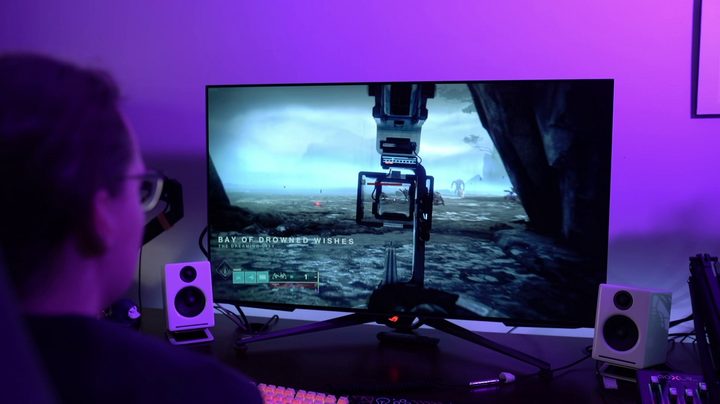
The headline feature that Nvidia is promoting is that Project G-Assist can help you when you’re stuck in a game. Developers can train the model on their game, and then that model can access your prompt, what’s visible on screen, and even data from the game. From there, you’d be able to ask questions you’d normally need to look up online. For example, where you should put a stat point, or how to craft a particular item. It’s not dissimilar to what we saw Microsoft show off with its Copilot demo at Build earlier this month, where a voice assistant walked a player through Minecraft in real time.
Nvidia’s version of that seems far more practical, but Project G-Assist has another card up its sleeve. In addition to the game assistant, Nvidia demoed a version of Project G-Assist that could help you tune your system for optimal performance by having full access to your system. That includes settings changes within the game, setting your refresh rate correctly, and more. It seems that the model can have access to Nvidia hardware as well.
Blink and you’ll miss it, but in its demo, Nvidia shows off Project G-Assist automatically applying an overclock to your GPU and graphing latency over time while you’re in a game. Even more impressive, Nvidia showed Project G-Assist reducing system power while maintaining a target frame rate by undervolting the GPU to achieve the performance target.

Although it’s great to get help in a game when you’re stuck, games are created to entice players to overcome challenges. The flip side of Project G-Assist is very interesting, however. It takes normally complex processes like undervolting and overclocking, and it makes them instantly accessible. It can do so in the context of what you’re doing on your PC as well, potentially saving hours of testing.
There’s a bit of shilling for Nvidia, even in the demo. In one scene, the AI assistant recommends turning on Nvidia Reflex in Cyberpunk 2077, for example. I’m sure there are cases where it would recommend something like Nvidia’s DLSS over other upscaling options as well. However, there’s clearly enough power here to overlook Nvidia plugging its other utilities.
Project G-Assist isn’t an actual product, at least not yet. Nvidia has a demo, and it’s pitching the tool as something that developers can take advantage of in the ways they see fit. I sincerely hope there’s a plan for Nvidia’s take on Project G-Assist, though. There are enough features, settings, and utilities available for RTX graphics cards to justify an AI assistant taking new users through them all, and according to Nvidia’s demo, that assistant could be very useful.


