
OpenAI’s steamrolling of its rivals continued apace this week, and a new study estimates just how much success it’s had in winning over paid subscribers through ChatGPT Plus.
According to a report published by Futuresearch this week, OpenAI’s products are far and away the most popular — and profitable — in the AI space. Per the study, OpenAI has an estimated annual recurring revenue of $3.4 billion dollars.
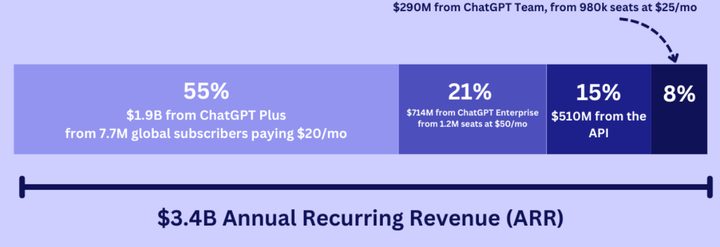
Some 55% of that, or $1.9 billion, comes from its 7.7 million ChatGPT Plus subscribers who pay $20 a month for the service. Another 21%, or $714 million, comes from the company’s 1.2 million $50/month ChatGPT Enterprise subscribers. Just 15%, or $510 million, is generated from the AI’s API while the remaining 8%, or $290 million, comes in from its 980,000 ChatGPT Teams subscribers who pay $25/month. In all, OpenAI is estimated to have some 9.88 million monthly subscribers.
That’s nearly 2 million more than the 8 million subscribers that YouTube TV, the nation’s fourth-largest cable television network, reportedly enjoys; though to be fair, Disney+ saw more than 10 million signups for its streaming service on its opening day. Still, it’s quite an achievement, especially at $20 per month.
The startling income begs the question: What’s the company doing with all this money? Well, another piece of news today ties directly into that answer.
Per a report from Bloomberg Thursday, OpenAI has developed a five-tier scale for measuring the capabilities of its AI systems as the company seeks to achieve AGI within the next decade. The company shared its scale internally with employees and investors earlier in the week.
OpenAI’s charter defines AGI as “highly autonomous systems that outperform humans at most economically valuable work — benefits all of humanity.” The company states that it will “attempt to directly build safe and beneficial AGI, but will also consider our mission fulfilled if our work aids others to achieve this outcome.”
The scale starts at Level 1 and describes AI that can interact with people in a conversational manner — essentially your run-of-the-mill chatbot. Level 2, where the company believes we are currently approaching, identifies Reasoners, AI that can solve problems in the same way (and as well as) a person with doctorate-level education could. We’re already seeing evidence of this given how often AI are passing state bar and medical school exams these days.
Level 3 describes Agents, AI that can operate on a user’s behalf across multiple days and systems — think Apple Intelligence but even more capable. Level 4, or Innovators, would be AI that can create its own novel solutions to a given problem or task, while Level 5 details “Organizations,” literally AI that can perform the same tasks as an entire company’s human workforce. The company was quick to point out that this categorization is still in its preliminary stages and could be adjusted as needed in the future.
The notion of interacting with an artificial intelligence as smart and capable as the people who built it has been around nearly as long as computers, though the requisite breakthroughs have always seemed to remain “a few years” out of reach. However, the release of ChatGPT in 2022 has drastically accelerated the estimated time frame for achieving that goal. Shane Legg, co-founder of Google’s DeepMind and the company’s lead AGI researcher, told Time last year that he estimates a 50-50 chance to develop AGI by 2028. Anthropic CEO Dario Amodei, on the other hand, believes AGI will be achieved in the next 24 months.
OpenAI certainly appears to be in position to achieve that goal.


