  1. Home
  2. Space
  3. Photography
  4. News

London sparkles in astronaut’s gorgeous night shot from the ISS

Add as a preferred source on Google
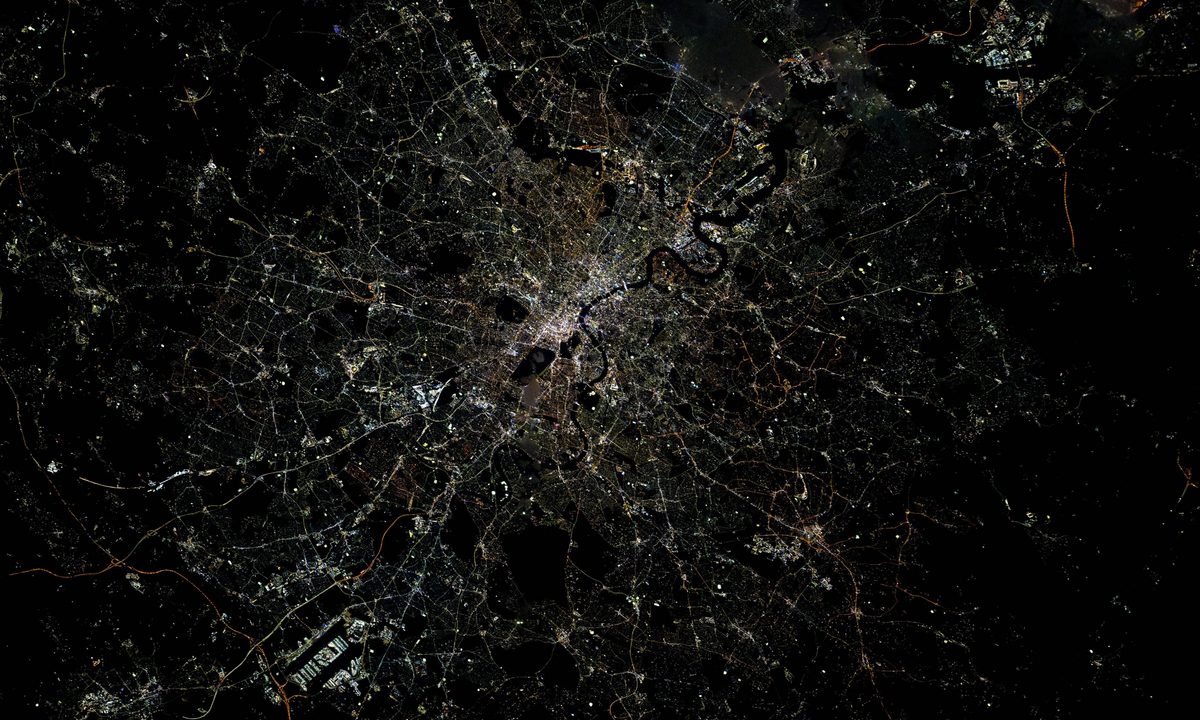
London seen from the ISS.
Don Pettit/NASA

A gorgeous image captured by a recent arrival at the International Space Station (ISS) shows the night lights of London gleaming 250 miles below.

NASA astronaut Don Pettit — NASA’s oldest active astronaut at 69 — arrived at the station last week on his fourth trip to orbit.

Recommended Videos

“London sparkling at night,” Pettit wrote in a post with the photo, which he shared on X (formerly Twitter) on Wednesday.

London sparkling at night.

Nikon Z9, 200mm f2, 1/320 sec, ISO 25600 pic.twitter.com/okPZz6N05f

— Don Pettit (@astro_Pettit) September 18, 2024

Pettit used a full-frame Nikon Z9 to take the photo. The focal length was 200mm, the aperture f2, speed 1/320 sec, and ISO 25600.

Just a few days after arriving at the ISS, Pettit took an extraordinary photo showing the Polaris Dawn spacecraft entering Earth’s atmosphere at high speed as it returned home with four astronauts at the end of a historic five-day mission.

The American astronaut captured similarly striking shots during his previous visits to the ISS, and so his social media followers can expect to see plenty more wonderful photos over the course of his six-month space mission.

Pettit is particularly adept at capturing dramatic star trail images, like this one taken in 2012 with a Nikon D3s and a 24mm lens and created using multiple stacked 30-second exposures:

Star trail from @Space_Station, with ghostly blue outline of a solar panel.

Multiple atmospheric layers are visible due to solar driven excitation of atomic oxygen (green) and hydroxyl (-OH) radicals (orange-pink). The star trails become curved near the horizon due to the… pic.twitter.com/F9HUVcEf9e

— Don Pettit (@astro_Pettit) July 19, 2024

He also likes to take near-infrared images, like this one captured in 2012 showing a flora-packed river delta (shown in bright magenta) wedged between the Pacific Ocean and the Andes Mountains. This image was taken using a modified Nikon D3s with a 180mm lens set at f/4.5 and ISO 400.

Camana, Peru region in near infrared. Wedged between the Pacific Ocean and the Andes Mountains, this lush flora-packed river delta appears as bright magenta. Camana is the grayish feature in the lower center of the river delta. This is in stark contrast to the sparse foliage in… pic.twitter.com/zXu6Gor1MF

— Don Pettit (@astro_Pettit) September 1, 2024

While most astronauts are happy to simply peer out of the ISS at the stunning scenery several hundred miles below, a few, such as Pettit, Matthew Dominick, and Thomas Pesquet, like to record what they see with a camera. And we’re mighty glad they do.

Trevor Mogg
Contributing Editor
Not so many moons ago, Trevor moved from one tea-loving island nation that drives on the left (Britain) to another (Japan)…
Blue Origin’s massive New Glenn rocket explodes in a fiery blaze during tests
The incident leaves NASA's Moon Base ambitions and Amazon's Kuiper constellation without their primary launch vehicle at the worst possible moment.
Explosion, Fire, Nuclear Explosion

Blue Origin's New Glenn rocket exploded during a static fire test at Launch Complex 36 in Cape Canaveral, Florida. The incident took place on the night of May 28, 2026. 

The explosion was captured on a live stream by NASASpaceflight.com and footage of the explosion spread rapidly across X. The Space Launch Complex 45 has confirmed in an official statement (shared by Spaceflight Now on X) that all personnel have been accounted for and there have been no injuries or fatalities.

Read more
Orbot Robotics’ space robot has four arms, but its Goro physique has a purpose
This four-armed robot could make routine space-station work easier for astronauts
Robot with four arms

Helios is a new four-armed robot from Zurich-based Orbit Robotics, and at first glance, it reminded me of Goro from Mortal Kombat. But unlike the prince from Outworld, Helios is not built for combat. It is designed to help astronauts on space stations with the repetitive, time-consuming work that keeps life in space running.

Orbit Robotics says that in microgravity, legs are not much help. Instead of walking or standing, Helios needs to move through tight station interiors, hold itself steady, and handle cargo, tools, or equipment. Its four-arm design turns extra limbs into both mobility aids and working hands.

Read more
A billionaire crypto bro will lead humanity to Mars atop Musk’s Starship
Chun Wang could become one of the first humans to travel toward Mars
Chun Wang in a space suit

Neil Armstrong and Buzz Aldrin became the faces of the Moon landing era. Elon Musk’s Mars era may get a very different public face in Chun Wang, a cryptocurrency billionaire whose fortune traces back to Bitcoin mining.

Wang is expected to lead a future SpaceX Starship mission that would fly past Mars and return to Earth. SpaceX has not announced a launch date, and the plan still depends on Starship proving it can safely carry humans far beyond Earth's orbit.

Read more