  1. Home
  2. Computing
  3. News

You can now live your developer dream with Google’s free Gemini Code Assist access

Add as a preferred source on Google
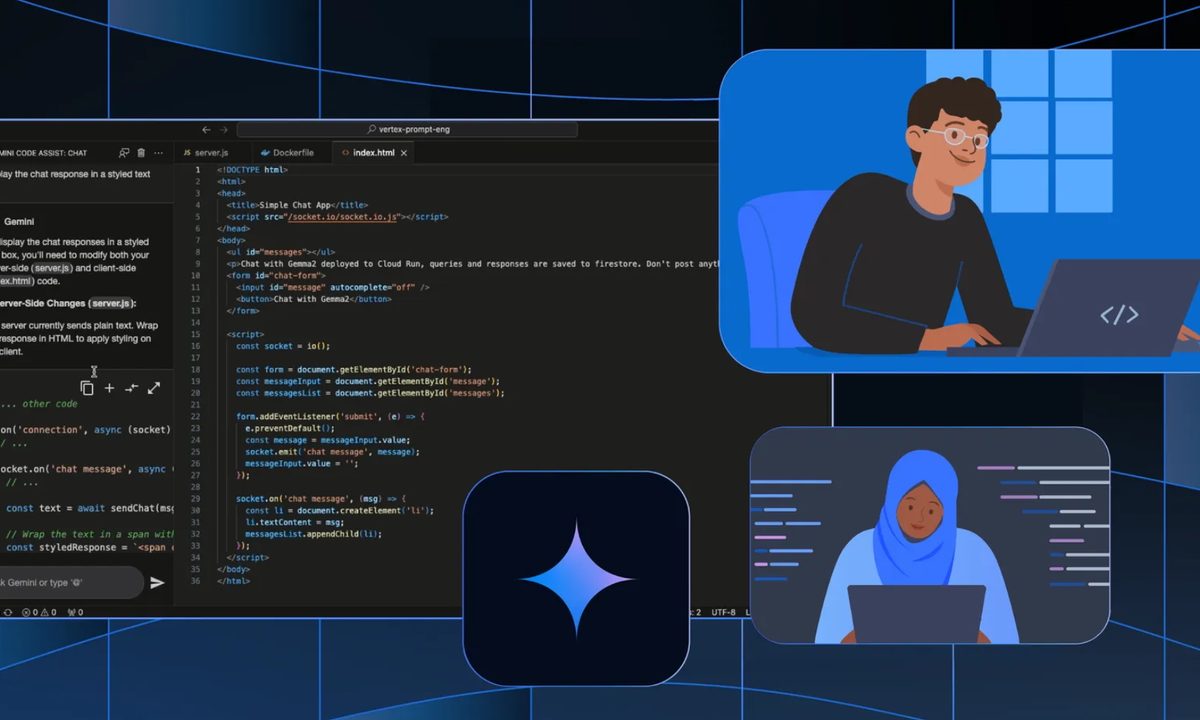
Google gemini code assist graphic.
Screenshot Google

Google has made a free version of its Gemini Code Assist tool available worldwide starting February 25. The generative AI model, previously aimed at businesses, is powered by Gemini 2.0 and integrates with IDEs like Visual Studio Code.

This means you can access Code Assist’s features directly from the environment you’re working in. It will auto-complete code as you’re typing it, and you can also work through problems in the chat or generate code snippets.

Recommended Videos

The most interesting point about this new free version (officially dubbed “Gemini Code Assist for individuals”) is the usage limits. Every user has access to 180,000 requests a month — which is well over 5,000 per day. These are big numbers no matter how you look at it, but how many requests you get through will depend a lot on what kind of project you’re working on.

Code completions count as a request, so every time Code Assist generates a suggestion based on what you’re typing, one request is used up — whether you accept the suggestion or not. Depending on the situation, developers can write thousands of lines of code per day, so it is definitely possible to hit the limit.

However, if you’re working on something more complex or concise, you’ll be much more unlikely to reach the cap. Plus, if you know you’re going to type a bunch of code manually and you don’t want to waste your requests, you can toggle off code completion until you’re ready to use it again.

So, all things considered, the usage caps really are very high and you’ll be able to get a lot of usage from the free assistant, even if you’re a full-time developer. In a blog post, Google compares its limit to “other popular free coding assistants” with only 2,000 code completions per month — which happens to be the cap for the free version of GitHub Copilot, Google’s main competitor in this area.

Alongside all of the requests, you’ll also get a pretty large token context window. This lets you work with big files and have Gemini take all of them into context when it generates responses.

Google is also starting a public preview of “Gemini Code Assist for GitHub,” which generates free code reviews of pull requests in GitHub and suggests improvements. This is intended to help teams review each other’s work more quickly and push changes more efficiently.

You’ll need a Gmail account to sign up and install Gemini Code Assist, and as a free user, you’ll get access to all of the features mentioned so far. If you need more advanced features like productivity metrics, customized responses, or cloud integrations, you’ll still need the paid version.

Willow Roberts
Willow Roberts has been a Computing Writer at Digital Trends for a year and has been writing for about a decade. She has a…
You can finally get rid of Bing on your Windows 11 PC
Windows users can finally stop accidentally opening Bing while searching for Calculator
New Bing search engine.

After years of forcing Bing into nearly every corner of Windows Search, Microsoft may finally be giving users a way out. The company is reportedly testing changes in Windows 11 that would allow people to completely disable Bing-powered web results from the operating system’s built-in Search experience.

For many PC users, this is a long-overdue change. Windows Search has spent years blending local file searches with Bing suggestions, online results, news links, and Microsoft services - often frustrating users who simply wanted to find an app, document, or system setting on their computer.

Read more
ChatGPT is eyeing a major “super app” overhaul that wants to do real work for you
ChatGPT is apparently tired of just answering questions now
ChatGPT running on a phone

OpenAI is reportedly preparing a major transformation of ChatGPT that could fundamentally change how people interact with artificial intelligence. Instead of remaining primarily a conversational chatbot, the company now wants ChatGPT to evolve into a “super app” powered by AI agents capable of managing tasks across both personal and professional life.

According to a report by the Financial Times, OpenAI executives increasingly believe the future of AI lies not in chatbots that simply answer questions, but in intelligent systems that actively complete tasks for users. The company’s long-term vision reportedly includes AI agents capable of organizing schedules, booking travel, writing software, generating content, and managing workflows across multiple services and platforms.

Read more
I asked ChatGPT to restore an image. It produced a naked man with a fish head
No, ChatGPT, I do not want to see a picture of a sweaty human with a giant fish head, hooked on cigarette and booze.
AI image generated by ChatGPT.

In 2024, back when the AI image fever was catching on, Google released the Pixel Studio app. It was meant to be a joyful playground where you could bring your imagination to life using AI. Well, it went a bit above and beyond. In our tests, Google’s app created disturbing images of SpongeBob dressed as a Nazi, Mickey Mouse as a slave owner, Elmo pointing a shotgun at Big Bird, Yoda doing cocaine, and Mr. Krabs holding an assault rifle. 

Well, ChatGPT is doing something similar, but in an even more worrying fashion.

Read more