


Open-ear earbuds are a great option for anyone who wants to hear their tunes, podcasts, and phone calls while staying aware of their surroundings. A lot of people also find them more comfortable than conventional wireless earbuds. Still, even within the open-ear category, there are choices to be made. One of the biggest choices is, do you want an earhook design or the newer, clip style?
If the answer is a clip style open-ear set of earbuds, two of the best models are the Bose Ultra Open Earbuds, which helped to popularize this earhook alternative, and the Shokz OpenDots One, one of the newest clip style models to join the category. However, though they share a similar shape, these open-ear clips are very different. Which one is right for you? We put them side by side to help you figure it out.
|
Bose Ultra Open Earbuds
|
Shokz OpenDots One
|
Bose Ultra Open Earbuds vs. Shokz OpenDots One: Price

Bose sees itself as a premium brand with premium products and its prices reflect that perspective. The Bose Ultra Open Earbuds were the most expensive open-ear earbuds when they debuted in February 2024 at $299, and with the exception of a few short-lived discounts, that price has stayed constant.
Shokz also sees itself as a premium brand. Its products tend to be priced higher than competitors in the same categories. However, in this case, at $200, the OpenDots One aren’t the most expensive clip style open-ears. That’s a big gap, and as we get further into this comparison, you can decide if Bose is still justified in charging $99 more for its earbuds.
Winner: Shokz OpenDots One
Bose Ultra Open Earbuds vs. Shokz OpenDots One: Specs comparison
| Bose Ultra Open Earbuds | Shokz OpenDots One | |
| Price | $299 | $200 |
| Colors | Sandstone, Black, Deep Plum, Diamond, White Smoke, Chilled Lilac, Lunar Blue, Carbon Blue, Moonstone Blue, Sunset Irridescent | Black, White |
| Weight | 0.35 ounces (each earbud), 1.76 ounces total with charging case | 0.23 oz (each earbud), 1.38 oz total with charging case |
| Form factor | Open-ear (clip style) | Open-ear (clip style) |
| Noise cancellation | No | No |
| Battery Life | 7 hours per charge, 27 hours total playtime | 10 hours per charge, 40 hours total playtime |
| Charging | USB-C | USB-C, Qi wireless |
| Voice assistant | Smartphone native assistant | Smartphone native assistant |
| Multipoint | Yes | Yes |
| Water/dust resistance | IPX4 | IP54 |
| Hi-res audio | No | No |
| Spatial audio | Yes, with head tracking | No |
| Fast pairing | Google Fast Pair | No |
| Bluetooth version/codecs | 5.3 with SBC, AAC, aptX, aptX Adaptive, aptX Lossless | 5.4 with SBC, AAC |
| Auracast | No | No |
Specs don’t tell the full story of any product, but they can definitely provide clues as to strengths and weaknesses.
The Bose Ultra Open Earbuds have a clear advantage when it comes to color choice (so many colors!), spatial audio, and Bluetooth codec support, while the Shokz OpenDots One benefit from their lighter weight, longer battery life, wireless charging, and slightly better protection (the 5 in IP54 indicates dust protection).
These specs demonstrate that even though Bose and Shokz are playing in the same space, they’ve geared their products to buyers with different needs or tastes.

Bose has always thought of the Ultra Open Earbuds as a fashion accessory as much as a personal audio product. This was evident when the company first made the Ultra Open available as a limited edition collaboration with fashion and lifestyle label, Kith, ahead of the full launch. The current selection of colors reinforces that positioning.
The Shokz OpenDots One, on the other hand, follow the same dual color choices that the company offers on the rest of its products. The muted colors are far less flashy than Bose.
Other than sound quality, which we’ll get to in a moment, battery life and wireless charging are the two areas that will likely impact buyers the most. Wireless charging is all about convenience. You can use wireless charging with the Ultra Open Earbuds, but only if you buy Bose’s optional $49 wireless charging cover.
When it comes to battery life, the tendency is to simply say “more is always better.” And while that’s true, it’s also worth asking yourself how much battery life you think you’ll need. Perhaps the Ultra Open Earbuds’ 7 hours per charge can get you through a full day. Just keep in mind, if you use Bose’s Immersive (spatial) Audio feature, it will their reduce stamina to just 4 hours.
On balance, with the kinds of specs that most people will value, Shokz wins this round too.
Winner: Shokz OpenDots One
Bose Ultra Open Earbuds vs. Shokz OpenDots One: Design and comfort


Clip style earbuds all work more or less the same way. They place a speaker module inside your ear’s concha, where it sits just outside your ear canal, while the battery module (usually joined by a flexible connector) wraps around you ear’s helix. This horseshoe/cuff shape provides enough clamping force that the earbud shouldn’t be easy to dislodge, but not so much that it causes discomfort.
Both the Bose Ultra Open Earbuds and the Shokz OpenDots One use this design, and both are very comfortable when worn. The OpenDots One are a bit lighter and their shape makes them a bit easier to put on, but the difference isn’t huge.
The charging cases are also very similar, offering a small size and very easy access to the earbuds via a flip-top lid. Once again, the Shokz are a bit smaller, and a bit lighter, which may make them slightly easier to pocket.
The biggest difference is the way each company does controls. On the Ultra Open Earbuds, Bose uses a physical button that sits atop the battery module. It’s very easy to use with a pinching gesture via single-, double-, and triple-clicks on the button. These control the main function like play/pause, track skipping, and volume. A fourth click-and-hold gesture can be customized in the Bose app. It’s one of the best control mechanisms I’ve ever used, and it even works when you’re wearing gloves.
On the OpenDots One, Shokz uses touch controls. There are two gestures — double-taps on the connector (or double-pinches on the battery module) or a long-pinch on the battery module. While the long-pinch can be customized, there simply aren’t enough gestures to control everything you might want. Play/pause and call answer/end are always available, but you’ll have to choose between track skipping, volume, and voice assistant access for that customizes gesture.
Though I prefer the Shokz OpenDots One for their lighter weight, Bose’s controls are far better, and that’s gives it a win.
Winner: Bose Ultra Open Earbuds
Bose Ultra Open Earbuds vs. Shokz OpenDots One: Sound quality

Bose knows a thing or two about sound and the Ultra Open Earbuds sound great. It’s typical Bose: high-energy, with excellent clarity in the highs, very good detail in the midranges, and decent if not perfect bass. Indoors, you get what might be the most intriguing earbud-listening experience available right now. Thanks to their open design, it sounds like you’re listening to speakers in your room, not earbuds in your ears.
This effect is further enhanced if you use Bose’s Immersive Audio feature (with or without optional head tracking) — my favorite earbuds-based spatial audio processing at the moment. Much of this extra level of fidelity is lost in noisy environments, but that’s true for all open-ear earbuds. Same thing goes for the Ultra Open’s available Qualcomm Snapdragon Sound Bluetooth codecs: a noticeable improvement to overall detail, but only when things are very quiet.
The Shokz OpenDots One are no slouch on the sound quality spectrum either, and when it comes to bass response, they’re the current king of the open-ear category. This is a big deal for anyone who depends on a driving beat to power their workouts. You can still get most of that bass presence even when outdoors.
Unfortunately, the OpenDots One can’t quite deliver the same overall sound as the Ultra Open Earbuds. The highs are clear, but the midrange suffers somewhat in the comparison. To be fair, the Bose Ultra Open Earbuds are the only clip style open-ear earbuds that sound better than the OpenDots One. Given that the Ultra cost $99 more, you would hope that’s the case.
Bass is a big deal for a lot of folks, and it’s almost enough to give Shokz the win, but overall, it’s hard to deny that the Bose Ultra Open Earbuds sound better.
Winner: Bose Ultra Open Earbuds
Bose Ultra Open Earbuds vs. Shokz OpenDots One: Call quality

Open-ear earbuds are fantastic for calling, simply because they let you hear your own voice unmuffled by a device that’s jammed up against your ear canal. In this regard, both the Bose Ultra Open Earbuds and Shokz OpenDots One are great for calls.
Indoors, both do an excellent job of capturing and transmitting your voice to callers. Outdoors, results tend to be a little more mixed, especially as environmental sounds get louder.
However, the OpenDots One do a better job at keeping your voice consistently clear when outside, where the Bose’s performance can vary a lot based on surrounding noise.
Winner: Shokz OpenDots One
Bose Ultra Open Earbuds vs. Shokz OpenDots One: The verdict
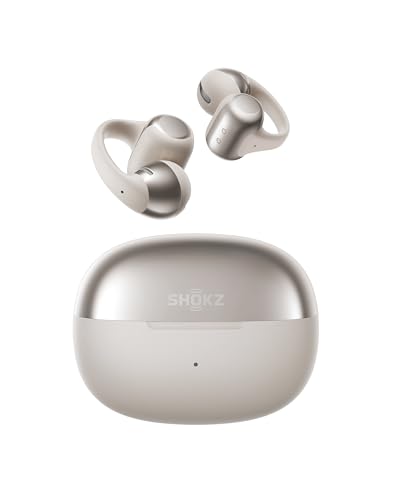
With three wins to two, the Shokz OpenDots One squeak out an overall win for this comparison. Their key strength is value for money — they offer a lot of desirable features for considerably less money. In a world where the Bose Ultra Open Earbuds didn’t exist, the OpenDots One would be total no-brainers.
But the Ultra Open do exist, and when it comes to deciding which clip style open-ear earbuds are right for you, remember where these buds came out on top (design and sound quality). If these categories matter more to you than the others (perhaps you almost never use earbuds for calls) then let those wins be your guide.
Winner: Shokz OpenDots One


