
If you’ve cut the cord and ditched cable to stream your movies and TV shows from the Internet, then you know that there’s one big problem with streaming TV right now. No, it’s not the lack of ESPN (though that is a huge problem). It’s that even if more sports were available on streaming services, you wouldn’t know where to look to find them. A wealth of content is scattered across a growing number of video services, with no great way to search between them all. Want to watch Downton Abbey? You need Amazon Prime. Mad Men? Get Netflix. WWE? That’s on Hulu Plus.
Internet TV is a great idea, but unlike the “guide” function on your cable box that let’s you see what’s playing across 1,000 different channels, there’s no master overview of what’s playing online. Oh, and if you want to watch streaming videos on your TV, you’re usually stuck using an Xbox Controller or Roku remote. There’s still no good way to sift through the thousands of movies and TV shows that should be at your fingertips. Enter Vidora.
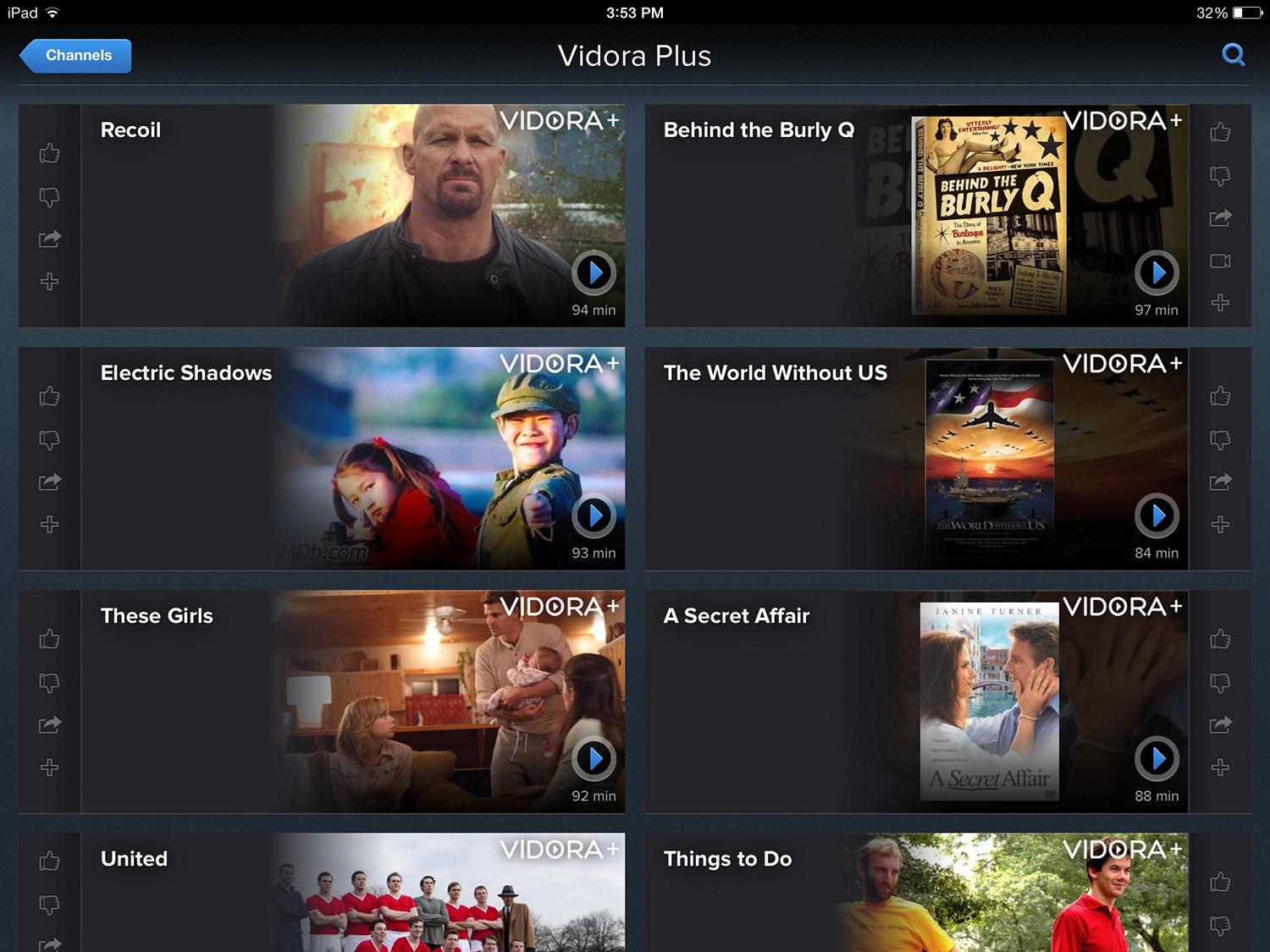 Vidora wants to organize the onslaught of online video. Available on iPad, and soon coming to other platforms, it allows you to search through and watch content from Netflix, Hulu Plus, Amazon Prime, and iTunes – all in a single app. When you decide to play a video, it opens up the Netflix, or whatever, app you want to watch. This is an app that will let you search for Mad Men, bring up the show, let you select which season and episode you want to watch, then tell you that you can choose to view it on Netflix or iTunes. In concept, it’s a cord cutter’s dream come true. In practice, it’s still a little shaky, but it’s improving.
I first spoke with Vidora co-founder Alex Holub back in June and he told me that he believes mobile – tablets and phones – will soon dominate the TV: “We think set top boxes go away. We think smart TVs will go away. We think everything will go through your mobile device. That will be where you find things.”
Bloomberg TV is a real cable TV channel inside Vidora.
Even as Digital Trends’ Mobile Editor, I thought he was getting ahead of himself. Then Google unveiled Chromecast. If you’ve been living under a rock (or a Roku), Chromecast is a $35 dongle that you plug into your TV’s HDMI port. You can connect it to your tablet or phone (Android or iOS) and stream content directly from your phone to your TV, as if by osmosis. It works well, and it’s as easy to setup as an Xbox (a lot easier, actually). Using the standard Netflix, Hulu, YouTube, or other apps, you can touch a button and switch the output from your tablet or phone screen to your TV. As soon as Google opens the platform up, Vidora will be fully compatible.
“Chromecast is pretty exciting for us because it’s a cheap way for folks in the Vidora platform to reach the TV,” said Holub. “We’re talking to Google right now. They’re [rolling out Chromecast] in a phased approach. Hopefully within the next few months we’ll be able to launch.”
The company is also making improvements to its app at a rapid pace. Back in June, I found the app’s premise intriguing, but its suggestions on what I should watch weren’t all that enticing. This is because, unlike Netflix and Hulu, which have tracked my viewing habits for years, Vidora just met me. But as I’ve used it more, the suggestions for me have improved. The app lets you give a thumbs up or thumbs down to any video (or series) and subtly learns your habits as you use it, regardless of whether you’re using it to watch Netflix videos or iTunes. Because you’ll use Vidora more than any one of the individual apps it connects with, it will eventually know more about your viewing habits than anything else.


A few weeks ago, Alex Holub wanted to run me through Vidora’s latest innovation: a new hub is designed to help attract publishers. It will tell them exactly how many people are watching their videos, how old they are, when they’re watching, and what other content they’ve been watching along with it. It’ll even show them how they’re doing against other publishers. Holub told me that it’s all completely anonymous, but no one is offering data back to publishers like this. He’s doing it because he wants Vidora to work with everyone who makes good content, whether it be a monster like Netflix, or a tiny new service. The publisher portal gives them all an incentive to cooperate.
It’s working. “We have the largest set of free, ad-supported content on the iPad. All directly playable inside of Vidora,” Holub explained. In addition to Netflix, Hulu, Amazon, and iTunes, Vidora has a bunch of smaller video partners. Yahoo, Bloomberg, and Vice, are among the more notable, but you’ll also find FlixFling, Creepster.TV, iFlixTV, Funimation, The Venture Channel, Fandor, Matador Network, Snag Films, and even a network dedicated to Yoga.
There’s still no good way to sift through the thousands of movies and TV shows that should be at your fingertips.
In concept, it’s a cord cutter’s dream come true.
No interest in spending $4.99 a month for unlimited retro horror and sci-fi movies from Creepster.TV? You can enable or disable any of the services, meaning more choice is always better. You may not love Yahoo’s videos, but if they pop up in a search result, maybe you’ll check them out.
The variety of channels has also lead Vidora to experiment with different business models. In the Bloomberg channel, for example, there is a live 24-hour feed in addition to video clips and stories. In essence, Bloomberg TV is a real cable TV channel inside Vidora that you can disable or enable at your will. Taking it a step further, The Venture Channel doesn’t even have clips or episodes to watch: it’s just a straight channel feed.
Soon, Vidora will also allow users to purchase individual videos from video partners who sell content, subscribe to channels for a monthly fee, or sign up for Vidora Plus, it’s own enhanced service that will cost $5 a month. Holub described these additions as rounding out what it can offer.
“We don’t want to make or buy our own content,” said Holub. “We’re a technology company and we’re interested in creating a platform [for all types of Internet video].”
 Right now, Vidora is a great idea, and an OK service. Its recommendations aren’t perfect, and its user interface has plenty of room to grow, but it’s the closest thing we’ve seen to a TV guide for Internet TV so far. It still needs a wider assortment of video partners, and needs to make deals with the big guys that allow it to play their videos inside its app (switching apps can be a pain), but there is gold at the end of this rainbow.
Thanks to the overnight success of Chromecast, mobile devices are beginning to directly link with the TV and manufacturers will undoubtedly start pumping out more ways to make that link. If it has what it takes to step up and evolve fast, Vidora may just be the cable box for the Internet TV generation, only a whole lot nicer.


