“Bose addresses the original Ultra’s weaknesses, bringing its flagship over-ears up to speed”
- Gold-standard ANC
- Open, crisp, entertaining sound
- Lossless USB-C listening
- Big battery boost
- Well-implemented spatial audio
- All-day comfort
- Volume control could be better
- No Bluetooth LE Audio or Auracast
- Beaten for sonic insight
“Why you can trust Digital Trends – We have a 20-year history of testing, reviewing, and rating products, services and apps to help you make a sound buying decision. Find out more about how we test and score products.“
Instant insight
The clue is in their rather long–winded name: here we have the second generation of Bose’s QuietComfort Ultra headphones, which arrive two years after the originals to not only build on their talented performance but also overcome the few shortcomings highlighted in our QuietComfort Ultra Headphones review.
The best noise-canceling headphones Bose has produced to date, these new QC Ultra Headphones 2 cost $449, with pre-orders open now and shipping beginning on 2nd October.
They have a reputation as the best noise-cancelers on the market to uphold, while needing to compete with the ruthless competition from Sony, Apple and Bowers & Wilkins on the sound, features and comfort fronts. Having spent time with the latest Bose over-ears, I’ve found out how they fare against those crowd favorites in each department…
Bose QC Ultra Headphones (2nd Gen) specs
| Price | $449 |
| Weight | 8.8 ounces (headphones), 7 ounces (case) |
| Form factor | Closed-back, over-ear |
| Noise cancellation | Yes |
| Battery life | 30 hours (ANC on) |
| Charging | USB-C |
| Voice assistant | Native smartphone assistant |
| Multipoint | Yes |
| Spatial audio | Yes (Immersive Audio) |
| Hi-res audio | No |
| Fast pairing | Google Fast Pair |
| Bluetooth/codecs | BT 5.4 with AAC, SBC, aptX Adaptive |
| Auracast | No |
Bose QC Ultra Headphones (2nd Gen) design: classy, comfortable and colorful
Quick take: Bose sticks to its winning design formula

The QC Ultra Headphones 2nd Gen are nigh-on identical to the originals, which themselves were modest modern revisions of the classy, business-like design language Bose over-ears have adopted for years. Lazy by Bose? That would be unfair. After all, if it ain’t broke…
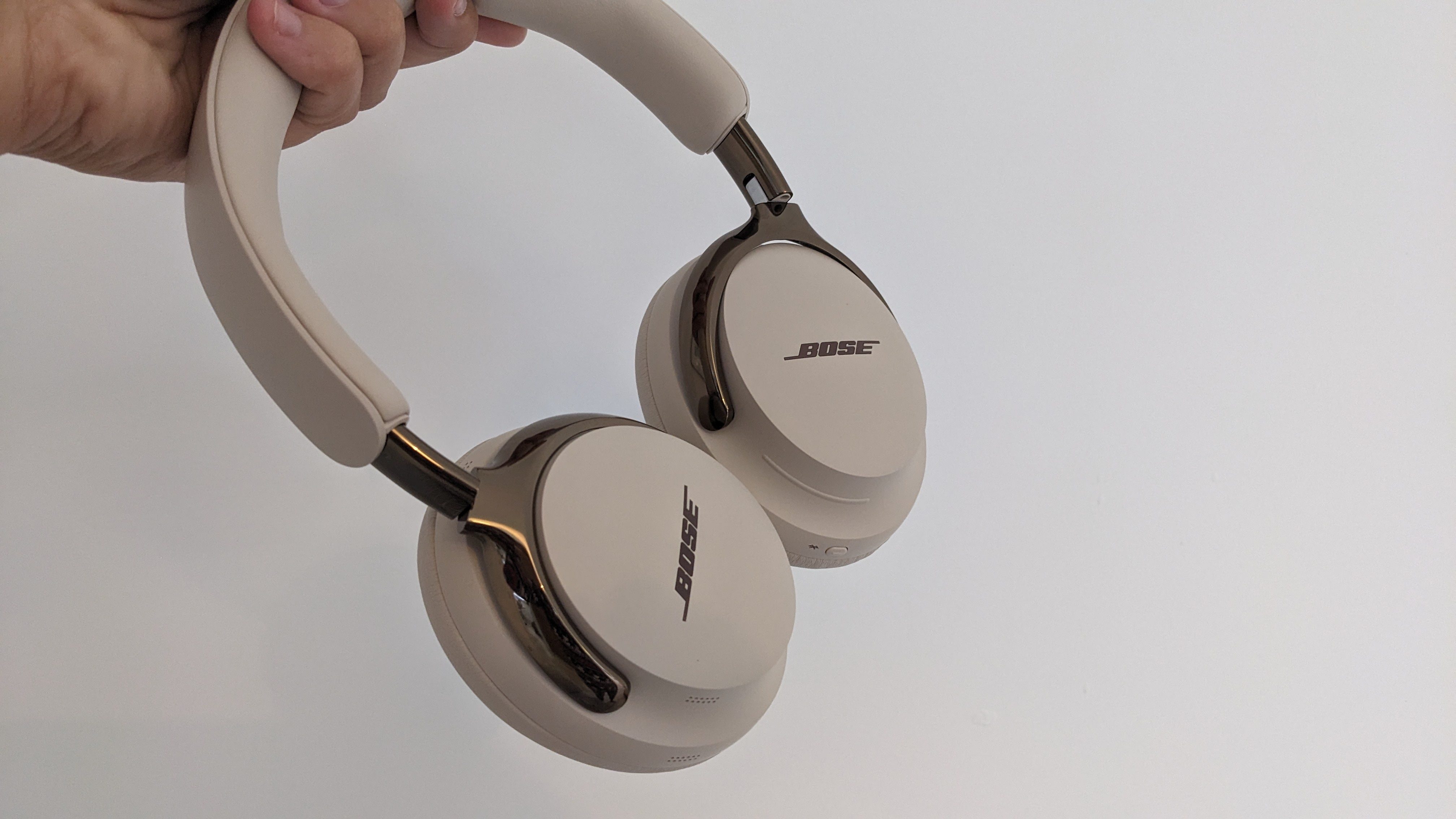
You still get the soft, nicely cushioned pleather headband and earpads, and the chamfered plastic oval earcups brandished with the brand logo, connected by aluminium arms and yokes that allow the headphones to fold inwards for easier storage.
This time, however, Bose introduces two colors alongside the familiar Black and White Smoke finishes at launch, rather than saving any splash of color for a following or special-edition model down the line. The Driftwood Sand you see photographed here is a swanky affair, while a deep, more out-there Midnight Violet screams ‘chic’.
That all makes for premium headphones that both look and feel every bit of their not-insignificant asking price, even if they aren’t quite up to the luxury standards of the Apple AirPods Max. Arguably a more important indicator of a headphone design’s success is its comfort, and it’s here the Boses truly excel. The clamp force, physical seal and cushioning are, in Goldilocks’ terms, ‘just right’.
I’m also a big fan of the multi-function button on the right-hand earcup’s outer panel – it’s easy to locate and an exact and responsive way to control music playback (through individual presses) and cycle through noise-canceling modes (long presses). And the accuracy with which the Ultras automatically pause/play music when they’re removed from your head and put back on is spot-on.
The only reservation I have is with the volume touch control on that same earcup’s sloped edge, which is also logically positioned, albeit difficult to perform all that smoothly with your thumb. And if your digit accidentally lingers too long on that panel, either during volume tweaking or when trying to physically adjust the headphones’ headband, it is all too easy to initiate the hold-press Shortcut if it’s activated in the app (it can be set to either read current battery status, cycle through the Immersive Audio modes, access a connected phone’s voice assistant, or resume Spotify playback).
Design score: 9/10
Bose QC Ultra Headphones (2nd Gen) noise-canceling: still number one
Quick take: The most complete ANC offering out there, and my number one companion pick for long-haul travel

Bose’s noise-canceling dynasty is increasingly under threat by Sony, whose latest WH-1000XM6 can, we said in our XM6 review, cancel almost as much noise as Bose’s original Ultras while being gentler on your ears.
Still, for brute noise-canceling force, which is particularly handy when travelling on planes and when passing through areas of other loud industrial noise, Bose still leads the pack with its hush-hush Quiet mode. The Ultra 2nd Gen would therefore be my number one companion pick for long-haul travel.
Bose’s engineers continue to nit-pick away at the ANC to make incremental improvements. This time they have upgraded the proprietary algorithm that impacts how smoothly the QC Ultra headphones automatically respond to sudden loud spikes of noise when in Aware Mode (the ANC setting that purposefully lets surrounding noise in for situations in which user awareness is helpful).
I don’t have the original Ultra to hand to see how much headway has been made here, but I had no qualms about how quickly, or well, the ANC system reacted to a tractor driving past and a hoover being turned on.
In the Bose companion app, ANC intensity can be adjusted on a slider and, this time, even turned completely off, which not only prolongs battery life but also gives owners a more safety-conscious listening experience without having to use the music-skewering Aware mode. This is great news because even with Bose’s lesser of two ANC modes (Immersion), the ANC is effective enough that you can easily jump from the sight of a truck or bus that you’ve not heard coming up beside you.
All in all, Bose’s ANC offering is the most complete out there.
NC score: 10/10
Bose QC Ultra Headphones (2nd Gen) sound: entertaining, if not elite
Quick take: Undisputedly talented, but ultimately beaten by Sony and B&W

Given time to warm up (they sound a little zingy fresh from the box), the Boses sound familiarly appealing: open, clear and balanced, with cutting highs, a breathiness around vocals and mids, and a pleasingly prominent yet well-judged bass.
Their spaciousness and keen precision lend themselves well to the tight, glossy production of Toto’s Africa – every instrument is clear, crisp and forthright, while the track’s upbeat momentum is well carried.
Over to indie belter Vampire Empire by Big Thief, and once again that open soundstage is filled with both surface and subtle details, the cymbal-heavy percussion and finger-picked strings making their intended musical contribution beneath and on either side of Adrienne Lenker’s raw, conversational vocal. With something piano-led, like Joni Mitchell’s The Last Time I Saw Richard, they capably get under the dynamic ebb and flow of the sequence, too.
To its credit, Bose has dialled back its once-signature tonal richness in recent headphone launches in favor of greater evenhandedness, and the result is a clearer, less coloured delivery, even if I do feel that the new Ultra 2s could benefit from a little more warmth.
While Bose’s wireless flagships now overtake (and justify their premium price over) Sony’s previous-gen WH-1000XM5, they don’t quite possess the drive or rhythmic maturity of the price-matching Bowers & Wilkins Px7 S3 or Sony WH-1000XM6, putting them in a (still very respectable) third place when it comes to involving you in your music.
For a welcome extra dose of refinement and detail in situations where being tethered to your device isn’t impractical, connect the QC Ultra 2 to your music device via the supplied USB-C-to-USB-C or 3.5mm-to-2.5mm cables. With the former, the Boses can play audio up to 16-bit/48kHz losslessly (i.e. without compression) – a quality not attainable over even the highest-quality Bluetooth codec the Boses support, aptX Adaptive, due to the technology’s lossy (compressed) nature.
Sound score: 8/10
Bose QC Ultra Headphones (2nd Gen) spatial audio: born for over-ears
Quick take: Cinema Mode proves a handy new addition

I’ve encountered several spatial audio implementations in wireless earbuds and over-ears over the past few years, most recently, incidentally, in the Bose QC Ultra Earbuds 2nd Gen, whose Immersive Audio (as it’s called) technology offers a satisfying spatial experience from their tiny enclosures.
And primarily, that has taught me one thing: over-ears are generally glossier adverts for the technology owing to their physically larger drivers and naturally more open soundstages.
These Bose QC Ultra Headphones 2 are consistent with that theory. In both of its modes – ‘Still’, which anchors the sound to the device; and my preference, ‘Motion’, which uses gyroscope sensors to track the sound to your head movement – you get a real sense of the music being pushed up, out, and beyond the usual ‘headphone’ experience.
In my mind, the headphones’ blanket ‘immersive’ effect isn’t preferable to stereo for most music, all too easily sounding artificial and losing focus, but with well spatial-mixed tracks, such as Imagine Dragons’ Believer, you’re effectively drawn into the production, and the value in spatial recordings and hardware support is easier to see.
A new Cinema Mode is onboard, too, locking your headphones into Still (Immersive Audio) and full ANC, and designed to ‘elevate’ the playback of video content, of which those with spatial audio soundtracks can be found on select Netflix (for Premium subscribers) and YouTube content.
Here, its use is a no brainer when watching TV or movies on your phone or tablet. That boost in scale and dimension and how the sounds are placed within that expanded soundfield truly add cinematic worth, and the device-anchored audio makes more sense too.
Spatial audio score: 8/10
Bose QC Ultra Headphones (2nd Gen) battery life: better at last
Quick take: Bose’s flagships finally compete in the durability department
Bose’s top wireless over-ears have finally found marathon endurance, hitting the claimed 30-hour battery life that has disappointingly eluded their ancestors, but not their competition, over the years.
That still falls short of class-leading footing – the Sennheiser Momentum 4 and Cambridge Audio Melomania P100 SE offer 60 hours, for example – but at least it’s on par with the Sony WH-1000XM6, Bowers & Wilkins Px7 S3 and Sonos Ace.
Turn ANC off, and that figure is an even more respectable 45 hours (five more than the Sony XM6 in similar conditions), though the juicebox unsurprisingly takes a significant hit when spatial Immersive Audio is used, dropping to 23 hours.
Battery life score: 8/10
Should you buy the Bose QC Ultra Headphones (2nd Gen)?
I am in no doubt that owners of the Bose QC Ultra 2 would be happy with their purchase. Bose has been in the headphone game a long time, and it shows through this model even more so than previous ones in recent history.
The company has plugged the feature and battery life gaps of its original Ultras here, while continuing to play to its noise-canceling, design and spatial audio strengths. This is one handsome pair of all-rounders that keep Bose very much in the conversation.
I only wish the second-gen Ultras had made bigger strides in sound quality to compete with the Sony WH-1000XM6, while next-gen support for Bluetooth technologies like aptX Lossless, LE Audio and Auracast would’ve given them a nice future-proofed edge too.
Why not try…?
The new, price-matching Sony WH-1000XM6 made a huge impression in our review, and ultimately take sound quality to best-in-class heights that the Bose Ultras don’t quite reach. The Sonys also get extremely close to the Bose’s ANC levels – just don’t expect aptX Bluetooth support or wired listening over USB-C.
The AirPods Max have typically been safe recommendations for iPhone users and die-hard Apple fans, too, owing to what was next-level ANC and audio performance, their unmatched design luxury and their seamless Apple-centric usability. Now, however, the XM6 have closed the gap that existed between the AirPods Max and the preceding Sony XM5 model, and are more affordable too.
That leaves the B&W Px7 S3 as my next recommendation after the Sonys. While they fall behind the Boses for ANC performance, they rival them for aesthetics and battery life, edge them for sound quality and arguably tick more feature boxes than any other pair on the market.
How we tested
We tested the Bose QuietComfort Ultra Headphones 2nd Gen by living with them for the best part of a week and comparing their noise-canceling and sound performances against those of their closest rivals, including Sony and Bowers & Wilkins pairs. This gave us the context we needed to see how they fared (and ranked) against the market leaders.
They were tested in the day-to-day environments they are naturally intended to be used in, including at an office desk, on a bus and whilst walking along busy pedestrianized streets. And with devices that supported aptX Adaptive Bluetooth, USB-C wired listening and spatial audio so that their full potential was on display.
Several test tracks of varying genre, such as those referenced in the sound quality section of this review, were also used to get a well-rounded impression of the headphones’ sound performance.