  1. Home
  2. Social Media
  3. Web
  4. Legacy Archives

Twitter’s ‘Nearby’ feed will show who’s tweeting in your local area

Add as a preferred source on Google

Mentioned by the Wall Street Journal this weekend, Twitter has started to roll out a limited test of a location-based content feed that lists the tweets of people currently in your general vicinity. Called the Nearby feed, users won’t need to actually follow another Twitter user in order to read a local tweet. Located at the top of the Twitter interface, users will see a map on the screen in addition to a blue dot that marks the general location of the user that posted the tweet. The bottom half of the screen shows the user’s Twitter profile picture, the written tweet as well as any graphic added to the tweet.

Taking a page out of Foursquare’s book, this could help Twitter gain a competitive advantage in the social geolocation market. Hypothetically, the new Nearby feed could help Twitter expand into local advertising markets. A small business, for instance, could target their advertising based on the nearby location of Twitter users as well as specific keywords or interests. 
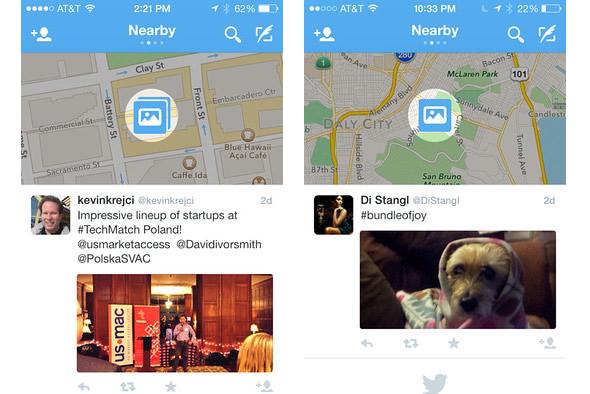
Twitter Nearby
Image used with permission by copyright holder

This type of feed would be ideal for real-time events such as natural disasters. For instance, people living in Los Angeles could immediately confirm that an earthquake had hit by checking the local feed to see if there are any tweets about it. The same goes for tornadoes in the Midwest, perhaps as a backup early warning system among the local community.    

Recommended Videos

Of course, users will have to manually turn on the geolocation feature in order to be listed within the Nearby feed. Users that previously opted into location sharing can also opt out in order to be removed from the Nearby feed. You can find this option in the “Security and Privacy” section of the Twitter settings. In addition, Twitter offers a way to delete all location information from previous tweets, ideal for anyone that would prefer more privacy.

[Photo Credit: Wall Street Journal]

Mike Flacy
By day, I'm the content and social media manager for High-Def Digest, Steve's Digicams and The CheckOut on Ben's Bargains…
Meta wants you to pay for WhatsApp now, and it’s already testing the waters
WhatsApp

WhatsApp has been free for over a decade, but Meta is starting to change that. The company is testing a paid subscription tier called WhatsApp Plus, and if you haven't heard about it yet, you probably will soon. The rollout was first spotted by WABetaInfo, and Meta's own Help Center page has since confirmed some of the details. 

So, what do you actually get?

Read more
Tinder wants to check your humanity by gazing into an orb. Yes, you read that right
Staring into an orb to prove you are human is no longer science fiction.
tinder-world-id-human-verification

Online dating is already a trust minefield, and now Tinder wants to add an eyeball scan to the mix. The popular dating app has announced a global partnership with World, the biometric identity company founded by OpenAI's Sam Altman. To prove you are a real human on Tinder, you will soon have the option to get your eyes scanned by a physical orb device.

What is World ID and how does Tinder's human verification work?

Read more
I didn’t expect food reels to help my diet – but they might
Scroll now, snack less later
Representative Image

A new study led by researchers at the University of Bristol has found that people trying to resist food cravings may be using social media content featuring indulgent meals as a substitute for actually eating them. The findings challenge the long-held assumption that exposure to tempting food imagery leads to overeating.

The research, conducted in collaboration with the University at Buffalo School of Management, explored how visual engagement with food content influences eating behaviour. Across three experiments involving 840 participants aged between 19 and 77, researchers combined online surveys with a controlled laboratory study to examine how people respond to food-related media.

Read more