  1. Home
  2. Phones
  3. News

Gemini’s Deep Research tool may soon learn to pull sources from your Gmail and Drive

Tired of manually uploading files for Deep Research? Google is working on a solution.

Add as a preferred source on Google
A person using Google Gemini on the Google Pixel 9a.
Andy Boxall / Digital Trends

What’s happened? Both Gemini and ChatGPT offer a Deep Research feature that can dig deep into topics on your behalf. However, while ChatGPT lets you choose which sources to include, Gemini isn’t that flexible. It currently lets you upload source files, but it can’t yet pull data from connected apps. That could change soon.

  • While digging through the latest build of the Google app for Android, Android Authority spotted an upcoming change that will allow users to pick sources for the Deep Research tool.
  • Once it rolls out, users will see a new “Sources” button in the Deep Research section. Tapping it will open a pop-up menu where users can select Search, Gmail, Drive, or Chat as input sources.

Why is this important? This upgrade will allow users to pull source material directly from their Gmail, Drive, or Chat, eliminating the need to manually download and upload files.

  • It will be especially useful when gathering information from multiple files or emails, as it will streamline the process and save time.
  • Additionally, it will give users the flexibility to exclude Search as a source, which could be helpful for those who want Deep Research to focus solely on their personal data rather than results from the web.
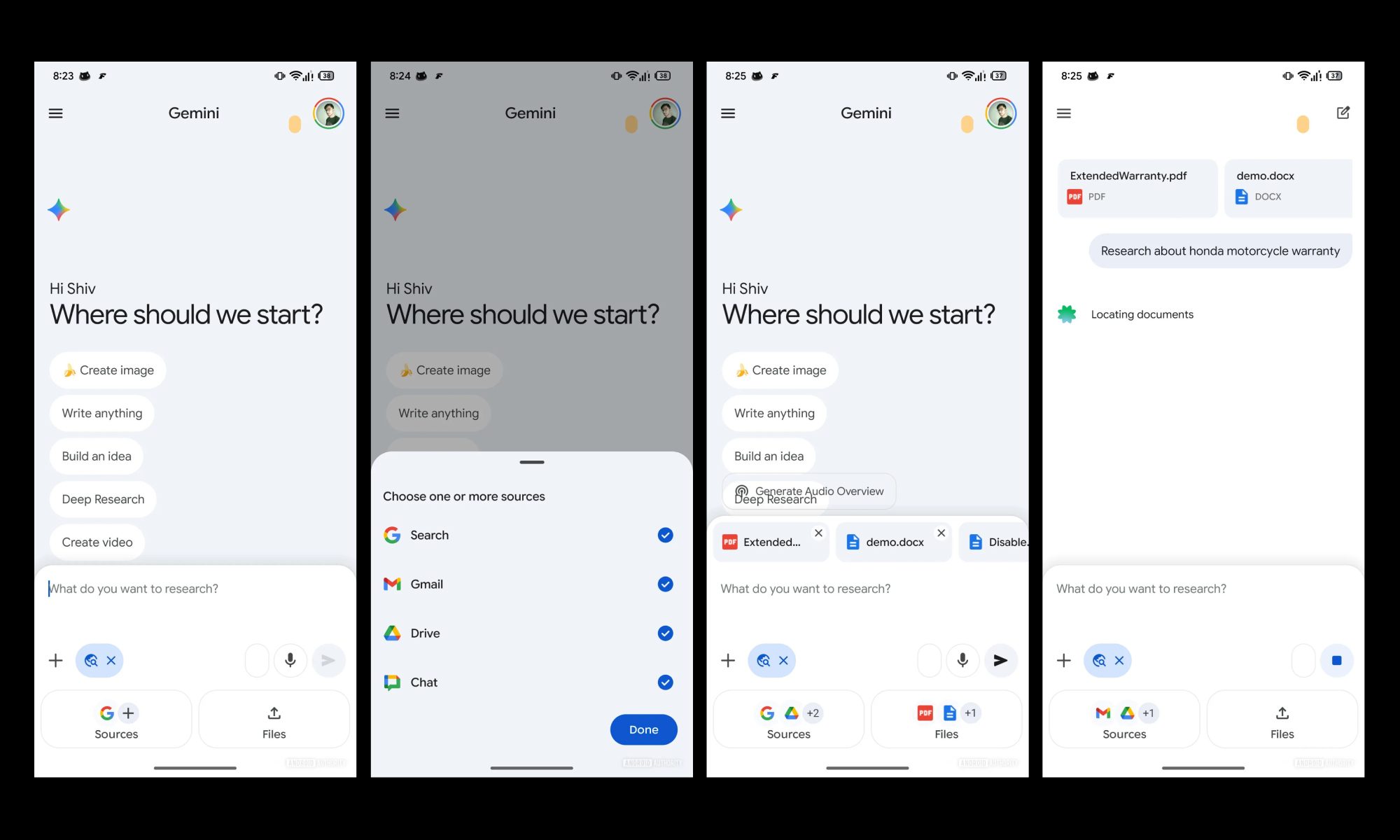
Why should I care? If you frequently use Gemini’s Deep Research tool for school or work, the ability to pull sources from Gmail, Drive, and Chat could result in a more seamless experience.

  • Instead of manually uploading files or emails, you’ll be able to pull everything you need straight from connected Google apps.
  • The update could also make Deep Research feel more integrated with the broader Google ecosystem for smoother workflows.
  • And if you’d rather keep your research limited to your own data, you’ll have the option to exclude web results by unchecking the Search source.
Recommended Videos

What’s next? Since this change was spotted in an APK teardown, Google might make additional tweaks before the official release. If and when it rolls out, the feature could bring Gemini Deep Research on par with ChatGPT’s offering.


Pranob Mehrotra
Pranob is a seasoned tech journalist with over eight years of experience covering consumer technology. His work has been…
Finding photos is so much easier with Siri AI in iOS 27 that I no longer scroll
Natural language photo search in iOS 27 is the kind of feature that quietly becomes essential.
Electronics, Phone, Mobile Phone

My camera roll has crossed 8,000 photos, and it got there by capturing random moments (only to forget them later). The problem, however, starts when someone asks me to share something specific. It could be their portrait from last weekend or the food pictures they snapped using my phone.

Finding those pictures usually means scrolling through my seemingly endless camera roll. If the photo is a month or two old, I end up scrolling past hundreds of other images to find it, and that gets old fast.

Read more
WhatsApp clears that usernames won’t leave you open to scammers
New safeguards include username keys, rate limits, and anti-impersonation protections.
Whatsapp Usernames Whatsapp Username

WhatsApp's long-awaited username feature is now officially rolling out to users. But almost as soon as it was announced, many began asking an obvious question: won't this make it easier for scammers to message strangers? Now, WhatsApp has stepped in to explain why it believes that won't happen.

WhatsApp says usernames aren't as open as Telegram's

Read more
Forget Apple’s AirTag, Motorola’s new Android tracker lasts over 500 days and costs less too
Moto Tag 2 could be the AirTag Android users actually buy
Moto Tag 2 with car keys

Motorola is finally bringing out its second-generation Android smart tracker. While Apple's AirTag has been hogging the limelight, the Moto Tag 2 is the new rival in town, arriving in North America starting June 30. It brings UWB (Ultra Wideband) tracking support, Bluetooth Channel Sounding, and Google Find Hub support in a compact tracker built for keys, bags, luggage, camera gear, and anything else people keep misplacing.

The real headline, though, is the battery life. Motorola claims that this is its longest-lasting smart tracker yet, with more than 500 days of battery life from a replaceable CR2032 battery.

Read more