  1. Home
  2. Emerging Tech
  3. News

Elon Musk is building a TeraFab chip factory, and it’s unlike anything in the world

The global chip supply is only 2% of what Musk needs. So he's just building his own.

Add as a preferred source on Google
Terafab live stream image
SpaceX

Elon Musk stated that every chip he can buy today only covers about 2% of what his companies actually need. Rather than wait for the rest of the world to catch up, he announced TeraFab on Saturday night, a chip factory in Austin and a joint venture between Tesla and SpaceX.

The announcement came via a livestream broadcast from the old Seaholm Power Plant in downtown Austin. “We either build the TeraFab, or we don’t have the chips, and we need the chips, so we’re going to build the TeraFab,” Musk said. The facility will be built on the Tesla campus in eastern Travis County.

Why is this announcement such a big deal?

What makes TeraFab different from existing chip manufacturers is its layout. The entire process, from creating lithography masks and making logic and memory chips to packaging and testing, will all take place under a single roof. Musk claims this doesn’t exist anywhere else in the world right now.

Announcing TERAFAB: the next step towards becoming a galactic civilization https://t.co/xTA70LOU0e

— SpaceX (@SpaceX) March 22, 2026

The advantage is a rapid design loop. “I can’t emphasize enough the importance of being able to make a chip, test it, and then change the design, do another one, and have that in a single building,” he said, adding that this approach could make their chip improvement cycle “an order of magnitude better than anything else in the world.”

What chips will the company actually make?

TeraFab will produce two types of chips. The first is optimized for edge inference, designed for Tesla cars and Optimus humanoid robots. On the scale of demand for the first chip alone, Musk was blunt and said, “I expect humanoid robot production to be somewhere between a billion and 10 billion units a year. So that’s a lot.”
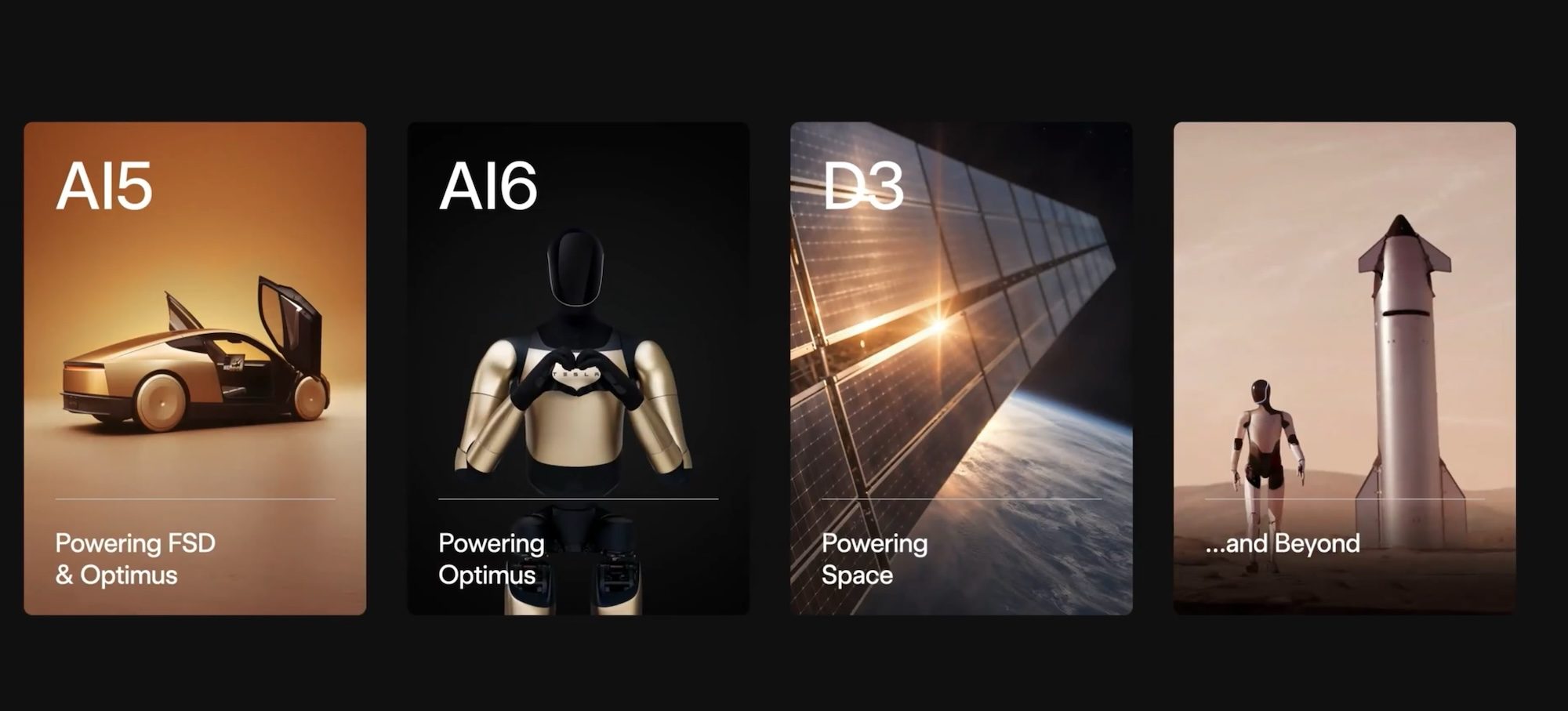
The second is hardened for the space environment, built to handle the radiation and high-energy ions that would destroy conventional chips. Musk also confirmed that Tesla, SpaceX, and xAI will continue buying chips from TSMC, Samsung, and Micron, and said he’d like them to expand as fast as they possibly can. 

Cool idea, but what’s the timeline??

Honestly, what Musk showed in the livestream is genuinely exciting. The idea of pushing the limits of chip physics, trying unconventional designs, and iterating on them faster than anyone else in the world is the kind of ambition that could change things. 

Recommended Videos

That said, no timeline was given for when TeraFab will begin producing chips. And given that Tesla announced the Roadster over a decade ago and it still hasn’t shipped, I’ll reserve my excitement until the first chip rolls off the line.

Rachit Agarwal
Rachit is a seasoned tech journalist with over seven years of experience covering the consumer technology landscape.
Rice grain-sized sensor could give robots a delicate touch and keep them from breaking stuff
Sprout Robot

Robots are incredibly precise, but being gentle is not always their strong suit. A machine that can build a car with near-perfect accuracy can still apply too much pressure when working in places where even the smallest mistake matters, like inside a human eye or during delicate surgery. That is why researchers at Shanghai Jiao Tong University are developing a new type of force sensor that could help robots “feel” what they are touching more accurately.

The sensor is tiny, about the size of a grain of rice at just 1.7 millimeters wide, making it small enough to fit inside advanced surgical tools. What makes it especially interesting is that it does not rely on traditional electronics. Instead, it uses light to measure force from every direction, including pressure, sliding movements, and twisting. Here is how it works. At the tip of an optical fiber sits a soft material that slightly changes shape when it comes into contact with something. That tiny deformation alters how light travels through the sensor. The altered light pattern is then sent through optical fibers to a camera, which captures it like an image. Researchers then use a machine learning model to study those light patterns and translate them into precise force readings. In simple terms, the system learns how to “read” touch through light alone, without needing a bunch of wires or multiple separate sensors packed into such a tiny space.

Read more
Meta’s own employees are having a hard time digesting AI. Who would’ve thought?
Artificial Intelligence

If you wanted a snapshot of what it looks like when a tech giant tries to force-feed its workforce an AI future, look no further than Meta right now. The company that built its empire on knowing everything about its users has turned that same appetite inward, and its employees are not happy about it. Last month, Meta quietly informed tens of thousands of its U.S. workers that their corporate laptops would begin tracking their keystrokes, mouse movements, clicks, and screen activity. The purpose was to feed that behavioral data into Meta's AI models so they could learn how people actually use computers. The reaction was immediate — within hours, internal comment threads were flooded with anger, confusion, and more than a hundred emoji reactions that left little to the imagination about how employees felt.

When an engineering manager asked how to opt out, Meta's chief technology officer, Andrew Bosworth, had a blunt answer: there was no opt-out, at least not on a company laptop. This is the same company that is also tying AI tool usage to performance reviews, running mandatory "AI Transformation Weeks" to retrain its workforce, and building internal dashboards that gamify how many AI tokens employees consume in a day — a metric so aggressively tracked that some workers started building AI agents to manage their other AI agents. The whole thing started to resemble a feedback loop eating itself.

Read more
Sci-fi got the gadgets right, but the vibes wrong
Sci-fi got plenty of consumer tech right, but reality keeps delivering the useful, compromised version of the dream
Officer K looking up at a neon-colored hologram in Blade Runner 2049.

I was recently waiting for an Uber when the GPS decided to lie for sport. The car was somewhere nearby, I was somewhere nearby, and somehow both of us were trapped in that modern ritual of wrong pins, slow turns, vague waving, and "I'm here" messages that help absolutely no one.

That was when I had a very reasonable thought: this is exactly where a hologram of a giant arrow pointing at me would be useful.

Read more