  1. Home
  2. Computing
  3. News

Fluffy robot seals are being used for mental health care at a UK hospital

A fluffy robotic seal could soon be your unlikely companion at mental health appointments.

Add as a preferred source on Google
robot seal paro
Kent and Medway Mental Health NHS Trust

A baby seal robot for mental health care might sound like something out of a sci-fi movie, but Kent and Medway Mental Health NHS Trust is actually piloting one in its outpatient clinics, and the idea makes a lot of sense when you dig into it.

It’s a PARO robot (a personal robot designed for therapeutic purposes) which looks and behaves like a baby seal. It responds to touch, sound, light, and temperature with gentle movements and soft sounds. Think of it like a therapy animal, but without the unpredictability of a real animal. You can hold it, interact with it, and it reacts back.

Why does this matter for mental health appointments?

Going to a mental health appointment can feel overwhelming for many people. For patients with learning disabilities, hospital environments can be especially difficult to navigate. The robot gives patients something calming to focus on during those moments. 

Recommended Videos

Dr Sharna Bennett, Senior Resident Doctor at the trust, highlighted this point and said, “PARO offers a gentle, person-centred way to help people feel more settled and engaged, so we can focus on their needs. It supports the reasonable adjustments we already make to improve care.”
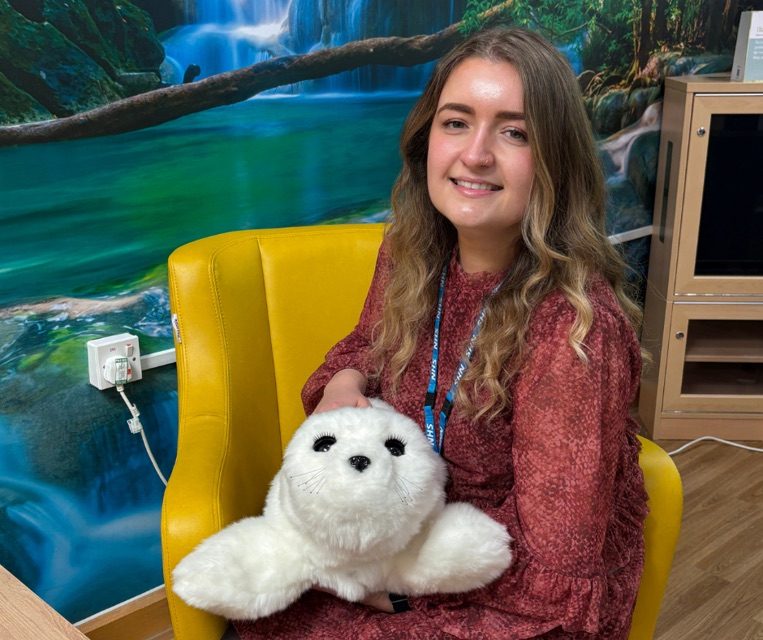
PARO is already widely used in dementia care internationally, where it has shown promise in reducing anxiety. This pilot will test whether it can do the same in learning disability services, where the research is still catching up.

Is this actually working?

The doctors know that this will not work for everyone. The pilot is specifically designed to figure out which patients benefit, how it should be used, and where its limitations lie. If the results are positive, the trust plans to expand its use to other settings, including inpatient services for older adults.

The UK seems ahead of most countries when it comes to mental health issues. Recently, we covered that some UK schools are testing VR headsets to relieve students’ stress and fix their attention issues. 

Other countries should also follow this trend and take mental health care seriously, and search for non-pharmaceutical treatments to help people cope with today’s lifestyle-induced stress.

Rachit Agarwal
Rachit is a seasoned tech journalist with over seven years of experience covering the consumer technology landscape.
AMD brings Zen 5 and 3D V-Cache to Ryzen Pro 9000 series workstation chips
AMD spent years telling gamers that more cache means faster performance. Now it's making the same argument to architects, video editors, and simulation engineers.
Ryzen Pro 9000 Series.

AMD just did something that should excite anyone running a professional workstation, and probably annoy anyone who believed 3D V-Cache was exclusively for gamers. 

The chip maker has announced six new Ryzen Pro 9000 Series desktop processors built on Zen 5 architecture. And, for the very first time, these processors bring 3D V-Cache technology to the commercial desktop market.

Read more
Android apps can now track your habits and whereabouts to offer task suggestions
Contextual Suggestions is Android acting on what it already knows, and the fact that most users will never find the off switch is exactly why you should pay attention.
Google Pixel 10a in the hands of a person.

Google just flipped a switch on Android phones, and you probably didn’t notice. A feature called Contextual Suggestions is currently rolling out to Android devices, enabled by default. 

It does what the name implies: watching what you do, learning your habits, and using the information to provide you with contextual suggestions or actions that you might perform next (via compatible apps). 

Read more
Google could be prepping a powerful new Gemini AI model to outsmart ChatGPT
Google is expected to unveil a stronger Gemini model as AI rivals pull ahead in coding and agents
Google IO 2025 logo on the surface of the earth

Google could announce a new Gemini AI model at I/O on May 19, and the timing is aggressive. A report says the release is expected to land near OpenAI’s GPT-5.5 class, while still trailing Anthropic’s Mythos, the model now shaping the industry’s frontier-model conversation.

For Google, the awkward part isn’t raw talent. A strong model can grab headlines, but developers don’t rebuild workflows for a leaderboard. They switch when a tool saves time, reduces cleanup, and survives real projects without becoming another tab to manage.

Read more