The original Google Glass was huge and awkward, weighing in at more than 7 pounds and attached to an ungainly backpack-like contraption. And while it’s made strides since its inception, the gadget still has a long way to go.
But don’t take our word for it. That’s straight from Google itself.
The opening keynote Tuesday of the Wearable Technologies Conference in San Francisco featured none other than Babak Parviz, Director of Google X, who noted that Glass and the entire industry has an uphill climb ahead before wearables are as unobtrusive and commonplace as ordinary wrist watches. The future will see improvements to the optics and photonics, miniaturization of the design, increased computing power and ultra low power designs, he said — all key steps on the path to ubiquity.
He then pointed our attention to a delightfully retro 1992 Discovery Channel clip predicting wearable computers circa 2000. (It seems we rather skipped that phase, thank goodness.)
The evolution of wearables
It’s lunchtime on day one of the conference, and attentions have drifted from shrinking computers to the absolute clobbering of Brazil in the World Cup semifinals. Since Wearable Technologies (the company behind the show) is based in Germany, this turn of events is accepted with enthusiasm by the crowd. After an hour of futbol is up, speakers get back to the subject at hand, arguably the hottest topic in tech right now: whatever should we wear?
Wearable technology is certainly on the path to ubiquity — but it’s not quite there yet.
On day one, the focus was on new materials that will allow for smaller, more flexible and more durable designs, as well as power solutions and the importance of an intuitive user interface. The day kicked off with an introduction by Wearable Technologies CEO Christian Stammel, who announced the company’s recent partnership with Flextronics to create a lab for showcasing the latest wearable tech.
He also slipped in a mention of the movie Her as an indication of where the field could be in as little as five years, which is to say barely noticeable, voice-activated devices with innumerable capabilities. He’s probably right on the money with that one (minus the OS with the ability to love).
The importance of design
Wearable technology is certainly on the path to ubiquity — but it’s not quite there yet. Flexible OLEDs aren’t yet widely available, which limits the capacity for touch interfaces on curved designs, and indium tin oxide (ITO) – a material used to make transparent surfaces conductive – can’t bend. Both are necessary to make wearable devices that are fashionable enough for people to want to wear every day. Plus, readability in daylight remains poor, another deterrent for on-the-go use.
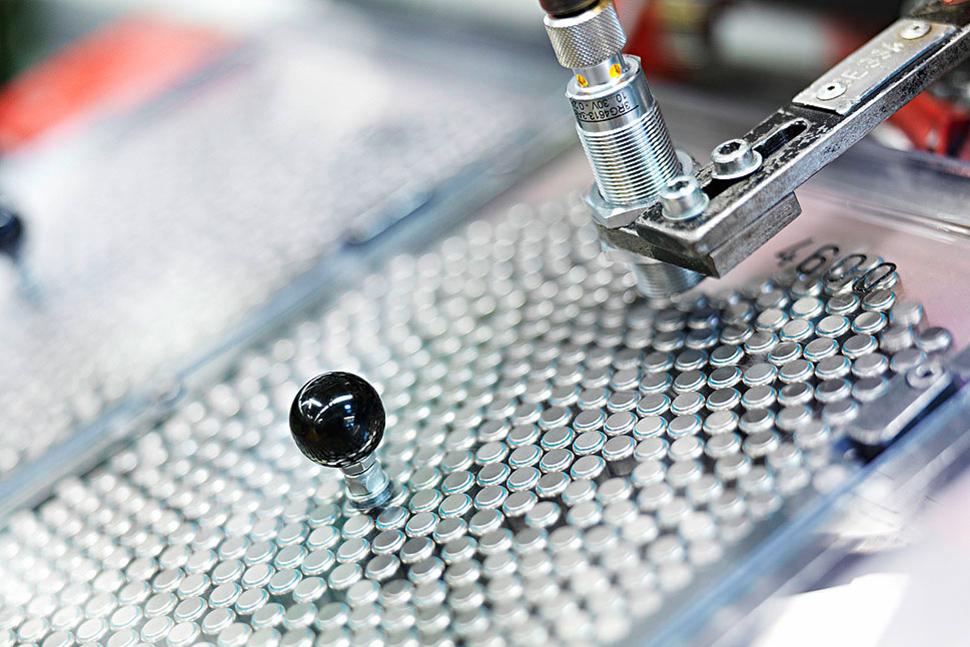
A Finnish company called Canatu has been working on a solution to this lack of flex. It comes in the form of a novel Carbon NanoBud (CNB) material, a form of carbon nanotubes that can be used to make conductive films that flex. It’s also durable enough to survive the lifetime of a foldable device, and has zero haze and zero reflectance in bright sunlight. Bob Senior, sales director at Canatu, maintains that the “war in wearables” is still in full swing, and the winners will be those who differentiate in the form of fashion items that are bendable and wrappable – properties his company hopes to make possible.
We have the power!
No need to worry about innovation in energy, because there’s plenty of that as well. Everything from microbatteries to “energy harvesters” are well underway. Philipp Miehlich, General Manager Marketing and Sales OEM at VARTA Microbattery was on hand to speak to the former, astutely pointing out that batteries define the duration, shape and size of modern portable devices. Improve them and we can improve our gear.
Miehlich also maintained that these devices have three main components — chips are the brain, displays are the face and batteries are the heart, proving that even techy types appreciate personification.
And then there’s harvesting energy from the human body — like in The Matrix. Byung Jin Cho, a researcher at South Korea’s Kaist research university, showed off an awesome thermoelectric battery made out of flexible glass fabric. The ultrathin wearable generator produces electricity from body heat.


- 1. Peltier Ring design. (Image courtesy of Sean Hodgins)
- 2. Peltier Ring. (Image courtesy of Sean Hodgins)
When asked if it could produce enough energy to power a house, Cho laughed and admitted that such generators are suitable only for devices that consume relatively little power. That’s also the case with the Peltier Ring, a gadget invented by student Sean Hodgins, who designed it with the goal to harness waste thermal energy and help us become less reliant on the grid.
So can I use that?
It’s all for naught if we can’t figure out how to use the darn things, of course. Luckily, there are haptics for that. And the folks at Immersion Corporation are ready to provide them. Senior UX Design Manager David Birnbaum and his team are firm believers that haptic feedback — which taps your sense of touch — is an essential complementing component for the traditional display when it comes to wearables.
The company has developed a tactile interface that allows users to determine the urgency and emotion of a message without a glance at the device. It also makes freehand gestures more controllable, lets you feel the invisible user interface for objects around you and makes video games way more fun.

David Holz, CTO and Co-Founder of Leap Motion was also in attendance, showing off the company’s motion sensing technology. While it certainly makes interfacing with your computer much more “hands on,” we’re not sure what the implications are for wearables as yet. Still, it was cool to watch his 3D hands molding clay and building blocks.
All smart, all smart everything
At the end of day one, we were left with a head swimming with technical specs, scientific minutiae and too many charts and graphs to keep track of. But one thing is for certain: We’re well on our way to all smart everything. It’s just a matter of time. And “smart” collaboration.